

alternative, the integration of process measurements and remote sensing within a model
whose geographical domain encompasses the entire reef system is a promising
approach to the estimation of net metabolic properties at the ecosystem level
(Andréfouët and Payri, 2001; Hatcher et al., 1987; Hatcher, 1997a; Hatcher, 1997b).
3. A Conceptual Model for the Use of Remote Sensing in Reef Metabolic Studies
Synoptic ecological models scaled by remote sensing are now in wide use in the
investigation of both terrestrial and marine ecosystems (Gurney et al., 1993). We
suggest that this approach has substantial potential to improve understanding of the
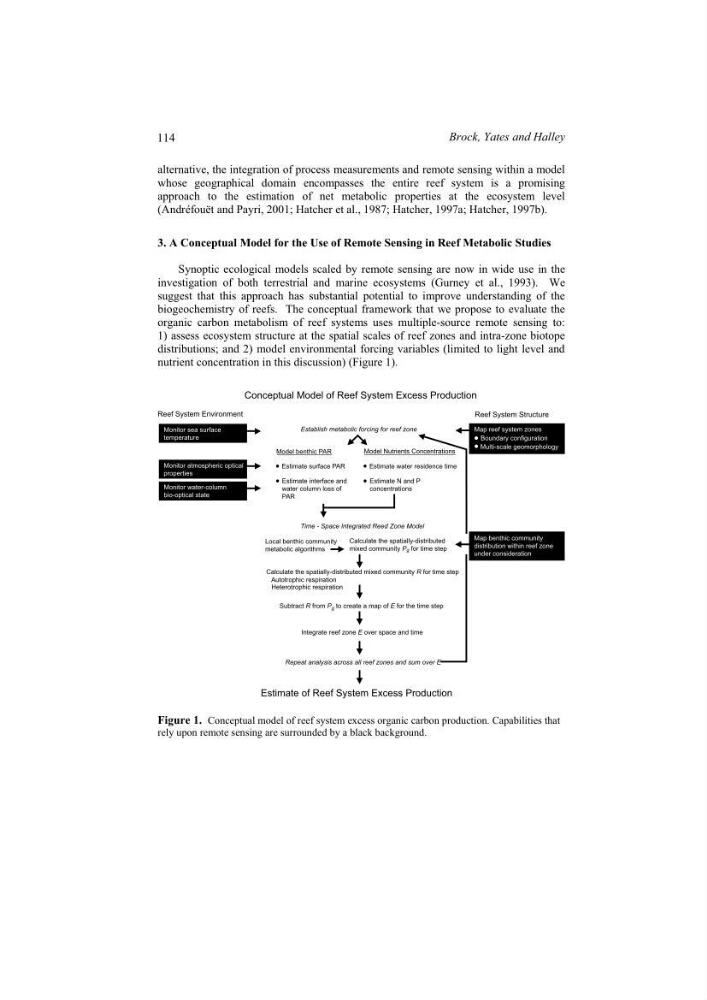
biogeochemistry of reefs. The conceptual framework that we propose to evaluate the
organic carbon metabolism of reef systems uses multiple-source remote sensing to:
1) assess ecosystem structure at the spatial scales of reef zones and intra-zone biotope
distributions; and 2) model environmental forcing variables (limited to light level and
nutrient concentration in this discussion) (Figure 1).
Conceptual Model of Reef System Excess Production
Reef System Environment
Reef System Structure
Establish metabolic forcing for reef zone
Model benthic PAR
Model Nutrients Concentrations
Estimate surface PAR
Estimate interface and
water column loss of
PAR
Estimate water residence time
Estimate N and P
concentrations
Time - Space Integrated Reed Zone Model
Local benthic community
metabolic algorithms
Calculate the spatially-distributed
mixed community Pg for time step
Calculate the spatially-distributed mixed community R for time step
Autotrophic respiration
Heterotrophic respiration
Subtract R from P g to create a map of E for the time step
Integrate reef zone E over space and time
Repeat analysis across all reef zones and sum over E
Estimate of Reef System Excess Production
Monitor sea surface
temperature
Monitor atmospheric optical
properties
Monitor water-column
bio-optical state
Map reef system zones
Boundary configuration
Multi-scale geomorphology
Map benthic community
distribution within reef zone
under consideration
Figure 1. Conceptual model of reef system excess organic carbon production. Capabilities that
rely upon remote sensing are surrounded by a black background.
114
Brock, Yates and Halley
whose geographical domain encompasses the entire reef system is a promising
approach to the estimation of net metabolic properties at the ecosystem level
(Andréfouët and Payri, 2001; Hatcher et al., 1987; Hatcher, 1997a; Hatcher, 1997b).
3. A Conceptual Model for the Use of Remote Sensing in Reef Metabolic Studies
Synoptic ecological models scaled by remote sensing are now in wide use in the
investigation of both terrestrial and marine ecosystems (Gurney et al., 1993). We
suggest that this approach has substantial potential to improve understanding of the
biogeochemistry of reefs. The conceptual framework that we propose to evaluate the
organic carbon metabolism of reef systems uses multiple-source remote sensing to:
1) assess ecosystem structure at the spatial scales of reef zones and intra-zone biotope
distributions; and 2) model environmental forcing variables (limited to light level and
nutrient concentration in this discussion) (Figure 1).
Conceptual Model of Reef System Excess Production
Reef System Environment
Reef System Structure
Establish metabolic forcing for reef zone
Model benthic PAR
Model Nutrients Concentrations
Estimate surface PAR
Estimate interface and
water column loss of
PAR
Estimate water residence time
Estimate N and P
concentrations
Time - Space Integrated Reed Zone Model
Local benthic community
metabolic algorithms
Calculate the spatially-distributed
mixed community Pg for time step
Calculate the spatially-distributed mixed community R for time step
Autotrophic respiration
Heterotrophic respiration
Subtract R from P g to create a map of E for the time step
Integrate reef zone E over space and time
Repeat analysis across all reef zones and sum over E
Estimate of Reef System Excess Production
Monitor sea surface
temperature
Monitor atmospheric optical
properties
Monitor water-column
bio-optical state
Map reef system zones
Boundary configuration
Multi-scale geomorphology
Map benthic community
distribution within reef zone
under consideration
Figure 1. Conceptual model of reef system excess organic carbon production. Capabilities that
rely upon remote sensing are surrounded by a black background.
114
Brock, Yates and Halley