

2.5 IRRADIANCE REFLECTANCE
2.5.1 Deep water
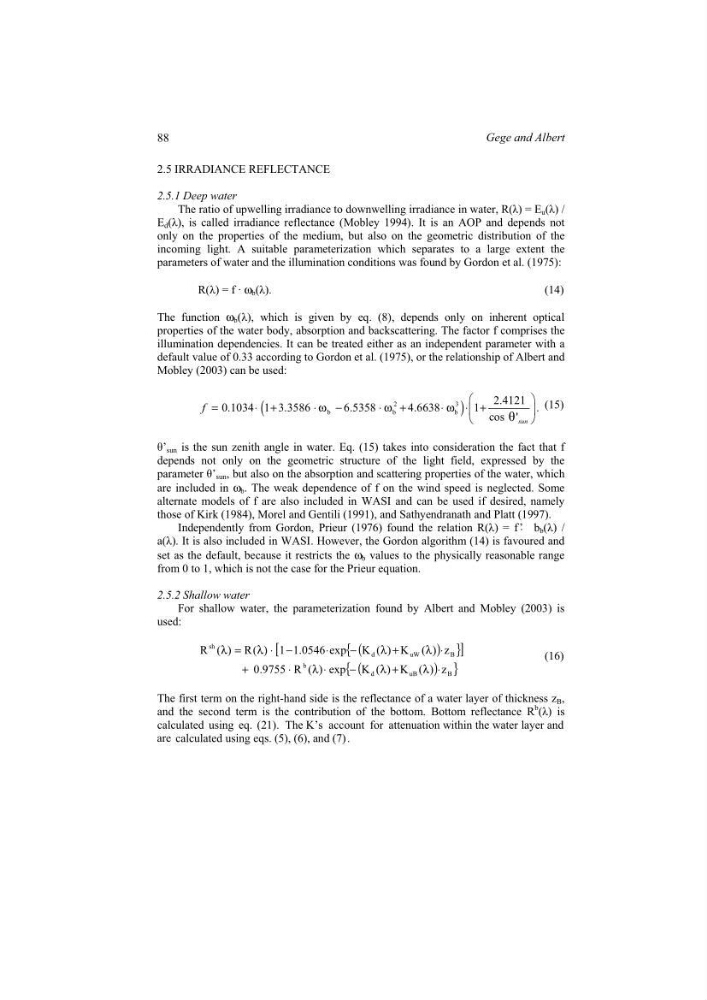
The ratio of upwelling irradiance to downwelling irradiance in water, R(Ȝ) = E u (Ȝ) /
E d (Ȝ), is called irradiance reflectance (Mobley 1994). It is an AOP and depends not
only on the properties of the medium, but also on the geometric distribution of the
incoming light. A suitable parameterization which separates to a large extent the
parameters of water and the illumination conditions was found by Gordon et al. (1975):
R(Ȝ) = f · ω b (Ȝ).
(14)
The function ω b (Ȝ), which is given by eq. (8), depends only on inherent optical
properties of the water body, absorption and backscattering. The factor f comprises the
illumination dependencies. It can be treated either as an independent parameter with a
default value of 0.33 according to Gordon et al. (1975), or the relationship of Albert and
Mobley (2003) can be used:
(
)
2
3
2.4121
0.1034 1 3.3586
6.5358
4.6638
1
.
cos '
b
b
b
sun
f
§
·
=
⋅ +
⋅
−
⋅
+
⋅
⋅ +
¨
¸
©
¹
(15)
ș’ sun is the sun zenith angle in water. Eq. (15) takes into consideration the fact that f
depends not only on the geometric structure of the light field, expressed by the
parameter ș’ sun , but also on the absorption and scattering properties of the water, which
are included in ω b . The weak dependence of f on the wind speed is neglected. Some
alternate models of f are also included in WASI and can be used if desired, namely
those of Kirk (1984), Morel and Gentili (1991), and Sathyendranath and Platt (1997).
Independently from Gordon, Prieur (1976) found the relation R(Ȝ) = f ’ · b b (Ȝ) /
a(Ȝ). It is also included in WASI. However, the Gordon algorithm (14) is favoured and
set as the default, because it restricts the ω b values to the physically reasonable range
from 0 to 1, which is not the case for the Prieur equation.
2.5.2 Shallow water
For shallow water, the parameterization found by Albert and Mobley (2003) is
used:
(
)
{
}
[
]
(
)
{
}
B
uB
d
b
B
uW
d
sh
z
)
(
K
)
(
K
exp
)
(
R
9755
.
0
z
)
(
K
)
(
K
exp
0546
.
1
1
)
(
R
)
(
R
⋅
λ
+
λ
−
⋅
λ
⋅
+
⋅
λ
+
λ
−
⋅
−
⋅
λ
=
λ
(16)
The first term on the right-hand side is the reflectance of a water layer of thickness z B ,
and the second term is the contribution of the bottom. Bottom reflectance R
b
(Ȝ) is
calculated using eq. (21). The K’s account for attenuation within the water layer and
are calculated using eqs. (5), (6), and (7).
ș
ω
ω
ω
88
Gege and Albert
2.5.1 Deep water
The ratio of upwelling irradiance to downwelling irradiance in water, R(Ȝ) = E u (Ȝ) /
E d (Ȝ), is called irradiance reflectance (Mobley 1994). It is an AOP and depends not
only on the properties of the medium, but also on the geometric distribution of the
incoming light. A suitable parameterization which separates to a large extent the
parameters of water and the illumination conditions was found by Gordon et al. (1975):
R(Ȝ) = f · ω b (Ȝ).
(14)
The function ω b (Ȝ), which is given by eq. (8), depends only on inherent optical
properties of the water body, absorption and backscattering. The factor f comprises the
illumination dependencies. It can be treated either as an independent parameter with a
default value of 0.33 according to Gordon et al. (1975), or the relationship of Albert and
Mobley (2003) can be used:
(
)
2
3
2.4121
0.1034 1 3.3586
6.5358
4.6638
1
.
cos '
b
b
b
sun
f
§
·
=
⋅ +
⋅
−
⋅
+
⋅
⋅ +
¨
¸
©
¹
(15)
ș’ sun is the sun zenith angle in water. Eq. (15) takes into consideration the fact that f
depends not only on the geometric structure of the light field, expressed by the
parameter ș’ sun , but also on the absorption and scattering properties of the water, which
are included in ω b . The weak dependence of f on the wind speed is neglected. Some
alternate models of f are also included in WASI and can be used if desired, namely
those of Kirk (1984), Morel and Gentili (1991), and Sathyendranath and Platt (1997).
Independently from Gordon, Prieur (1976) found the relation R(Ȝ) = f ’ · b b (Ȝ) /
a(Ȝ). It is also included in WASI. However, the Gordon algorithm (14) is favoured and
set as the default, because it restricts the ω b values to the physically reasonable range
from 0 to 1, which is not the case for the Prieur equation.
2.5.2 Shallow water
For shallow water, the parameterization found by Albert and Mobley (2003) is
used:
(
)
{
}
[
]
(
)
{
}
B
uB
d
b
B
uW
d
sh
z
)
(
K
)
(
K
exp
)
(
R
9755
.
0
z
)
(
K
)
(
K
exp
0546
.
1
1
)
(
R
)
(
R
⋅
λ
+
λ
−
⋅
λ
⋅
+
⋅
λ
+
λ
−
⋅
−
⋅
λ
=
λ
(16)
The first term on the right-hand side is the reflectance of a water layer of thickness z B ,
and the second term is the contribution of the bottom. Bottom reflectance R
b
(Ȝ) is
calculated using eq. (21). The K’s account for attenuation within the water layer and
are calculated using eqs. (5), (6), and (7).
ș
ω
ω
ω
88
Gege and Albert