

AGB ¼ dM
c
f
ð3:4Þ
where M f is foliage biomass, c and d are coefficients.
The foliage-based generalized allometric model was applied to estimate forest
biomass over North America after coefficients c and d were determined using a set
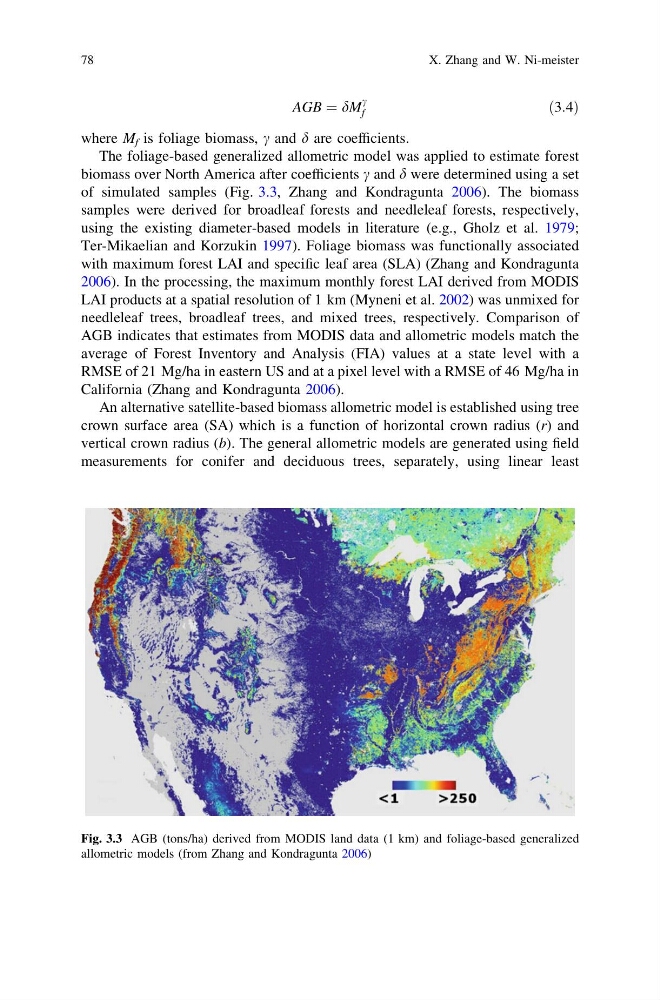
of simulated samples (Fig. 3.3, Zhang and Kondragunta 2006). The biomass
samples were derived for broadleaf forests and needleleaf forests, respectively,
using the existing diameter-based models in literature (e.g., Gholz et al. 1979;
Ter-Mikaelian and Korzukin 1997). Foliage biomass was functionally associated
with maximum forest LAI and specific leaf area (SLA) (Zhang and Kondragunta
2006). In the processing, the maximum monthly forest LAI derived from MODIS
LAI products at a spatial resolution of 1 km (Myneni et al. 2002) was unmixed for
needleleaf trees, broadleaf trees, and mixed trees, respectively. Comparison of
AGB indicates that estimates from MODIS data and allometric models match the
average of Forest Inventory and Analysis (FIA) values at a state level with a
RMSE of 21 Mg/ha in eastern US and at a pixel level with a RMSE of 46 Mg/ha in
California (Zhang and Kondragunta 2006).
An alternative satellite-based biomass allometric model is established using tree
crown surface area (SA) which is a function of horizontal crown radius (r) and
vertical crown radius (b). The general allometric models are generated using field
measurements for conifer and deciduous trees, separately, using linear least
Fig. 3.3 AGB (tons/ha) derived from MODIS land data (1 km) and foliage-based generalized
allometric models (from Zhang and Kondragunta 2006)
78
X. Zhang and W. Ni-meister
c
f
ð3:4Þ
where M f is foliage biomass, c and d are coefficients.
The foliage-based generalized allometric model was applied to estimate forest
biomass over North America after coefficients c and d were determined using a set
of simulated samples (Fig. 3.3, Zhang and Kondragunta 2006). The biomass
samples were derived for broadleaf forests and needleleaf forests, respectively,
using the existing diameter-based models in literature (e.g., Gholz et al. 1979;
Ter-Mikaelian and Korzukin 1997). Foliage biomass was functionally associated
with maximum forest LAI and specific leaf area (SLA) (Zhang and Kondragunta
2006). In the processing, the maximum monthly forest LAI derived from MODIS
LAI products at a spatial resolution of 1 km (Myneni et al. 2002) was unmixed for
needleleaf trees, broadleaf trees, and mixed trees, respectively. Comparison of
AGB indicates that estimates from MODIS data and allometric models match the
average of Forest Inventory and Analysis (FIA) values at a state level with a
RMSE of 21 Mg/ha in eastern US and at a pixel level with a RMSE of 46 Mg/ha in
California (Zhang and Kondragunta 2006).
An alternative satellite-based biomass allometric model is established using tree
crown surface area (SA) which is a function of horizontal crown radius (r) and
vertical crown radius (b). The general allometric models are generated using field
measurements for conifer and deciduous trees, separately, using linear least
Fig. 3.3 AGB (tons/ha) derived from MODIS land data (1 km) and foliage-based generalized
allometric models (from Zhang and Kondragunta 2006)
78
X. Zhang and W. Ni-meister