

account for sediment resuspension. Among these are the 2-band ratio algorithms
(Ruddick et al. 2001; Jiao et al. 2006; Dall’Olmo et al. 2005; Gitelson et al. 2008;
Pierson and Sträombäack 2000; Thiemann and Kaufman, 2000), 3-band algorithms
(Dall’Olmo et al. 2005; Gitelson et al. 2008), and 4-band algorithms (Tassan and
Ferrari 2003; Tzortziou et al. 2006; Le et al. 2009). Applications of these algorithms often require regional tuning of the algorithm coefficients to account for the
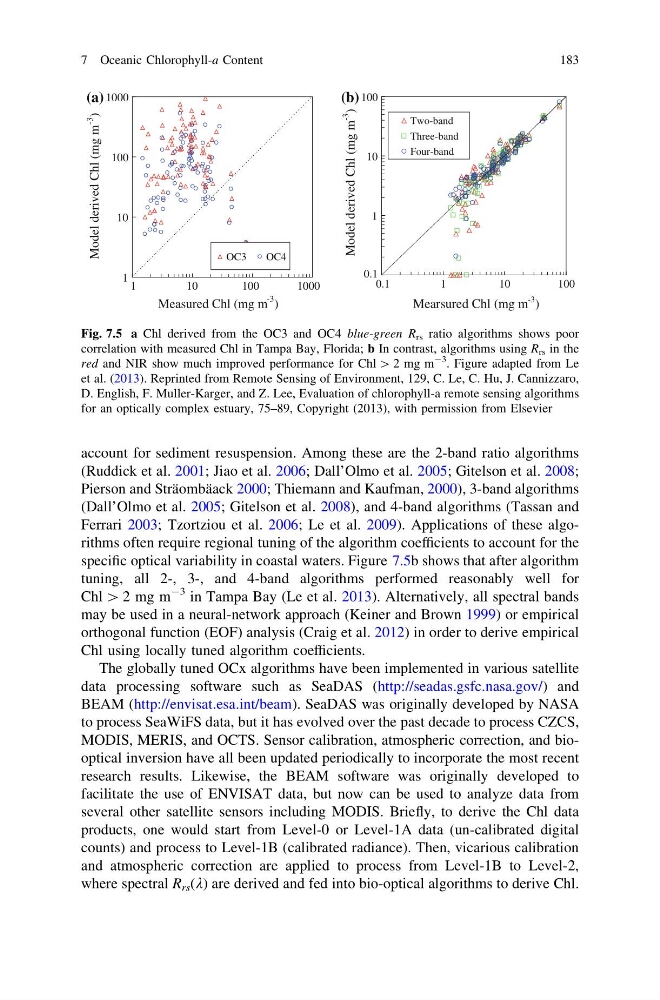
specific optical variability in coastal waters. Figure 7.5b shows that after algorithm
tuning, all 2-, 3-, and 4-band algorithms performed reasonably well for
Chl [ 2 mg m
-3 in Tampa Bay (Le et al. 2013). Alternatively, all spectral bands
may be used in a neural-network approach (Keiner and Brown 1999) or empirical
orthogonal function (EOF) analysis (Craig et al. 2012) in order to derive empirical
Chl using locally tuned algorithm coefficients.
The globally tuned OCx algorithms have been implemented in various satellite
data processing software such as SeaDAS (http://seadas.gsfc.nasa.gov/) and
BEAM (http://envisat.esa.int/beam). SeaDAS was originally developed by NASA
to process SeaWiFS data, but it has evolved over the past decade to process CZCS,
MODIS, MERIS, and OCTS. Sensor calibration, atmospheric correction, and biooptical inversion have all been updated periodically to incorporate the most recent
research results. Likewise, the BEAM software was originally developed to
facilitate the use of ENVISAT data, but now can be used to analyze data from
several other satellite sensors including MODIS. Briefly, to derive the Chl data
products, one would start from Level-0 or Level-1A data (un-calibrated digital
counts) and process to Level-1B (calibrated radiance). Then, vicarious calibration
and atmospheric correction are applied to process from Level-1B to Level-2,
where spectral R rs (k) are derived and fed into bio-optical algorithms to derive Chl.
1
10
100
1000
1
10
100
1000
Measured Chl (mg m
-3 )
Model derived Chl (mg m
-3
)
OC3
OC4
0.1
1
10
100
0.1
1
10
100
Mearsured Chl (mg m
-3 )
Model derived Chl (mg m
-3
)
Two-band
Three-band
Four-band
(b)
(a)
Fig. 7.5 a Chl derived from the OC3 and OC4 blue-green R rs ratio algorithms shows poor
correlation with measured Chl in Tampa Bay, Florida; b In contrast, algorithms using R rs in the
red and NIR show much improved performance for Chl [ 2 mg m
-3
. Figure adapted from Le
et al. (2013). Reprinted from Remote Sensing of Environment, 129, C. Le, C. Hu, J. Cannizzaro,
D. English, F. Muller-Karger, and Z. Lee, Evaluation of chlorophyll-a remote sensing algorithms
for an optically complex estuary, 75–89, Copyright (2013), with permission from Elsevier
7 Oceanic Chlorophyll-a Content
183
(Ruddick et al. 2001; Jiao et al. 2006; Dall’Olmo et al. 2005; Gitelson et al. 2008;
Pierson and Sträombäack 2000; Thiemann and Kaufman, 2000), 3-band algorithms
(Dall’Olmo et al. 2005; Gitelson et al. 2008), and 4-band algorithms (Tassan and
Ferrari 2003; Tzortziou et al. 2006; Le et al. 2009). Applications of these algorithms often require regional tuning of the algorithm coefficients to account for the
specific optical variability in coastal waters. Figure 7.5b shows that after algorithm
tuning, all 2-, 3-, and 4-band algorithms performed reasonably well for
Chl [ 2 mg m
-3 in Tampa Bay (Le et al. 2013). Alternatively, all spectral bands
may be used in a neural-network approach (Keiner and Brown 1999) or empirical
orthogonal function (EOF) analysis (Craig et al. 2012) in order to derive empirical
Chl using locally tuned algorithm coefficients.
The globally tuned OCx algorithms have been implemented in various satellite
data processing software such as SeaDAS (http://seadas.gsfc.nasa.gov/) and
BEAM (http://envisat.esa.int/beam). SeaDAS was originally developed by NASA
to process SeaWiFS data, but it has evolved over the past decade to process CZCS,
MODIS, MERIS, and OCTS. Sensor calibration, atmospheric correction, and biooptical inversion have all been updated periodically to incorporate the most recent
research results. Likewise, the BEAM software was originally developed to
facilitate the use of ENVISAT data, but now can be used to analyze data from
several other satellite sensors including MODIS. Briefly, to derive the Chl data
products, one would start from Level-0 or Level-1A data (un-calibrated digital
counts) and process to Level-1B (calibrated radiance). Then, vicarious calibration
and atmospheric correction are applied to process from Level-1B to Level-2,
where spectral R rs (k) are derived and fed into bio-optical algorithms to derive Chl.
1
10
100
1000
1
10
100
1000
Measured Chl (mg m
-3 )
Model derived Chl (mg m
-3
)
OC3
OC4
0.1
1
10
100
0.1
1
10
100
Mearsured Chl (mg m
-3 )
Model derived Chl (mg m
-3
)
Two-band
Three-band
Four-band
(b)
(a)
Fig. 7.5 a Chl derived from the OC3 and OC4 blue-green R rs ratio algorithms shows poor
correlation with measured Chl in Tampa Bay, Florida; b In contrast, algorithms using R rs in the
red and NIR show much improved performance for Chl [ 2 mg m
-3
. Figure adapted from Le
et al. (2013). Reprinted from Remote Sensing of Environment, 129, C. Le, C. Hu, J. Cannizzaro,
D. English, F. Muller-Karger, and Z. Lee, Evaluation of chlorophyll-a remote sensing algorithms
for an optically complex estuary, 75–89, Copyright (2013), with permission from Elsevier
7 Oceanic Chlorophyll-a Content
183