

factors of R a include air temperature, tissue carbon (foliage, stem, roots), and
nitrogen content in vegetation compartments (Ryan 1991), whereas R h is often
modeled as a function of substrate availability, soil temperature and soil moisture
(Ryan and Law 2005). All these factors influence NEE by regulating GPP and/or
R e . NEE is also affected by disturbances from fire and harvest (Amiro et al. 2010;
Liu et al. 2011).
Satellite remote sensing can be used to account for many of these factors
influencing NEE (Xiao et al. 2008). For instance, surface reflectance of vegetation
depends on not only wavelength region and sun-object-sensor geometry but also on
biophysical properties (e.g., biomass, leaf area, and stand age) and soil moisture
(Ranson et al. 1985; Penuelas et al. 1993). Vegetation indices and biophysical
parameters derived from surface reflectance can also account for factors influencing
NEE, such as the enhanced vegetation index (EVI), the land surface temperature
(LST), the normalized difference water index (NDWI), the fraction of photosynthetically active radiation absorbed by vegetation canopies (fPAR), and LAI.
Vegetation indices such as the normalized difference vegetation index (NDVI)
capture the contrast between the visible-red and near-infrared reflectance of
vegetation canopies, and are closely correlated to fPAR (Asrar et al. 1984). These
vegetation indices are also related to vegetation biomass (Myneni et al. 2001),
photosynthetic activity (Zhou et al. 2001; Xiao and Moody 2004), and fractional
vegetation cover (Xiao and Moody 2005). However, NDVI has several limitations,
including saturation in a multilayer closed canopy and sensitivity to both atmospheric aerosols and soil background (Huete et al. 2002; Xiao and Moody 2005).
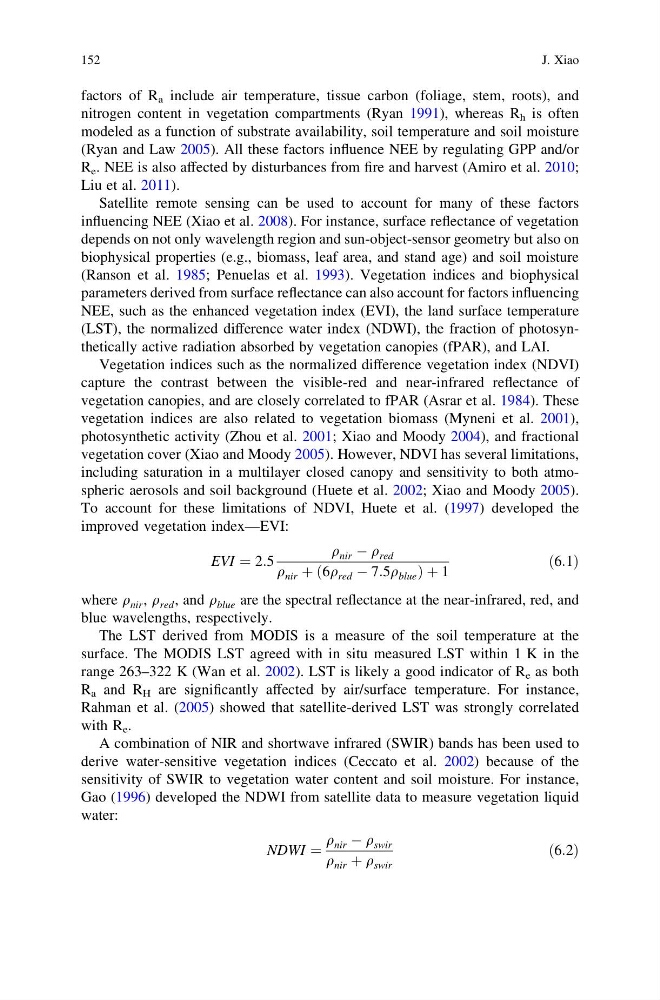
To account for these limitations of NDVI, Huete et al. (1997) developed the
improved vegetation index—EVI:
EVI ¼ 2:5
q nir À q red
q nir þ 6q red À 7:5q blue
ð
Þ þ 1
ð6:1Þ
where q nir , q red , and q blue are the spectral reflectance at the near-infrared, red, and
blue wavelengths, respectively.
The LST derived from MODIS is a measure of the soil temperature at the
surface. The MODIS LST agreed with in situ measured LST within 1 K in the
range 263–322 K (Wan et al. 2002). LST is likely a good indicator of R e as both
R a and R H are significantly affected by air/surface temperature. For instance,
Rahman et al. (2005) showed that satellite-derived LST was strongly correlated
with R e .
A combination of NIR and shortwave infrared (SWIR) bands has been used to
derive water-sensitive vegetation indices (Ceccato et al. 2002) because of the
sensitivity of SWIR to vegetation water content and soil moisture. For instance,
Gao (1996) developed the NDWI from satellite data to measure vegetation liquid
water:
NDWI ¼
q nir À q swir
q nir þ q swir
ð6:2Þ
152
J. Xiao
nitrogen content in vegetation compartments (Ryan 1991), whereas R h is often
modeled as a function of substrate availability, soil temperature and soil moisture
(Ryan and Law 2005). All these factors influence NEE by regulating GPP and/or
R e . NEE is also affected by disturbances from fire and harvest (Amiro et al. 2010;
Liu et al. 2011).
Satellite remote sensing can be used to account for many of these factors
influencing NEE (Xiao et al. 2008). For instance, surface reflectance of vegetation
depends on not only wavelength region and sun-object-sensor geometry but also on
biophysical properties (e.g., biomass, leaf area, and stand age) and soil moisture
(Ranson et al. 1985; Penuelas et al. 1993). Vegetation indices and biophysical
parameters derived from surface reflectance can also account for factors influencing
NEE, such as the enhanced vegetation index (EVI), the land surface temperature
(LST), the normalized difference water index (NDWI), the fraction of photosynthetically active radiation absorbed by vegetation canopies (fPAR), and LAI.
Vegetation indices such as the normalized difference vegetation index (NDVI)
capture the contrast between the visible-red and near-infrared reflectance of
vegetation canopies, and are closely correlated to fPAR (Asrar et al. 1984). These
vegetation indices are also related to vegetation biomass (Myneni et al. 2001),
photosynthetic activity (Zhou et al. 2001; Xiao and Moody 2004), and fractional
vegetation cover (Xiao and Moody 2005). However, NDVI has several limitations,
including saturation in a multilayer closed canopy and sensitivity to both atmospheric aerosols and soil background (Huete et al. 2002; Xiao and Moody 2005).
To account for these limitations of NDVI, Huete et al. (1997) developed the
improved vegetation index—EVI:
EVI ¼ 2:5
q nir À q red
q nir þ 6q red À 7:5q blue
ð
Þ þ 1
ð6:1Þ
where q nir , q red , and q blue are the spectral reflectance at the near-infrared, red, and
blue wavelengths, respectively.
The LST derived from MODIS is a measure of the soil temperature at the
surface. The MODIS LST agreed with in situ measured LST within 1 K in the
range 263–322 K (Wan et al. 2002). LST is likely a good indicator of R e as both
R a and R H are significantly affected by air/surface temperature. For instance,
Rahman et al. (2005) showed that satellite-derived LST was strongly correlated
with R e .
A combination of NIR and shortwave infrared (SWIR) bands has been used to
derive water-sensitive vegetation indices (Ceccato et al. 2002) because of the
sensitivity of SWIR to vegetation water content and soil moisture. For instance,
Gao (1996) developed the NDWI from satellite data to measure vegetation liquid
water:
NDWI ¼
q nir À q swir
q nir þ q swir
ð6:2Þ
152
J. Xiao