

1993), the Vegetation Photosynthesis Model (VPM) (Xiao et al. 2004a), the
Terrestrial Uptake and Release of Carbon model (TRUC) (Ruimy et al. 1996a),
and the MODIS Daily Photosynthesis model (PSN) (Running et al. 2000). Several
recent reviews have discussed existing PEMs from different perspectives (Hilker
et al. 2008; McCallum 2009). There is still a need to compare PEMs in the context
of model variables (e.g., light absorption) and model parameters (e.g., maximum
light-use efficiency).
This book chapter is organized into five sections. In the first section we briefly
review the theory of PEMs. The second section compares several well-developed
PEMs in the contexts of model variables (e.g., light absorption) and model
parameters (e.g., light-use efficiency). The third section presents the validation
strategy using in situ data from eddy covariance technique. In the fourth section we
illustrate the simulation and evaluation processes of PEMs with a case study that
estimates GPP of maize (C 4 plant) and soybeans (C 3 plant) over years using the
VPM model. We conclude with a series of recommendations for parameter
estimation and improvements of validation exercises for PEMs.
5.2 Theoretical Basis
Plant photosynthesis occurs within the chloroplasts of plant leaves and is composed of two processes: (1) light absorption and (2) carbon fixation. Chlorophyll
pigment absorbs incoming PAR (mostly in the spectrum of 400–700 nm) from
sunlight, and the absorbed energy is then used to combine water and CO 2 to
produce carbohydrates.
When incoming radiance reaches the plant canopy, we can measure the
amounts of radiance that are reflected, transmitted, and absorbed. What fractions
of PAR are absorbed by the vegetation canopy and by chlorophyll pigment,
respectively? At the leaf level, individual green leaves have pigments (chlorophyll
and other pigments) and nonphotosynthetic materials (e.g., cell walls, veins, etc.).
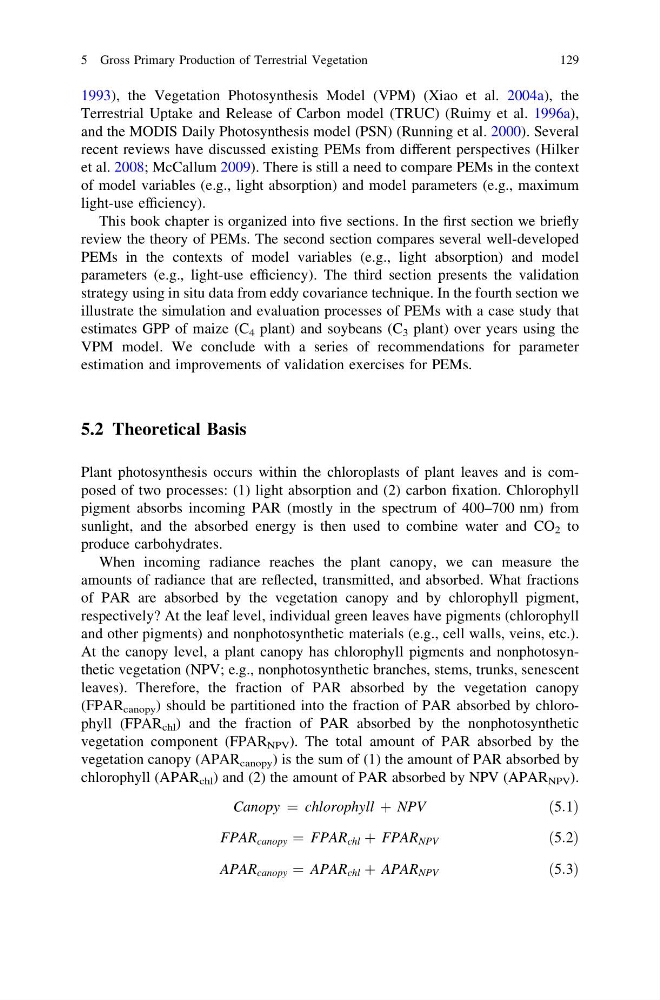
At the canopy level, a plant canopy has chlorophyll pigments and nonphotosynthetic vegetation (NPV; e.g., nonphotosynthetic branches, stems, trunks, senescent
leaves). Therefore, the fraction of PAR absorbed by the vegetation canopy
(FPAR canopy ) should be partitioned into the fraction of PAR absorbed by chlorophyll (FPAR chl ) and the fraction of PAR absorbed by the nonphotosynthetic
vegetation component (FPAR NPV ). The total amount of PAR absorbed by the
vegetation canopy (APAR canopy ) is the sum of (1) the amount of PAR absorbed by
chlorophyll (APAR chl ) and (2) the amount of PAR absorbed by NPV (APAR NPV ).
Canopy ¼ chlorophyll þ NPV
ð5:1Þ
FPAR canopy ¼ FPAR chl þ FPAR NPV
ð5:2Þ
APAR canopy ¼ APAR chl þ APAR NPV
ð5:3Þ
5 Gross Primary Production of Terrestrial Vegetation
129
Terrestrial Uptake and Release of Carbon model (TRUC) (Ruimy et al. 1996a),
and the MODIS Daily Photosynthesis model (PSN) (Running et al. 2000). Several
recent reviews have discussed existing PEMs from different perspectives (Hilker
et al. 2008; McCallum 2009). There is still a need to compare PEMs in the context
of model variables (e.g., light absorption) and model parameters (e.g., maximum
light-use efficiency).
This book chapter is organized into five sections. In the first section we briefly
review the theory of PEMs. The second section compares several well-developed
PEMs in the contexts of model variables (e.g., light absorption) and model
parameters (e.g., light-use efficiency). The third section presents the validation
strategy using in situ data from eddy covariance technique. In the fourth section we
illustrate the simulation and evaluation processes of PEMs with a case study that
estimates GPP of maize (C 4 plant) and soybeans (C 3 plant) over years using the
VPM model. We conclude with a series of recommendations for parameter
estimation and improvements of validation exercises for PEMs.
5.2 Theoretical Basis
Plant photosynthesis occurs within the chloroplasts of plant leaves and is composed of two processes: (1) light absorption and (2) carbon fixation. Chlorophyll
pigment absorbs incoming PAR (mostly in the spectrum of 400–700 nm) from
sunlight, and the absorbed energy is then used to combine water and CO 2 to
produce carbohydrates.
When incoming radiance reaches the plant canopy, we can measure the
amounts of radiance that are reflected, transmitted, and absorbed. What fractions
of PAR are absorbed by the vegetation canopy and by chlorophyll pigment,
respectively? At the leaf level, individual green leaves have pigments (chlorophyll
and other pigments) and nonphotosynthetic materials (e.g., cell walls, veins, etc.).
At the canopy level, a plant canopy has chlorophyll pigments and nonphotosynthetic vegetation (NPV; e.g., nonphotosynthetic branches, stems, trunks, senescent
leaves). Therefore, the fraction of PAR absorbed by the vegetation canopy
(FPAR canopy ) should be partitioned into the fraction of PAR absorbed by chlorophyll (FPAR chl ) and the fraction of PAR absorbed by the nonphotosynthetic
vegetation component (FPAR NPV ). The total amount of PAR absorbed by the
vegetation canopy (APAR canopy ) is the sum of (1) the amount of PAR absorbed by
chlorophyll (APAR chl ) and (2) the amount of PAR absorbed by NPV (APAR NPV ).
Canopy ¼ chlorophyll þ NPV
ð5:1Þ
FPAR canopy ¼ FPAR chl þ FPAR NPV
ð5:2Þ
APAR canopy ¼ APAR chl þ APAR NPV
ð5:3Þ
5 Gross Primary Production of Terrestrial Vegetation
129