

Chapter 9
The Thermal Remote Sounding of the
Atmosphere
Abstract The inverse problem of the thermal sounding of the atmosphere is
formulated. The matrix form of the problem is considered. Features of ill-posed
inverse problem are analyzed. Two approaches for solution are proposed.
9.1 The Problem Statement
The thermal remote sounding of the atmosphere and surface is based on data of
measurements of the heat radiance from boards of space platforms. And the
problem arises: to retrieve the temperature vertical profile from observed data at
the atmosphere top.
Thus the direct problem is solved at the first stage:
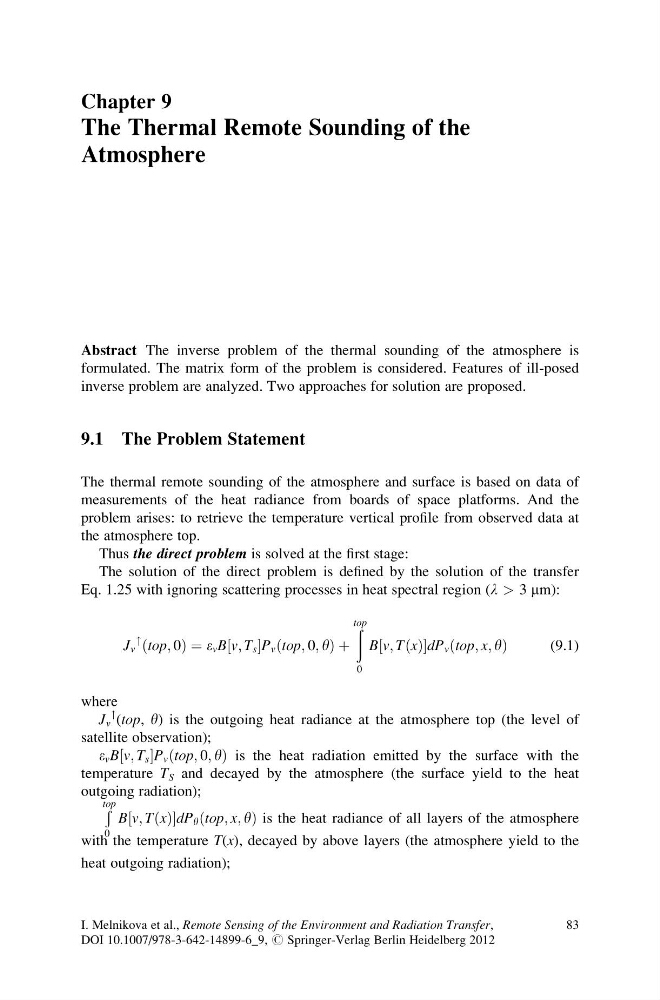
The solution of the direct problem is defined by the solution of the transfer
Eq. 1.25 with ignoring scattering processes in heat spectral region (l > 3 mm):
J v
" top; 0
ð
Þ¼e v B v; T s
½
P v top; 0; y
ð
Þþ
ð
top
0
B v; TðxÞ
½
dP v top; x; y
ð
Þ
(9.1)
where
J n
" (top, y) is the outgoing heat radiance at the atmosphere top (the level of
satellite observation);
e v B v; T s
½
P v top; 0; y
ð
Þ is the heat radiation emitted by the surface with the
temperature T S and decayed by the atmosphere (the surface yield to the heat
outgoing radiation);
Ð
top
0
B v; TðxÞ
½
dP y top; x; y
ð
Þis the heat radiance of all layers of the atmosphere
with the temperature T(x), decayed by above layers (the atmosphere yield to the
heat outgoing radiation);
I. Melnikova et al., Remote Sensing of the Environment and Radiation Transfer,
DOI 10.1007/978-3-642-14899-6_9, # Springer-Verlag Berlin Heidelberg 2012
83
The Thermal Remote Sounding of the
Atmosphere
Abstract The inverse problem of the thermal sounding of the atmosphere is
formulated. The matrix form of the problem is considered. Features of ill-posed
inverse problem are analyzed. Two approaches for solution are proposed.
9.1 The Problem Statement
The thermal remote sounding of the atmosphere and surface is based on data of
measurements of the heat radiance from boards of space platforms. And the
problem arises: to retrieve the temperature vertical profile from observed data at
the atmosphere top.
Thus the direct problem is solved at the first stage:
The solution of the direct problem is defined by the solution of the transfer
Eq. 1.25 with ignoring scattering processes in heat spectral region (l > 3 mm):
J v
" top; 0
ð
Þ¼e v B v; T s
½
P v top; 0; y
ð
Þþ
ð
top
0
B v; TðxÞ
½
dP v top; x; y
ð
Þ
(9.1)
where
J n
" (top, y) is the outgoing heat radiance at the atmosphere top (the level of
satellite observation);
e v B v; T s
½
P v top; 0; y
ð
Þ is the heat radiation emitted by the surface with the
temperature T S and decayed by the atmosphere (the surface yield to the heat
outgoing radiation);
Ð
top
0
B v; TðxÞ
½
dP y top; x; y
ð
Þis the heat radiance of all layers of the atmosphere
with the temperature T(x), decayed by above layers (the atmosphere yield to the
heat outgoing radiation);
I. Melnikova et al., Remote Sensing of the Environment and Radiation Transfer,
DOI 10.1007/978-3-642-14899-6_9, # Springer-Verlag Berlin Heidelberg 2012
83