

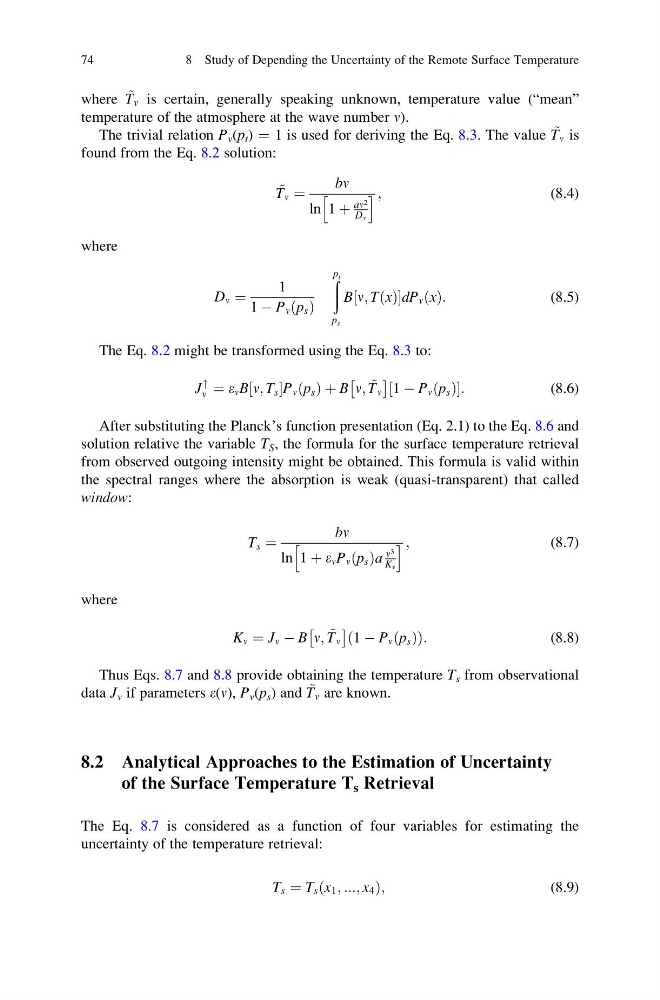
where ~
T n is certain, generally speaking unknown, temperature value (“mean”
temperature of the atmosphere at the wave number n).
The trivial relation P n (p t ) ¼ 1 is used for deriving the Eq. 8.3. The value ~
T n is
found from the Eq. 8.2 solution:
~
T n ¼
bn
ln 1 þ
an 2
D n
h
i;
(8.4)
where
D n ¼
1
1 À P n p s
ð Þ
ð p t
p s
B n; TðxÞ
½
dP n ðxÞ:
(8.5)
The Eq. 8.2 might be transformed using the Eq. 8.3 to:
J
"
n ¼ e n B n; T s
½
P n p s
ð Þ þ B n; ~
T n
Â
Ã
1 À P n p s
ð Þ
½
:
(8.6)
After substituting the Planck’s function presentation (Eq. 2.1) to the Eq. 8.6 and
solution relative the variable T S , the formula for the surface temperature retrieval
from observed outgoing intensity might be obtained. This formula is valid within
the spectral ranges where the absorption is weak (quasi-transparent) that called
window:
T s ¼
bn
ln 1 þ e n P n p s
ð Þa
n 3
K n
h
i ;
(8.7)
where
K n ¼ J n À B n; ~
T n
Â
Ã
1 À P n p s
ð Þ
ð
Þ :
(8.8)
Thus Eqs. 8.7 and 8.8 provide obtaining the temperature T s from observational
data J n if parameters e(n), P n (p s ) and ~
T n are known.
8.2 Analytical Approaches to the Estimation of Uncertainty
of the Surface Temperature T s Retrieval
The Eq. 8.7 is considered as a function of four variables for estimating the
uncertainty of the temperature retrieval:
T s ¼ T s x 1 ; :::; x 4
ð
Þ ;
(8.9)
74
8 Study of Depending the Uncertainty of the Remote Surface Temperature
T n is certain, generally speaking unknown, temperature value (“mean”
temperature of the atmosphere at the wave number n).
The trivial relation P n (p t ) ¼ 1 is used for deriving the Eq. 8.3. The value ~
T n is
found from the Eq. 8.2 solution:
~
T n ¼
bn
ln 1 þ
an 2
D n
h
i;
(8.4)
where
D n ¼
1
1 À P n p s
ð Þ
ð p t
p s
B n; TðxÞ
½
dP n ðxÞ:
(8.5)
The Eq. 8.2 might be transformed using the Eq. 8.3 to:
J
"
n ¼ e n B n; T s
½
P n p s
ð Þ þ B n; ~
T n
Â
Ã
1 À P n p s
ð Þ
½
:
(8.6)
After substituting the Planck’s function presentation (Eq. 2.1) to the Eq. 8.6 and
solution relative the variable T S , the formula for the surface temperature retrieval
from observed outgoing intensity might be obtained. This formula is valid within
the spectral ranges where the absorption is weak (quasi-transparent) that called
window:
T s ¼
bn
ln 1 þ e n P n p s
ð Þa
n 3
K n
h
i ;
(8.7)
where
K n ¼ J n À B n; ~
T n
Â
Ã
1 À P n p s
ð Þ
ð
Þ :
(8.8)
Thus Eqs. 8.7 and 8.8 provide obtaining the temperature T s from observational
data J n if parameters e(n), P n (p s ) and ~
T n are known.
8.2 Analytical Approaches to the Estimation of Uncertainty
of the Surface Temperature T s Retrieval
The Eq. 8.7 is considered as a function of four variables for estimating the
uncertainty of the temperature retrieval:
T s ¼ T s x 1 ; :::; x 4
ð
Þ ;
(8.9)
74
8 Study of Depending the Uncertainty of the Remote Surface Temperature