

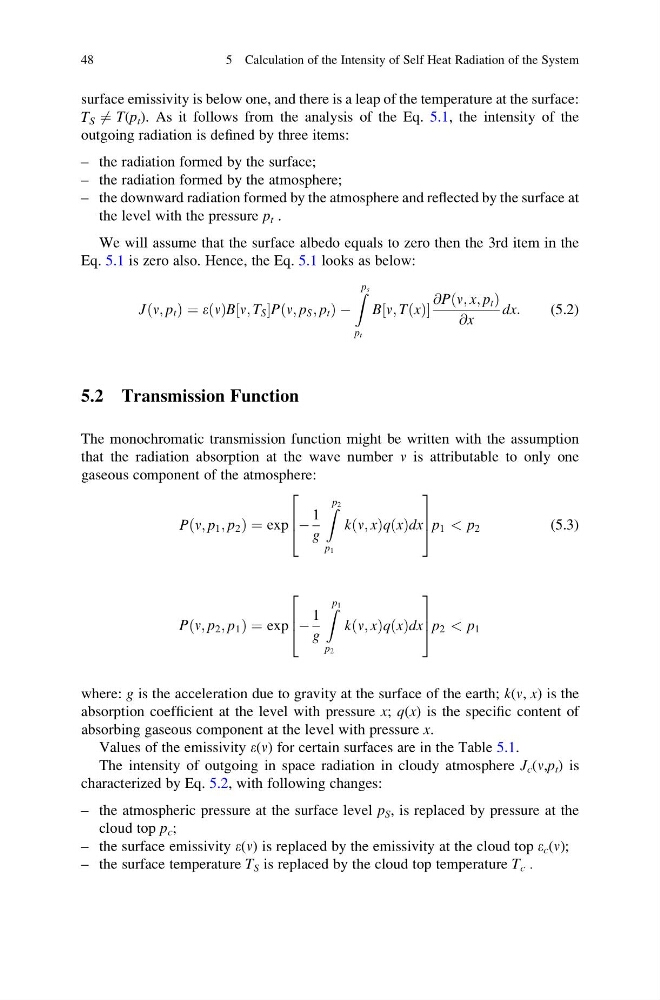
surface emissivity is below one, and there is a leap of the temperature at the surface:
T S 6 ¼ T(p t ). As it follows from the analysis of the Eq. 5.1, the intensity of the
outgoing radiation is defined by three items:
– the radiation formed by the surface;
– the radiation formed by the atmosphere;
– the downward radiation formed by the atmosphere and reflected by the surface at
the level with the pressure p t .
We will assume that the surface albedo equals to zero then the 3rd item in the
Eq. 5.1 is zero also. Hence, the Eq. 5.1 looks as below:
J n; p t
ð
Þ ¼ e n
ð ÞB n; T S
½
P n; p S ; p t
ð
ÞÀ
Z p s
pt
B n; TðxÞ
½
@P n; x; p t
ð
Þ
@x
dx:
(5.2)
5.2 Transmission Function
The monochromatic transmission function might be written with the assumption
that the radiation absorption at the wave number n is attributable to only one
gaseous component of the atmosphere:
P n; p 1 ; p 2
ð
Þ¼exp À
1
g
Z p2
p 1
k n; x
ð ÞqðxÞdx
2
6
4
3
7
5p1 < p 2
(5.3)
P n; p 2 ; p 1
ð
Þ¼exp À
1
g
Z p1
p2
k n; x
ð ÞqðxÞdx
2
6
4
3
7
5p2 < p 1
where: g is the acceleration due to gravity at the surface of the earth; k(n, x) is the
absorption coefficient at the level with pressure x; q(x) is the specific content of
absorbing gaseous component at the level with pressure x.
Values of the emissivity e(n) for certain surfaces are in the Table 5.1.
The intensity of outgoing in space radiation in cloudy atmosphere J c (n,p t ) is
characterized by Eq. 5.2, with following changes:
– the atmospheric pressure at the surface level p S , is replaced by pressure at the
cloud top p c ;
– the surface emissivity e(n) is replaced by the emissivity at the cloud top e c (n);
– the surface temperature T S is replaced by the cloud top temperature T c .
48
5 Calculation of the Intensity of Self Heat Radiation of the System
T S 6 ¼ T(p t ). As it follows from the analysis of the Eq. 5.1, the intensity of the
outgoing radiation is defined by three items:
– the radiation formed by the surface;
– the radiation formed by the atmosphere;
– the downward radiation formed by the atmosphere and reflected by the surface at
the level with the pressure p t .
We will assume that the surface albedo equals to zero then the 3rd item in the
Eq. 5.1 is zero also. Hence, the Eq. 5.1 looks as below:
J n; p t
ð
Þ ¼ e n
ð ÞB n; T S
½
P n; p S ; p t
ð
ÞÀ
Z p s
pt
B n; TðxÞ
½
@P n; x; p t
ð
Þ
@x
dx:
(5.2)
5.2 Transmission Function
The monochromatic transmission function might be written with the assumption
that the radiation absorption at the wave number n is attributable to only one
gaseous component of the atmosphere:
P n; p 1 ; p 2
ð
Þ¼exp À
1
g
Z p2
p 1
k n; x
ð ÞqðxÞdx
2
6
4
3
7
5p1 < p 2
(5.3)
P n; p 2 ; p 1
ð
Þ¼exp À
1
g
Z p1
p2
k n; x
ð ÞqðxÞdx
2
6
4
3
7
5p2 < p 1
where: g is the acceleration due to gravity at the surface of the earth; k(n, x) is the
absorption coefficient at the level with pressure x; q(x) is the specific content of
absorbing gaseous component at the level with pressure x.
Values of the emissivity e(n) for certain surfaces are in the Table 5.1.
The intensity of outgoing in space radiation in cloudy atmosphere J c (n,p t ) is
characterized by Eq. 5.2, with following changes:
– the atmospheric pressure at the surface level p S , is replaced by pressure at the
cloud top p c ;
– the surface emissivity e(n) is replaced by the emissivity at the cloud top e c (n);
– the surface temperature T S is replaced by the cloud top temperature T c .
48
5 Calculation of the Intensity of Self Heat Radiation of the System