

3.3 The Microwave Spectral Interval
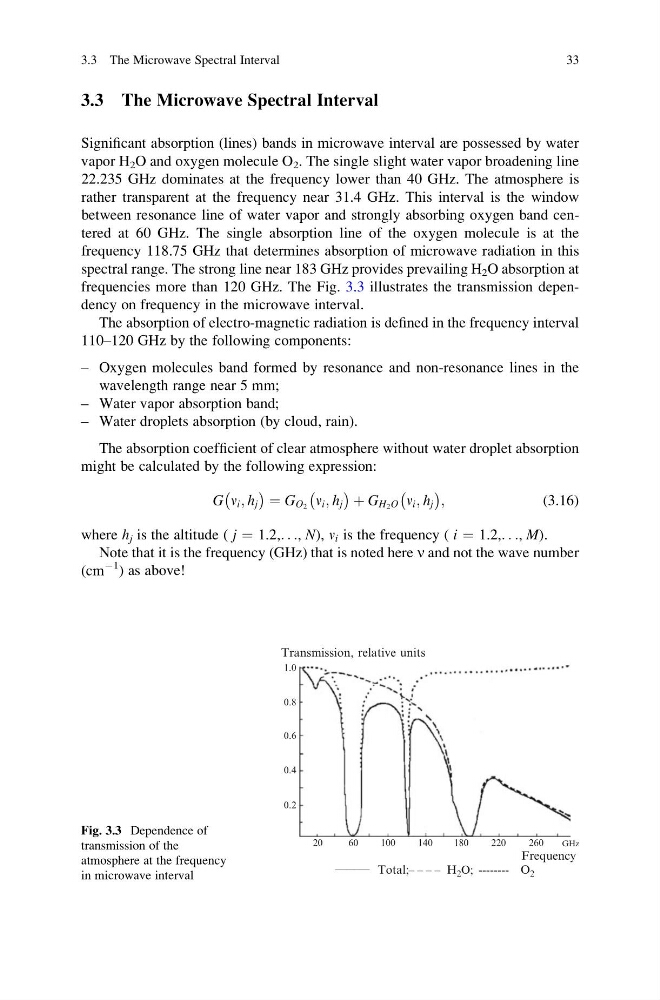
Significant absorption (lines) bands in microwave interval are possessed by water
vapor H 2 O and oxygen molecule O 2 . The single slight water vapor broadening line
22.235 GHz dominates at the frequency lower than 40 GHz. The atmosphere is
rather transparent at the frequency near 31.4 GHz. This interval is the window
between resonance line of water vapor and strongly absorbing oxygen band centered at 60 GHz. The single absorption line of the oxygen molecule is at the
frequency 118.75 GHz that determines absorption of microwave radiation in this
spectral range. The strong line near 183 GHz provides prevailing H 2 O absorption at
frequencies more than 120 GHz. The Fig. 3.3 illustrates the transmission dependency on frequency in the microwave interval.
The absorption of electro-magnetic radiation is defined in the frequency interval
110–120 GHz by the following components:
– Oxygen molecules band formed by resonance and non-resonance lines in the
wavelength range near 5 mm;
– Water vapor absorption band;
– Water droplets absorption (by cloud, rain).
The absorption coefficient of clear atmosphere without water droplet absorption
might be calculated by the following expression:
G n i ; h j
À
Á ¼ G O2 n i ; h j
À
Á þ G H2O n i ; h j
À
Á
;
(3.16)
where h j is the altitude ( j ¼ 1.2,. . ., N), n i is the frequency ( i ¼ 1.2,. . ., M).
Note that it is the frequency (GHz) that is noted here n and not the wave number
(cm
À1 ) as above!
Transmission, relative units
Frequency
_________ Total; – – – – H 2 O; -------- O 2
1.0
0.8
0.6
0.4
0.2
20
60
100
140
180
220
260
GHz
Fig. 3.3 Dependence of
transmission of the
atmosphere at the frequency
in microwave interval
3.3 The Microwave Spectral Interval
33
Significant absorption (lines) bands in microwave interval are possessed by water
vapor H 2 O and oxygen molecule O 2 . The single slight water vapor broadening line
22.235 GHz dominates at the frequency lower than 40 GHz. The atmosphere is
rather transparent at the frequency near 31.4 GHz. This interval is the window
between resonance line of water vapor and strongly absorbing oxygen band centered at 60 GHz. The single absorption line of the oxygen molecule is at the
frequency 118.75 GHz that determines absorption of microwave radiation in this
spectral range. The strong line near 183 GHz provides prevailing H 2 O absorption at
frequencies more than 120 GHz. The Fig. 3.3 illustrates the transmission dependency on frequency in the microwave interval.
The absorption of electro-magnetic radiation is defined in the frequency interval
110–120 GHz by the following components:
– Oxygen molecules band formed by resonance and non-resonance lines in the
wavelength range near 5 mm;
– Water vapor absorption band;
– Water droplets absorption (by cloud, rain).
The absorption coefficient of clear atmosphere without water droplet absorption
might be calculated by the following expression:
G n i ; h j
À
Á ¼ G O2 n i ; h j
À
Á þ G H2O n i ; h j
À
Á
;
(3.16)
where h j is the altitude ( j ¼ 1.2,. . ., N), n i is the frequency ( i ¼ 1.2,. . ., M).
Note that it is the frequency (GHz) that is noted here n and not the wave number
(cm
À1 ) as above!
Transmission, relative units
Frequency
_________ Total; – – – – H 2 O; -------- O 2
1.0
0.8
0.6
0.4
0.2
20
60
100
140
180
220
260
GHz
Fig. 3.3 Dependence of
transmission of the
atmosphere at the frequency
in microwave interval
3.3 The Microwave Spectral Interval
33