

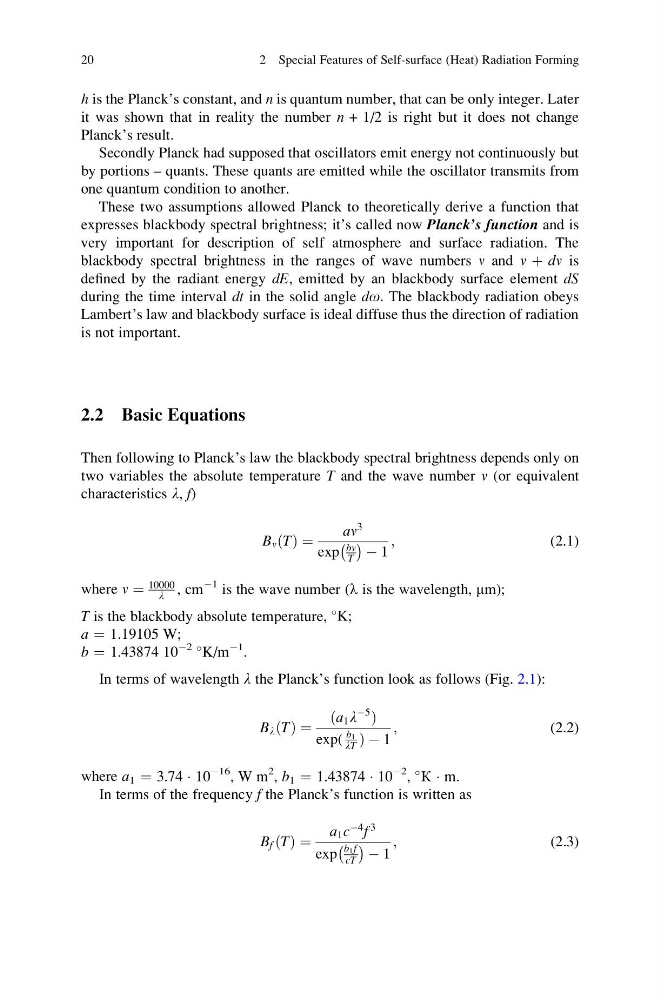
h is the Planck’s constant, and n is quantum number, that can be only integer. Later
it was shown that in reality the number n + 1/2 is right but it does not change
Planck’s result.
Secondly Planck had supposed that oscillators emit energy not continuously but
by portions – quants. These quants are emitted while the oscillator transmits from
one quantum condition to another.
These two assumptions allowed Planck to theoretically derive a function that
expresses blackbody spectral brightness; it’s called now Planck’s function and is
very important for description of self atmosphere and surface radiation. The
blackbody spectral brightness in the ranges of wave numbers n and n þ dn is
defined by the radiant energy dE, emitted by an blackbody surface element dS
during the time interval dt in the solid angle do. The blackbody radiation obeys
Lambert’s law and blackbody surface is ideal diffuse thus the direction of radiation
is not important.
2.2 Basic Equations
Then following to Planck’s law the blackbody spectral brightness depends only on
two variables the absolute temperature T and the wave number n (or equivalent
characteristics l, f)
B n ðTÞ ¼
an
3
exp
bn
T
À Á À 1
;
(2.1)
where n ¼
10000
l , cm
À1 is the wave number (l is the wavelength, mm);
T is the blackbody absolute temperature,
K;
a ¼ 1.19105 W;
b ¼ 1.43874 10
À2 K/m
À1 .
In terms of wavelength l the Planck’s function look as follows (Fig. 2.1):
B l ðTÞ ¼
ða 1 l
À5
Þ
exp(
b1
lT Þ À 1
;
(2.2)
where a 1 ¼ 3.74 Á 10
À16 , W m
2
, b 1 ¼ 1.43874 Á 10
À2 ,
К Á m.
In terms of the frequency f the Planck’s function is written as
B f ðTÞ ¼
a 1 c
À4 f
3
exp
b 1 f
cT
À Á À 1
;
(2.3)
20
2 Special Features of Self-surface (Heat) Radiation Forming
it was shown that in reality the number n + 1/2 is right but it does not change
Planck’s result.
Secondly Planck had supposed that oscillators emit energy not continuously but
by portions – quants. These quants are emitted while the oscillator transmits from
one quantum condition to another.
These two assumptions allowed Planck to theoretically derive a function that
expresses blackbody spectral brightness; it’s called now Planck’s function and is
very important for description of self atmosphere and surface radiation. The
blackbody spectral brightness in the ranges of wave numbers n and n þ dn is
defined by the radiant energy dE, emitted by an blackbody surface element dS
during the time interval dt in the solid angle do. The blackbody radiation obeys
Lambert’s law and blackbody surface is ideal diffuse thus the direction of radiation
is not important.
2.2 Basic Equations
Then following to Planck’s law the blackbody spectral brightness depends only on
two variables the absolute temperature T and the wave number n (or equivalent
characteristics l, f)
B n ðTÞ ¼
an
3
exp
bn
T
À Á À 1
;
(2.1)
where n ¼
10000
l , cm
À1 is the wave number (l is the wavelength, mm);
T is the blackbody absolute temperature,
K;
a ¼ 1.19105 W;
b ¼ 1.43874 10
À2 K/m
À1 .
In terms of wavelength l the Planck’s function look as follows (Fig. 2.1):
B l ðTÞ ¼
ða 1 l
À5
Þ
exp(
b1
lT Þ À 1
;
(2.2)
where a 1 ¼ 3.74 Á 10
À16 , W m
2
, b 1 ¼ 1.43874 Á 10
À2 ,
К Á m.
In terms of the frequency f the Planck’s function is written as
B f ðTÞ ¼
a 1 c
À4 f
3
exp
b 1 f
cT
À Á À 1
;
(2.3)
20
2 Special Features of Self-surface (Heat) Radiation Forming