

Rðz 1 ; z 2 Þ ¼ F
#
ðz 2 Þ þ F
"
ðz 1 Þ À F
#
ðz 1 Þ À F
"
ðz 2 Þ ¼ Fðz 2 Þ À Fðz 1 Þ
(1.5)
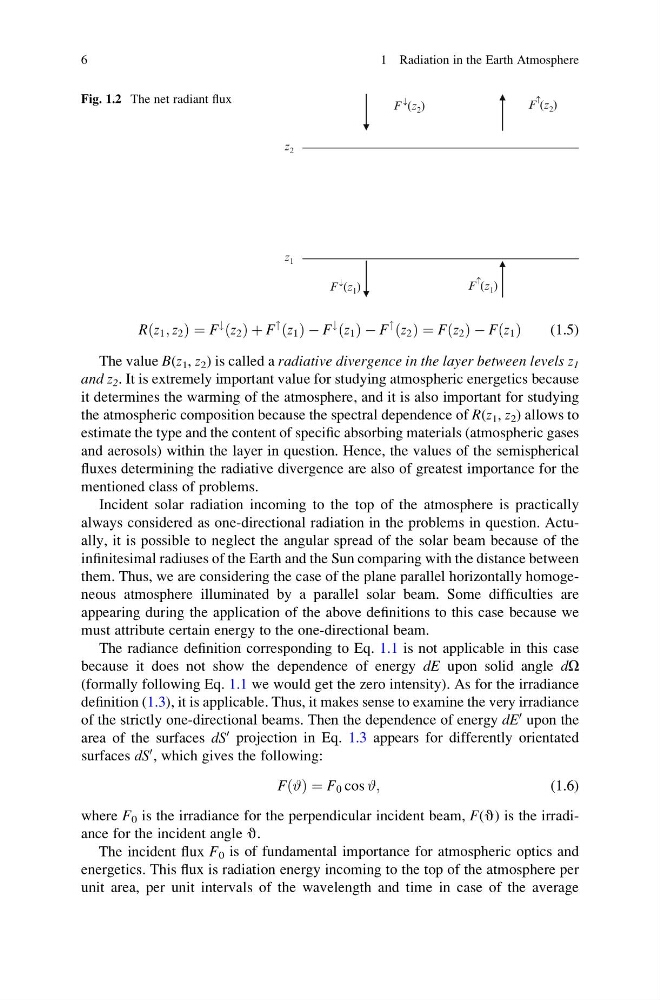
The value B(z 1 , z 2 ) is called a radiative divergence in the layer between levels z 1
and z 2 . It is extremely important value for studying atmospheric energetics because
it determines the warming of the atmosphere, and it is also important for studying
the atmospheric composition because the spectral dependence of R(z 1 , z 2 ) allows to
estimate the type and the content of specific absorbing materials (atmospheric gases
and aerosols) within the layer in question. Hence, the values of the semispherical
fluxes determining the radiative divergence are also of greatest importance for the
mentioned class of problems.
Incident solar radiation incoming to the top of the atmosphere is practically
always considered as one-directional radiation in the problems in question. Actually, it is possible to neglect the angular spread of the solar beam because of the
infinitesimal radiuses of the Earth and the Sun comparing with the distance between
them. Thus, we are considering the case of the plane parallel horizontally homogeneous atmosphere illuminated by a parallel solar beam. Some difficulties are
appearing during the application of the above definitions to this case because we
must attribute certain energy to the one-directional beam.
The radiance definition corresponding to Eq. 1.1 is not applicable in this case
because it does not show the dependence of energy dE upon solid angle dO
(formally following Eq. 1.1 we would get the zero intensity). As for the irradiance
definition (1.3), it is applicable. Thus, it makes sense to examine the very irradiance
of the strictly one-directional beams. Then the dependence of energy dE
0 upon the
area of the surfaces dS
0 projection in Eq. 1.3 appears for differently orientated
surfaces dS
0 , which gives the following:
Fð#Þ ¼ F 0 cos #;
(1.6)
where F 0 is the irradiance for the perpendicular incident beam, F(ϑ) is the irradiance for the incident angle ϑ.
The incident flux F 0 is of fundamental importance for atmospheric optics and
energetics. This flux is radiation energy incoming to the top of the atmosphere per
unit area, per unit intervals of the wavelength and time in case of the average
F
¯
(z 2 )
F (z 2 )
z 2
z 1
F
¯
(z 1 )
F (z 1 )
Fig. 1.2 The net radiant flux
6
1 Radiation in the Earth Atmosphere
#
ðz 2 Þ þ F
"
ðz 1 Þ À F
#
ðz 1 Þ À F
"
ðz 2 Þ ¼ Fðz 2 Þ À Fðz 1 Þ
(1.5)
The value B(z 1 , z 2 ) is called a radiative divergence in the layer between levels z 1
and z 2 . It is extremely important value for studying atmospheric energetics because
it determines the warming of the atmosphere, and it is also important for studying
the atmospheric composition because the spectral dependence of R(z 1 , z 2 ) allows to
estimate the type and the content of specific absorbing materials (atmospheric gases
and aerosols) within the layer in question. Hence, the values of the semispherical
fluxes determining the radiative divergence are also of greatest importance for the
mentioned class of problems.
Incident solar radiation incoming to the top of the atmosphere is practically
always considered as one-directional radiation in the problems in question. Actually, it is possible to neglect the angular spread of the solar beam because of the
infinitesimal radiuses of the Earth and the Sun comparing with the distance between
them. Thus, we are considering the case of the plane parallel horizontally homogeneous atmosphere illuminated by a parallel solar beam. Some difficulties are
appearing during the application of the above definitions to this case because we
must attribute certain energy to the one-directional beam.
The radiance definition corresponding to Eq. 1.1 is not applicable in this case
because it does not show the dependence of energy dE upon solid angle dO
(formally following Eq. 1.1 we would get the zero intensity). As for the irradiance
definition (1.3), it is applicable. Thus, it makes sense to examine the very irradiance
of the strictly one-directional beams. Then the dependence of energy dE
0 upon the
area of the surfaces dS
0 projection in Eq. 1.3 appears for differently orientated
surfaces dS
0 , which gives the following:
Fð#Þ ¼ F 0 cos #;
(1.6)
where F 0 is the irradiance for the perpendicular incident beam, F(ϑ) is the irradiance for the incident angle ϑ.
The incident flux F 0 is of fundamental importance for atmospheric optics and
energetics. This flux is radiation energy incoming to the top of the atmosphere per
unit area, per unit intervals of the wavelength and time in case of the average
F
¯
(z 2 )
F (z 2 )
z 2
z 1
F
¯
(z 1 )
F (z 1 )
Fig. 1.2 The net radiant flux
6
1 Radiation in the Earth Atmosphere