

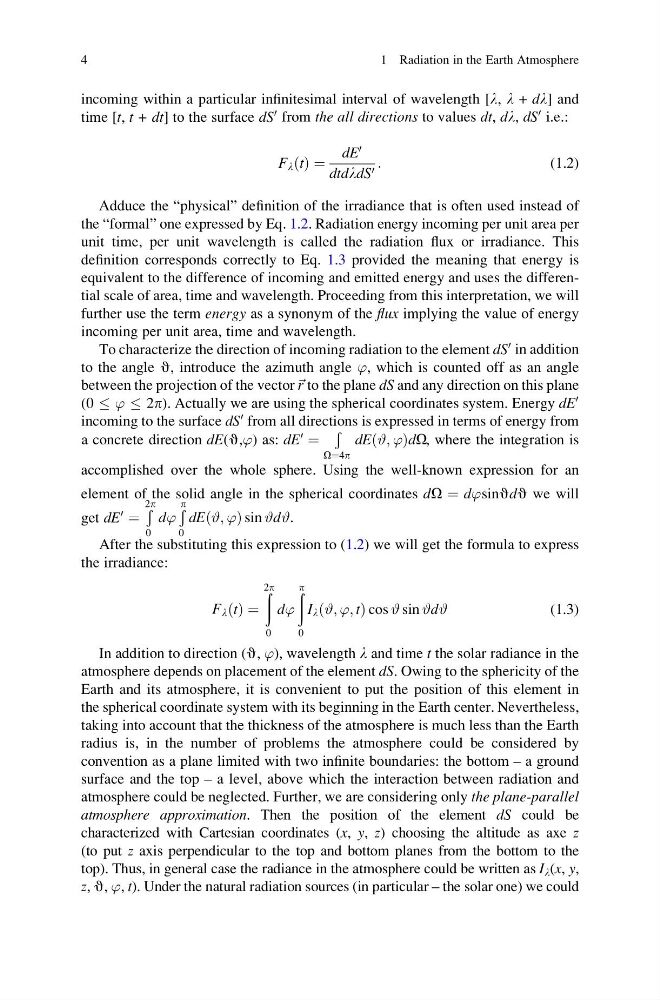
incoming within a particular infinitesimal interval of wavelength [l, l + dl] and
time [t, t + dt] to the surface dS
0 from the all directions to values dt, dl, dS
0 i.e.:
F l ðtÞ ¼
dE
0
dtdldS 0 :
(1.2)
Adduce the “physical” definition of the irradiance that is often used instead of
the “formal” one expressed by Eq. 1.2. Radiation energy incoming per unit area per
unit time, per unit wavelength is called the radiation flux or irradiance. This
definition corresponds correctly to Eq. 1.3 provided the meaning that energy is
equivalent to the difference of incoming and emitted energy and uses the differential scale of area, time and wavelength. Proceeding from this interpretation, we will
further use the term energy as a synonym of the flux implying the value of energy
incoming per unit area, time and wavelength.
To characterize the direction of incoming radiation to the element dS
0 in addition
to the angle ϑ, introduce the azimuth angle ’, which is counted off as an angle
between the projection of the vector ~ r to the plane dS and any direction on this plane
(0 ’ 2p). Actually we are using the spherical coordinates system. Energy dE
0
incoming to the surface dS
0 from all directions is expressed in terms of energy from
a concrete direction dE(ϑ,’) as: dE
0
¼
Ð
O¼4p
dEð#; ’ÞdO, where the integration is
accomplished over the whole sphere. Using the well-known expression for an
element of the solid angle in the spherical coordinates dO ¼ d’sinϑdϑ we will
get dE
0
¼
Ð
2p
0
d’
Ð p
0
dEð#; ’Þ sin #d#.
After the substituting this expression to (1.2) we will get the formula to express
the irradiance:
F l ðtÞ ¼
ð
2p
0
d’
ð p
0
I l ð#; ’; tÞ cos # sin #d#
(1.3)
In addition to direction (ϑ, ’), wavelength l and time t the solar radiance in the
atmosphere depends on placement of the element dS. Owing to the sphericity of the
Earth and its atmosphere, it is convenient to put the position of this element in
the spherical coordinate system with its beginning in the Earth center. Nevertheless,
taking into account that the thickness of the atmosphere is much less than the Earth
radius is, in the number of problems the atmosphere could be considered by
convention as a plane limited with two infinite boundaries: the bottom – a ground
surface and the top – a level, above which the interaction between radiation and
atmosphere could be neglected. Further, we are considering only the plane-parallel
atmosphere approximation. Then the position of the element dS could be
characterized with Cartesian coordinates (x, y, z) choosing the altitude as axe z
(to put z axis perpendicular to the top and bottom planes from the bottom to the
top). Thus, in general case the radiance in the atmosphere could be written as I l (x, y,
z, ϑ, ’, t). Under the natural radiation sources (in particular – the solar one) we could
4
1 Radiation in the Earth Atmosphere
time [t, t + dt] to the surface dS
0 from the all directions to values dt, dl, dS
0 i.e.:
F l ðtÞ ¼
dE
0
dtdldS 0 :
(1.2)
Adduce the “physical” definition of the irradiance that is often used instead of
the “formal” one expressed by Eq. 1.2. Radiation energy incoming per unit area per
unit time, per unit wavelength is called the radiation flux or irradiance. This
definition corresponds correctly to Eq. 1.3 provided the meaning that energy is
equivalent to the difference of incoming and emitted energy and uses the differential scale of area, time and wavelength. Proceeding from this interpretation, we will
further use the term energy as a synonym of the flux implying the value of energy
incoming per unit area, time and wavelength.
To characterize the direction of incoming radiation to the element dS
0 in addition
to the angle ϑ, introduce the azimuth angle ’, which is counted off as an angle
between the projection of the vector ~ r to the plane dS and any direction on this plane
(0 ’ 2p). Actually we are using the spherical coordinates system. Energy dE
0
incoming to the surface dS
0 from all directions is expressed in terms of energy from
a concrete direction dE(ϑ,’) as: dE
0
¼
Ð
O¼4p
dEð#; ’ÞdO, where the integration is
accomplished over the whole sphere. Using the well-known expression for an
element of the solid angle in the spherical coordinates dO ¼ d’sinϑdϑ we will
get dE
0
¼
Ð
2p
0
d’
Ð p
0
dEð#; ’Þ sin #d#.
After the substituting this expression to (1.2) we will get the formula to express
the irradiance:
F l ðtÞ ¼
ð
2p
0
d’
ð p
0
I l ð#; ’; tÞ cos # sin #d#
(1.3)
In addition to direction (ϑ, ’), wavelength l and time t the solar radiance in the
atmosphere depends on placement of the element dS. Owing to the sphericity of the
Earth and its atmosphere, it is convenient to put the position of this element in
the spherical coordinate system with its beginning in the Earth center. Nevertheless,
taking into account that the thickness of the atmosphere is much less than the Earth
radius is, in the number of problems the atmosphere could be considered by
convention as a plane limited with two infinite boundaries: the bottom – a ground
surface and the top – a level, above which the interaction between radiation and
atmosphere could be neglected. Further, we are considering only the plane-parallel
atmosphere approximation. Then the position of the element dS could be
characterized with Cartesian coordinates (x, y, z) choosing the altitude as axe z
(to put z axis perpendicular to the top and bottom planes from the bottom to the
top). Thus, in general case the radiance in the atmosphere could be written as I l (x, y,
z, ϑ, ’, t). Under the natural radiation sources (in particular – the solar one) we could
4
1 Radiation in the Earth Atmosphere