

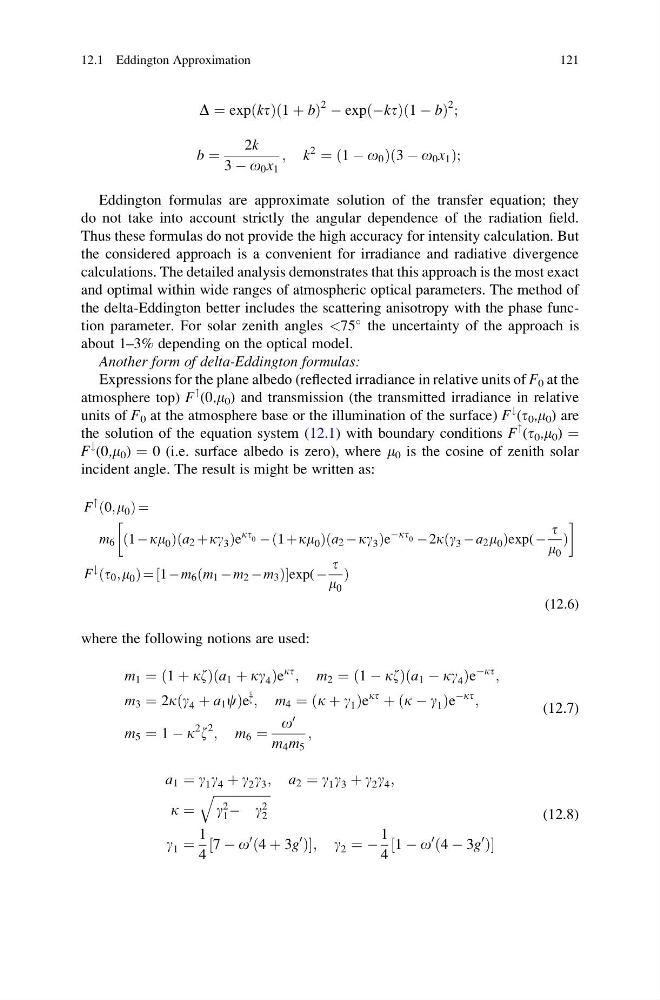
D ¼ expðktÞð1 þ bÞ
2 À expðÀktÞð1 À bÞ
2 ;
b ¼
2k
3 À o 0 x 1
; k
2
¼ ð1 À o 0 Þð3 À o 0 x 1 Þ;
Eddington formulas are approximate solution of the transfer equation; they
do not take into account strictly the angular dependence of the radiation field.
Thus these formulas do not provide the high accuracy for intensity calculation. But
the considered approach is a convenient for irradiance and radiative divergence
calculations. The detailed analysis demonstrates that this approach is the most exact
and optimal within wide ranges of atmospheric optical parameters. The method of
the delta-Eddington better includes the scattering anisotropy with the phase function parameter. For solar zenith angles <75
the uncertainty of the approach is
about 1–3% depending on the optical model.
Another form of delta-Eddington formulas:
Expressions for the plane albedo (reflected irradiance in relative units of F 0 at the
atmosphere top) F
" (0,m 0 ) and transmission (the transmitted irradiance in relative
units of F 0 at the atmosphere base or the illumination of the surface) F
#
(t 0 ,m 0 ) are
the solution of the equation system (12.1) with boundary conditions F
" (t 0 ,m 0 ) ¼
F
# (0,m 0 ) ¼ 0 (i.e. surface albedo is zero), where m 0 is the cosine of zenith solar
incident angle. The result is might be written as:
F
"
ð0;m 0 Þ ¼
m 6 ð1 À km 0 Þða 2 þ kg 3 Þe
kt 0 À ð1 þ km 0 Þða 2 À kg 3 Þe
Àkt 0 À 2kðg 3 À a 2 m 0 Þexp( À
t
m 0
Þ
!
F
#
ðt 0 ;m 0 Þ ¼ 1 À m 6 ðm 1 À m 2 À m 3 Þ
½
exp( À
t
m 0
Þ
(12.6)
where the following notions are used:
m 1 ¼ ð1 þ kzÞða 1 þ kg 4 Þe
kt
; m 2 ¼ ð1 À kzÞða 1 À kg 4 Þe
Àkt
;
m 3 ¼ 2kðg 4 þ a 1 cÞe
t
z ; m 4 ¼ ðk þ g 1 Þe
kt
þ ðk À g 1 Þe
Àkt
;
m 5 ¼ 1 À k
2 z
2
; m 6 ¼
o
0
m 4 m 5
;
(12.7)
a 1 ¼ g 1 g 4 þ g 2 g 3 ; a 2 ¼ g 1 g 3 þ g 2 g 4 ;
k ¼
ffiffiffiffiffiffiffiffiffiffiffiffiffiffiffiffiffiffi ffi
g
2
1 À g
2
2
q
g 1 ¼
1
4
7 À o
0
ð4 þ 3g
0
Þ
½
; g 2 ¼ À
1
4
1 À o
0
ð4 À 3g
0
Þ
½
(12.8)
12.1 Eddington Approximation
121
2 À expðÀktÞð1 À bÞ
2 ;
b ¼
2k
3 À o 0 x 1
; k
2
¼ ð1 À o 0 Þð3 À o 0 x 1 Þ;
Eddington formulas are approximate solution of the transfer equation; they
do not take into account strictly the angular dependence of the radiation field.
Thus these formulas do not provide the high accuracy for intensity calculation. But
the considered approach is a convenient for irradiance and radiative divergence
calculations. The detailed analysis demonstrates that this approach is the most exact
and optimal within wide ranges of atmospheric optical parameters. The method of
the delta-Eddington better includes the scattering anisotropy with the phase function parameter. For solar zenith angles <75
the uncertainty of the approach is
about 1–3% depending on the optical model.
Another form of delta-Eddington formulas:
Expressions for the plane albedo (reflected irradiance in relative units of F 0 at the
atmosphere top) F
" (0,m 0 ) and transmission (the transmitted irradiance in relative
units of F 0 at the atmosphere base or the illumination of the surface) F
#
(t 0 ,m 0 ) are
the solution of the equation system (12.1) with boundary conditions F
" (t 0 ,m 0 ) ¼
F
# (0,m 0 ) ¼ 0 (i.e. surface albedo is zero), where m 0 is the cosine of zenith solar
incident angle. The result is might be written as:
F
"
ð0;m 0 Þ ¼
m 6 ð1 À km 0 Þða 2 þ kg 3 Þe
kt 0 À ð1 þ km 0 Þða 2 À kg 3 Þe
Àkt 0 À 2kðg 3 À a 2 m 0 Þexp( À
t
m 0
Þ
!
F
#
ðt 0 ;m 0 Þ ¼ 1 À m 6 ðm 1 À m 2 À m 3 Þ
½
exp( À
t
m 0
Þ
(12.6)
where the following notions are used:
m 1 ¼ ð1 þ kzÞða 1 þ kg 4 Þe
kt
; m 2 ¼ ð1 À kzÞða 1 À kg 4 Þe
Àkt
;
m 3 ¼ 2kðg 4 þ a 1 cÞe
t
z ; m 4 ¼ ðk þ g 1 Þe
kt
þ ðk À g 1 Þe
Àkt
;
m 5 ¼ 1 À k
2 z
2
; m 6 ¼
o
0
m 4 m 5
;
(12.7)
a 1 ¼ g 1 g 4 þ g 2 g 3 ; a 2 ¼ g 1 g 3 þ g 2 g 4 ;
k ¼
ffiffiffiffiffiffiffiffiffiffiffiffiffiffiffiffiffiffi ffi
g
2
1 À g
2
2
q
g 1 ¼
1
4
7 À o
0
ð4 þ 3g
0
Þ
½
; g 2 ¼ À
1
4
1 À o
0
ð4 À 3g
0
Þ
½
(12.8)
12.1 Eddington Approximation
121