

Chapter 12
Calculating Solar Irradiance with Eddington
Method
Abstract The formulas of Eddington approximation as a kind of two-stream
methods are presented for calculating solar irradiance in the atmosphere. The
optical model of clear atmosphere is proposed for the practice implementation.
12.1 Eddington Approximation
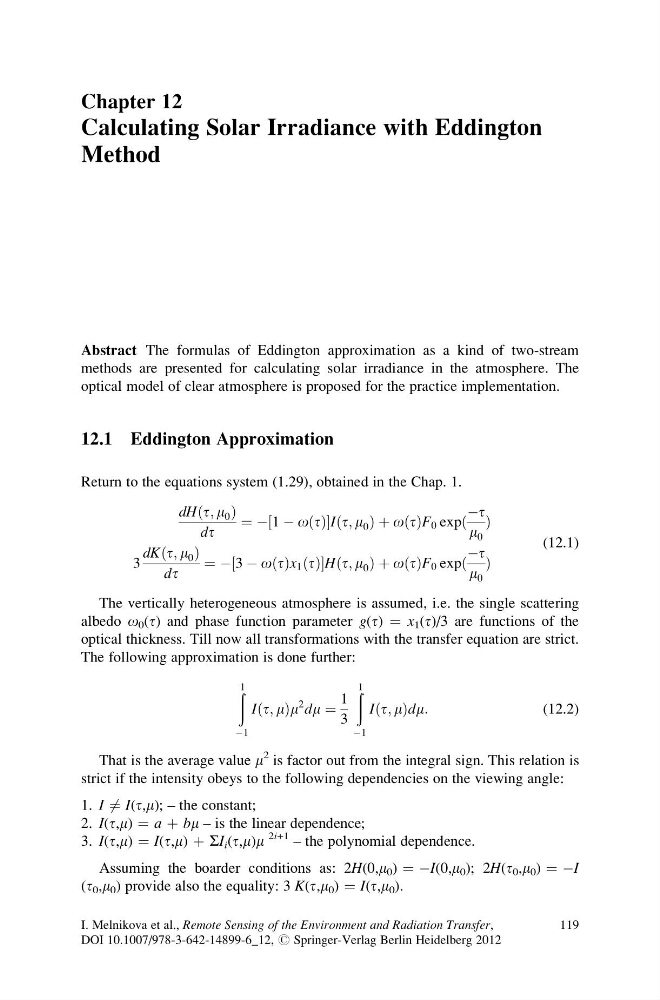
Return to the equations system (1.29), obtained in the Chap. 1.
dHðt; m 0 Þ
dt
¼ À 1 À oðtÞ
½
Iðt; m 0 Þ þ oðtÞF 0 expð
Àt
m 0
Þ
3
dKðt; m 0 Þ
dt
¼ À 3 À oðtÞx 1 ðtÞ
½
Hðt; m 0 Þ þ oðtÞF 0 expð
Àt
m 0
Þ
(12.1)
The vertically heterogeneous atmosphere is assumed, i.e. the single scattering
albedo o 0 (t) and phase function parameter g(t) ¼ x 1 (t)/3 are functions of the
optical thickness. Till now all transformations with the transfer equation are strict.
The following approximation is done further:
ð 1
À1
Iðt; mÞm
2 dm ¼
1
3
ð 1
À1
Iðt; mÞdm:
(12.2)
That is the average value m
2 is factor out from the integral sign. This relation is
strict if the intensity obeys to the following dependencies on the viewing angle:
1. I 6 ¼ I(t,m); – the constant;
2. I(t,m) ¼ a þ bm – is the linear dependence;
3. I(t,m) ¼ I(t,m) þ SI i (t,m)m
2i+1 – the polynomial dependence.
Assuming the boarder conditions as: 2H(0,m 0 ) ¼ ÀI(0,m 0 ); 2H(t 0 ,m 0 ) ¼ ÀI
(t 0 ,m 0 ) provide also the equality: 3 K(t,m 0 ) ¼ I(t,m 0 ).
I. Melnikova et al., Remote Sensing of the Environment and Radiation Transfer,
DOI 10.1007/978-3-642-14899-6_12, # Springer-Verlag Berlin Heidelberg 2012
119
Calculating Solar Irradiance with Eddington
Method
Abstract The formulas of Eddington approximation as a kind of two-stream
methods are presented for calculating solar irradiance in the atmosphere. The
optical model of clear atmosphere is proposed for the practice implementation.
12.1 Eddington Approximation
Return to the equations system (1.29), obtained in the Chap. 1.
dHðt; m 0 Þ
dt
¼ À 1 À oðtÞ
½
Iðt; m 0 Þ þ oðtÞF 0 expð
Àt
m 0
Þ
3
dKðt; m 0 Þ
dt
¼ À 3 À oðtÞx 1 ðtÞ
½
Hðt; m 0 Þ þ oðtÞF 0 expð
Àt
m 0
Þ
(12.1)
The vertically heterogeneous atmosphere is assumed, i.e. the single scattering
albedo o 0 (t) and phase function parameter g(t) ¼ x 1 (t)/3 are functions of the
optical thickness. Till now all transformations with the transfer equation are strict.
The following approximation is done further:
ð 1
À1
Iðt; mÞm
2 dm ¼
1
3
ð 1
À1
Iðt; mÞdm:
(12.2)
That is the average value m
2 is factor out from the integral sign. This relation is
strict if the intensity obeys to the following dependencies on the viewing angle:
1. I 6 ¼ I(t,m); – the constant;
2. I(t,m) ¼ a þ bm – is the linear dependence;
3. I(t,m) ¼ I(t,m) þ SI i (t,m)m
2i+1 – the polynomial dependence.
Assuming the boarder conditions as: 2H(0,m 0 ) ¼ ÀI(0,m 0 ); 2H(t 0 ,m 0 ) ¼ ÀI
(t 0 ,m 0 ) provide also the equality: 3 K(t,m 0 ) ¼ I(t,m 0 ).
I. Melnikova et al., Remote Sensing of the Environment and Radiation Transfer,
DOI 10.1007/978-3-642-14899-6_12, # Springer-Verlag Berlin Heidelberg 2012
119