

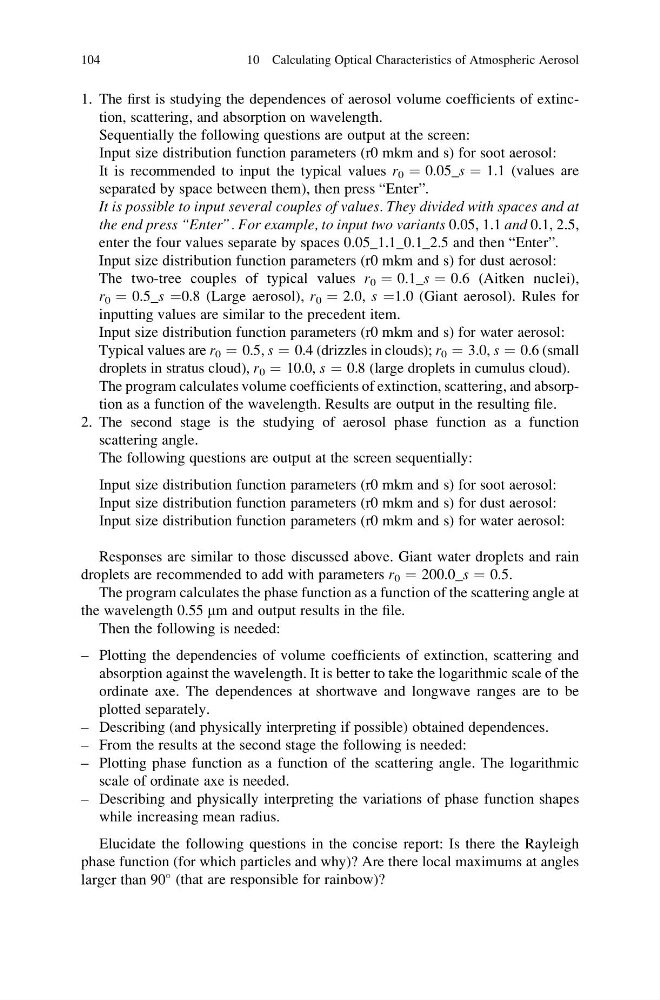
1. The first is studying the dependences of aerosol volume coefficients of extinction, scattering, and absorption on wavelength.
Sequentially the following questions are output at the screen:
Input size distribution function parameters (r0 mkm and s) for soot aerosol:
It is recommended to input the typical values r 0 ¼ 0.05_s ¼ 1.1 (values are
separated by space between them), then press “Enter”.
It is possible to input several couples of values. They divided with spaces and at
the end press “Enter”. For example, to input two variants 0.05, 1.1 and 0.1, 2.5,
enter the four values separate by spaces 0.05_1.1_0.1_2.5 and then “Enter”.
Input size distribution function parameters (r0 mkm and s) for dust aerosol:
The two-tree couples of typical values r 0 ¼ 0.1_s ¼ 0.6 (Aitken nuclei),
r 0 ¼ 0.5_s ¼0.8 (Large aerosol), r 0 ¼ 2.0, s ¼1.0 (Giant aerosol). Rules for
inputting values are similar to the precedent item.
Input size distribution function parameters (r0 mkm and s) for water aerosol:
Typical values are r 0 ¼ 0.5, s ¼ 0.4 (drizzles in clouds); r 0 ¼ 3.0, s ¼ 0.6 (small
droplets in stratus cloud), r 0 ¼ 10.0, s ¼ 0.8 (large droplets in cumulus cloud).
The program calculates volume coefficients of extinction, scattering, and absorption as a function of the wavelength. Results are output in the resulting file.
2. The second stage is the studying of aerosol phase function as a function
scattering angle.
The following questions are output at the screen sequentially:
Input size distribution function parameters (r0 mkm and s) for soot aerosol:
Input size distribution function parameters (r0 mkm and s) for dust aerosol:
Input size distribution function parameters (r0 mkm and s) for water aerosol:
Responses are similar to those discussed above. Giant water droplets and rain
droplets are recommended to add with parameters r 0 ¼ 200.0_s ¼ 0.5.
The program calculates the phase function as a function of the scattering angle at
the wavelength 0.55 mm and output results in the file.
Then the following is needed:
– Plotting the dependencies of volume coefficients of extinction, scattering and
absorption against the wavelength. It is better to take the logarithmic scale of the
ordinate axe. The dependences at shortwave and longwave ranges are to be
plotted separately.
– Describing (and physically interpreting if possible) obtained dependences.
– From the results at the second stage the following is needed:
– Plotting phase function as a function of the scattering angle. The logarithmic
scale of ordinate axe is needed.
– Describing and physically interpreting the variations of phase function shapes
while increasing mean radius.
Elucidate the following questions in the concise report: Is there the Rayleigh
phase function (for which particles and why)? Are there local maximums at angles
larger than 90
(that are responsible for rainbow)?
104
10 Calculating Optical Characteristics of Atmospheric Aerosol
Sequentially the following questions are output at the screen:
Input size distribution function parameters (r0 mkm and s) for soot aerosol:
It is recommended to input the typical values r 0 ¼ 0.05_s ¼ 1.1 (values are
separated by space between them), then press “Enter”.
It is possible to input several couples of values. They divided with spaces and at
the end press “Enter”. For example, to input two variants 0.05, 1.1 and 0.1, 2.5,
enter the four values separate by spaces 0.05_1.1_0.1_2.5 and then “Enter”.
Input size distribution function parameters (r0 mkm and s) for dust aerosol:
The two-tree couples of typical values r 0 ¼ 0.1_s ¼ 0.6 (Aitken nuclei),
r 0 ¼ 0.5_s ¼0.8 (Large aerosol), r 0 ¼ 2.0, s ¼1.0 (Giant aerosol). Rules for
inputting values are similar to the precedent item.
Input size distribution function parameters (r0 mkm and s) for water aerosol:
Typical values are r 0 ¼ 0.5, s ¼ 0.4 (drizzles in clouds); r 0 ¼ 3.0, s ¼ 0.6 (small
droplets in stratus cloud), r 0 ¼ 10.0, s ¼ 0.8 (large droplets in cumulus cloud).
The program calculates volume coefficients of extinction, scattering, and absorption as a function of the wavelength. Results are output in the resulting file.
2. The second stage is the studying of aerosol phase function as a function
scattering angle.
The following questions are output at the screen sequentially:
Input size distribution function parameters (r0 mkm and s) for soot aerosol:
Input size distribution function parameters (r0 mkm and s) for dust aerosol:
Input size distribution function parameters (r0 mkm and s) for water aerosol:
Responses are similar to those discussed above. Giant water droplets and rain
droplets are recommended to add with parameters r 0 ¼ 200.0_s ¼ 0.5.
The program calculates the phase function as a function of the scattering angle at
the wavelength 0.55 mm and output results in the file.
Then the following is needed:
– Plotting the dependencies of volume coefficients of extinction, scattering and
absorption against the wavelength. It is better to take the logarithmic scale of the
ordinate axe. The dependences at shortwave and longwave ranges are to be
plotted separately.
– Describing (and physically interpreting if possible) obtained dependences.
– From the results at the second stage the following is needed:
– Plotting phase function as a function of the scattering angle. The logarithmic
scale of ordinate axe is needed.
– Describing and physically interpreting the variations of phase function shapes
while increasing mean radius.
Elucidate the following questions in the concise report: Is there the Rayleigh
phase function (for which particles and why)? Are there local maximums at angles
larger than 90
(that are responsible for rainbow)?
104
10 Calculating Optical Characteristics of Atmospheric Aerosol