

10.4 Calculation of Optical Characteristics of Aerosol
Particles Ensembles
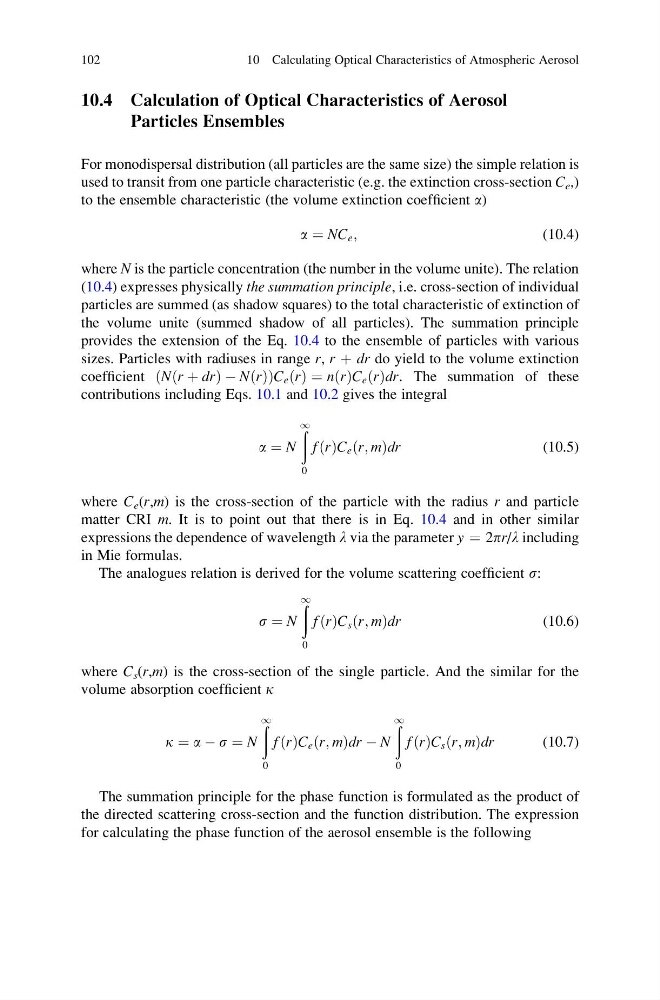
For monodispersal distribution (all particles are the same size) the simple relation is
used to transit from one particle characteristic (e.g. the extinction cross-section C e ,)
to the ensemble characteristic (the volume extinction coefficient a)
a ¼ NC e ;
(10.4)
where N is the particle concentration (the number in the volume unite). The relation
(10.4) expresses physically the summation principle, i.e. cross-section of individual
particles are summed (as shadow squares) to the total characteristic of extinction of
the volume unite (summed shadow of all particles). The summation principle
provides the extension of the Eq. 10.4 to the ensemble of particles with various
sizes. Particles with radiuses in range r, r þ dr do yield to the volume extinction
coefficient ðNðr þ drÞ À NðrÞÞC e ðrÞ ¼ nðrÞC e ðrÞdr. The summation of these
contributions including Eqs. 10.1 and 10.2 gives the integral
a ¼ N
ð
1
0
f ðrÞC e ðr; mÞdr
(10.5)
where C e (r,m) is the cross-section of the particle with the radius r and particle
matter CRI m. It is to point out that there is in Eq. 10.4 and in other similar
expressions the dependence of wavelength l via the parameter y ¼ 2pr/l including
in Mie formulas.
The analogues relation is derived for the volume scattering coefficient s:
s ¼ N
ð
1
0
f ðrÞC s ðr; mÞdr
(10.6)
where C s (r,m) is the cross-section of the single particle. And the similar for the
volume absorption coefficient k
k ¼ a À s ¼ N
ð
1
0
f ðrÞC e ðr; mÞdr À N
ð
1
0
f ðrÞC s ðr; mÞdr
(10.7)
The summation principle for the phase function is formulated as the product of
the directed scattering cross-section and the function distribution. The expression
for calculating the phase function of the aerosol ensemble is the following
102
10 Calculating Optical Characteristics of Atmospheric Aerosol
Particles Ensembles
For monodispersal distribution (all particles are the same size) the simple relation is
used to transit from one particle characteristic (e.g. the extinction cross-section C e ,)
to the ensemble characteristic (the volume extinction coefficient a)
a ¼ NC e ;
(10.4)
where N is the particle concentration (the number in the volume unite). The relation
(10.4) expresses physically the summation principle, i.e. cross-section of individual
particles are summed (as shadow squares) to the total characteristic of extinction of
the volume unite (summed shadow of all particles). The summation principle
provides the extension of the Eq. 10.4 to the ensemble of particles with various
sizes. Particles with radiuses in range r, r þ dr do yield to the volume extinction
coefficient ðNðr þ drÞ À NðrÞÞC e ðrÞ ¼ nðrÞC e ðrÞdr. The summation of these
contributions including Eqs. 10.1 and 10.2 gives the integral
a ¼ N
ð
1
0
f ðrÞC e ðr; mÞdr
(10.5)
where C e (r,m) is the cross-section of the particle with the radius r and particle
matter CRI m. It is to point out that there is in Eq. 10.4 and in other similar
expressions the dependence of wavelength l via the parameter y ¼ 2pr/l including
in Mie formulas.
The analogues relation is derived for the volume scattering coefficient s:
s ¼ N
ð
1
0
f ðrÞC s ðr; mÞdr
(10.6)
where C s (r,m) is the cross-section of the single particle. And the similar for the
volume absorption coefficient k
k ¼ a À s ¼ N
ð
1
0
f ðrÞC e ðr; mÞdr À N
ð
1
0
f ðrÞC s ðr; mÞdr
(10.7)
The summation principle for the phase function is formulated as the product of
the directed scattering cross-section and the function distribution. The expression
for calculating the phase function of the aerosol ensemble is the following
102
10 Calculating Optical Characteristics of Atmospheric Aerosol