

horizontally propagating radar is to observe echo amplitudes from wave crests and
hence deduce 2D wave spectra; these are usually called X-band wave radars.
Radar resolution should be considered separately as radial and angular components. The angular resolution is dependent upon the transmitted wavelength
(linearly) and antenna length (inversely), so that resolution is improved for shorter
wavelengths and longer antennae. It is of note that a radar pixel dimension corresponding to this angle increases with the distance from the antenna, such that
more-distant targets have larger cell sizes. In the radial direction, the range resolution is linearly dependent upon the duration of the transmitted pulse. However,
shorter pulses imply lesser transmit energy, which degrades the range performance
of the system. One technique to overcome these limitations is to impose a modulation on a longer pulse, called pulse coding (e.g., chirp). In such systems the
backscatter signal is correlated with the transmitted coding during processing.
Measurement using radar can be complicated by noise from other undesirable
sources. Detection of this noise is an important aspect of signal processing. The
most dramatic impact occurs in relation to changes in the ionosphere between day
and night, which can alter the background noise and significantly reduce the
quality and range of signal. Solar radiation causes separation of electrons (ionization) that reflect radar signals, whereas at night, neutralization of free electrons
and ions reduces this reflection capacity. Savidge et al. (2011) examined radar
returns at day and night through a 13 month deployment of HF radar on the
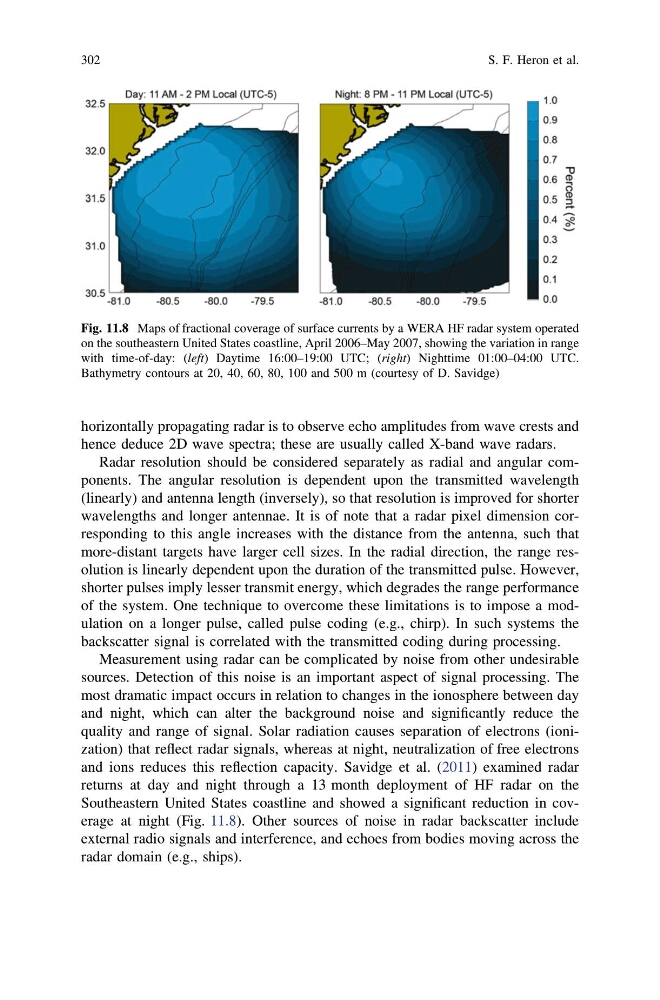
Southeastern United States coastline and showed a significant reduction in coverage at night (Fig. 11.8). Other sources of noise in radar backscatter include
external radio signals and interference, and echoes from bodies moving across the
radar domain (e.g., ships).
Fig. 11.8 Maps of fractional coverage of surface currents by a WERA HF radar system operated
on the southeastern United States coastline, April 2006–May 2007, showing the variation in range
with time-of-day: (left) Daytime 16:00–19:00 UTC; (right) Nighttime 01:00–04:00 UTC.
Bathymetry contours at 20, 40, 60, 80, 100 and 500 m (courtesy of D. Savidge)
302
S. F. Heron et al.
hence deduce 2D wave spectra; these are usually called X-band wave radars.
Radar resolution should be considered separately as radial and angular components. The angular resolution is dependent upon the transmitted wavelength
(linearly) and antenna length (inversely), so that resolution is improved for shorter
wavelengths and longer antennae. It is of note that a radar pixel dimension corresponding to this angle increases with the distance from the antenna, such that
more-distant targets have larger cell sizes. In the radial direction, the range resolution is linearly dependent upon the duration of the transmitted pulse. However,
shorter pulses imply lesser transmit energy, which degrades the range performance
of the system. One technique to overcome these limitations is to impose a modulation on a longer pulse, called pulse coding (e.g., chirp). In such systems the
backscatter signal is correlated with the transmitted coding during processing.
Measurement using radar can be complicated by noise from other undesirable
sources. Detection of this noise is an important aspect of signal processing. The
most dramatic impact occurs in relation to changes in the ionosphere between day
and night, which can alter the background noise and significantly reduce the
quality and range of signal. Solar radiation causes separation of electrons (ionization) that reflect radar signals, whereas at night, neutralization of free electrons
and ions reduces this reflection capacity. Savidge et al. (2011) examined radar
returns at day and night through a 13 month deployment of HF radar on the
Southeastern United States coastline and showed a significant reduction in coverage at night (Fig. 11.8). Other sources of noise in radar backscatter include
external radio signals and interference, and echoes from bodies moving across the
radar domain (e.g., ships).
Fig. 11.8 Maps of fractional coverage of surface currents by a WERA HF radar system operated
on the southeastern United States coastline, April 2006–May 2007, showing the variation in range
with time-of-day: (left) Daytime 16:00–19:00 UTC; (right) Nighttime 01:00–04:00 UTC.
Bathymetry contours at 20, 40, 60, 80, 100 and 500 m (courtesy of D. Savidge)
302
S. F. Heron et al.