

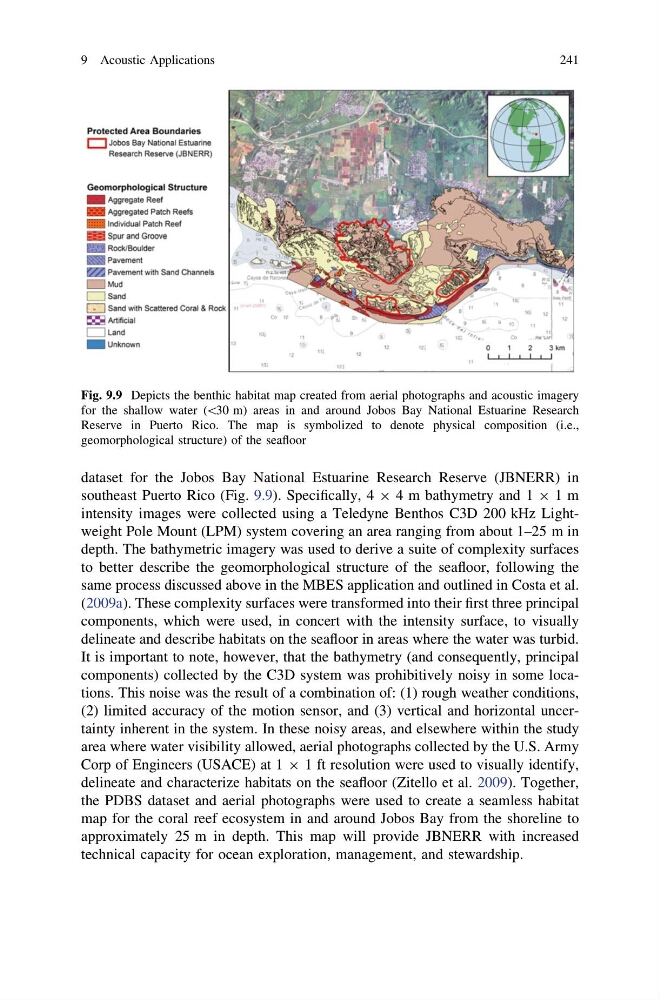
dataset for the Jobos Bay National Estuarine Research Reserve (JBNERR) in
southeast Puerto Rico (Fig. 9.9). Specifically, 4 9 4 m bathymetry and 1 9 1 m
intensity images were collected using a Teledyne Benthos C3D 200 kHz Lightweight Pole Mount (LPM) system covering an area ranging from about 1–25 m in
depth. The bathymetric imagery was used to derive a suite of complexity surfaces
to better describe the geomorphological structure of the seafloor, following the
same process discussed above in the MBES application and outlined in Costa et al.
(2009a). These complexity surfaces were transformed into their first three principal
components, which were used, in concert with the intensity surface, to visually
delineate and describe habitats on the seafloor in areas where the water was turbid.
It is important to note, however, that the bathymetry (and consequently, principal
components) collected by the C3D system was prohibitively noisy in some locations. This noise was the result of a combination of: (1) rough weather conditions,
(2) limited accuracy of the motion sensor, and (3) vertical and horizontal uncertainty inherent in the system. In these noisy areas, and elsewhere within the study
area where water visibility allowed, aerial photographs collected by the U.S. Army
Corp of Engineers (USACE) at 1 9 1 ft resolution were used to visually identify,
delineate and characterize habitats on the seafloor (Zitello et al. 2009). Together,
the PDBS dataset and aerial photographs were used to create a seamless habitat
map for the coral reef ecosystem in and around Jobos Bay from the shoreline to
approximately 25 m in depth. This map will provide JBNERR with increased
technical capacity for ocean exploration, management, and stewardship.
Fig. 9.9 Depicts the benthic habitat map created from aerial photographs and acoustic imagery
for the shallow water (\30 m) areas in and around Jobos Bay National Estuarine Research
Reserve in Puerto Rico. The map is symbolized to denote physical composition (i.e.,
geomorphological structure) of the seafloor
9 Acoustic Applications
241
southeast Puerto Rico (Fig. 9.9). Specifically, 4 9 4 m bathymetry and 1 9 1 m
intensity images were collected using a Teledyne Benthos C3D 200 kHz Lightweight Pole Mount (LPM) system covering an area ranging from about 1–25 m in
depth. The bathymetric imagery was used to derive a suite of complexity surfaces
to better describe the geomorphological structure of the seafloor, following the
same process discussed above in the MBES application and outlined in Costa et al.
(2009a). These complexity surfaces were transformed into their first three principal
components, which were used, in concert with the intensity surface, to visually
delineate and describe habitats on the seafloor in areas where the water was turbid.
It is important to note, however, that the bathymetry (and consequently, principal
components) collected by the C3D system was prohibitively noisy in some locations. This noise was the result of a combination of: (1) rough weather conditions,
(2) limited accuracy of the motion sensor, and (3) vertical and horizontal uncertainty inherent in the system. In these noisy areas, and elsewhere within the study
area where water visibility allowed, aerial photographs collected by the U.S. Army
Corp of Engineers (USACE) at 1 9 1 ft resolution were used to visually identify,
delineate and characterize habitats on the seafloor (Zitello et al. 2009). Together,
the PDBS dataset and aerial photographs were used to create a seamless habitat
map for the coral reef ecosystem in and around Jobos Bay from the shoreline to
approximately 25 m in depth. This map will provide JBNERR with increased
technical capacity for ocean exploration, management, and stewardship.
Fig. 9.9 Depicts the benthic habitat map created from aerial photographs and acoustic imagery
for the shallow water (\30 m) areas in and around Jobos Bay National Estuarine Research
Reserve in Puerto Rico. The map is symbolized to denote physical composition (i.e.,
geomorphological structure) of the seafloor
9 Acoustic Applications
241