

Basic to all acoustic techniques is the physics of the sound wave as an energy
carrier. Waves are defined as propagations of a vibrational state that is periodic in
space and time, in which energy is transported without simultaneous mass transport (Benenson et al. 2002). The vibrational state of a wave is described by its
phase. Sound waves can exist as plane waves, in which the wave fronts are planes
perpendicular to the propagation vector, or as spherical waves, in which the wave
fronts are surfaces of concentric spheres around the center. The Huygens-Fresnel
principle (Medwin and Clay 1998) states that each point of an advancing wave
front is, in fact, the center of a fresh disturbance and the source of a new train of
waves; the entire advancing wave is the sum of all the secondary waves arising
from points in the medium already traversed. Application of this principle allows
the explanation of diffraction, because every point on an object encountered by a
sound wave becomes the source of a new one. It also allows convenient visualization and explanation of wave propagation (Fig. 8.2).
8.2.2 Sound in Water
The speed of sound in a medium is dependent on its density, and since water can
have varying physical properties, the speed of sound also varies among and even
within distinct water bodies (Fig. 8.3). Speed is determined by the water’s bulk
modulus and mass density. The earliest measurements were taken in 1827 by
Colladon and Sturm in Lake Geneva. They suspended a bell underwater from a
boat and struck it by means of a lever. That same lever also ignited a charge of
powder that set off a light, allowing a distant observer to exactly mark the time of
origination of the underwater sound. Using a listening tube from a second boat, the
time differential between flash and arriving sound could be measured. Thus, a
value of 1,435 m/s was obtained in this study. Soon after, it was realized that water
temperature, density, and salinity are also important variables in sound speed.
Since these variables are commonly horizontally stratified in the ocean, this results
in the speed of sound being similarly horizontally stratified. The speed of sound in
water also varies as a function of depth and environmental conditions, including
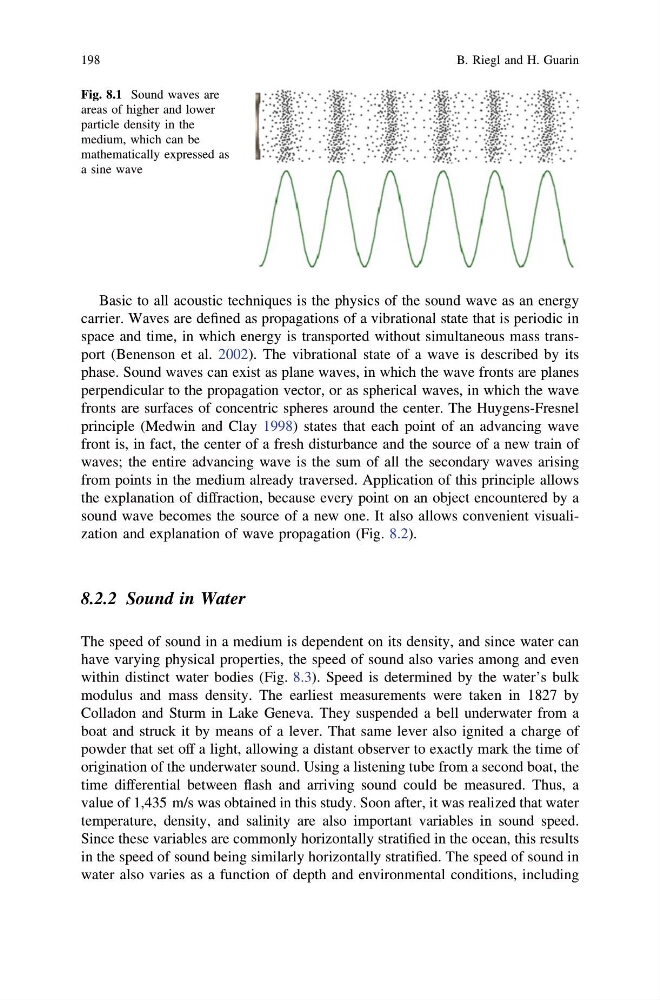
Fig. 8.1 Sound waves are
areas of higher and lower
particle density in the
medium, which can be
mathematically expressed as
a sine wave
198
B. Riegl and H. Guarin
carrier. Waves are defined as propagations of a vibrational state that is periodic in
space and time, in which energy is transported without simultaneous mass transport (Benenson et al. 2002). The vibrational state of a wave is described by its
phase. Sound waves can exist as plane waves, in which the wave fronts are planes
perpendicular to the propagation vector, or as spherical waves, in which the wave
fronts are surfaces of concentric spheres around the center. The Huygens-Fresnel
principle (Medwin and Clay 1998) states that each point of an advancing wave
front is, in fact, the center of a fresh disturbance and the source of a new train of
waves; the entire advancing wave is the sum of all the secondary waves arising
from points in the medium already traversed. Application of this principle allows
the explanation of diffraction, because every point on an object encountered by a
sound wave becomes the source of a new one. It also allows convenient visualization and explanation of wave propagation (Fig. 8.2).
8.2.2 Sound in Water
The speed of sound in a medium is dependent on its density, and since water can
have varying physical properties, the speed of sound also varies among and even
within distinct water bodies (Fig. 8.3). Speed is determined by the water’s bulk
modulus and mass density. The earliest measurements were taken in 1827 by
Colladon and Sturm in Lake Geneva. They suspended a bell underwater from a
boat and struck it by means of a lever. That same lever also ignited a charge of
powder that set off a light, allowing a distant observer to exactly mark the time of
origination of the underwater sound. Using a listening tube from a second boat, the
time differential between flash and arriving sound could be measured. Thus, a
value of 1,435 m/s was obtained in this study. Soon after, it was realized that water
temperature, density, and salinity are also important variables in sound speed.
Since these variables are commonly horizontally stratified in the ocean, this results
in the speed of sound being similarly horizontally stratified. The speed of sound in
water also varies as a function of depth and environmental conditions, including
Fig. 8.1 Sound waves are
areas of higher and lower
particle density in the
medium, which can be
mathematically expressed as
a sine wave
198
B. Riegl and H. Guarin