

image in Fig. 4.7a, or even a monochrome version, it is fairly easy for a person
familiar with coral reefs to identify sand regions, fore reef and back reef, and
where coral is likely to be found. Spatial pixel-to-pixel patterns of light and dark
are enough for the human eye (and brain) to do almost as good a job as hyperspectral remote sensing. It is clear that treating the mapping problem as one in
which each single pixel is examined in isolation runs counter to the methods
evolution has shaped in our own image processing system. This observation points
the way to future developments: to mirror the capabilities of human vision is
technically challenging but offers rich potential in an environment that is so
strongly characterized by spatial patterns.
Acknowledgments Reflectance spectra in Fig. 4.3 were collected by Chris Roelfsema. Heron
Island imagery was collected by Stuart Phinn and funded by the Australian Research Council, and
image pre-processing was conducted by Karen Joyce. Inherent optical properties in Fig. 4.2b
were collected with instrumentation held by the UK’s NERC Field Spectroscopy Facility and
during field work part-funded by the World Bank/Global Environment Facility Coral Reef
Targeted Research Program. Figure 4.4a and b were derived from a figure previously published
in Hedley et al. 2005 and are reproduced with permission from Taylor and Francis. Figure 4.5 is
reproduced from Harborne et al. 2006 with permission from the Ecological Society of America.
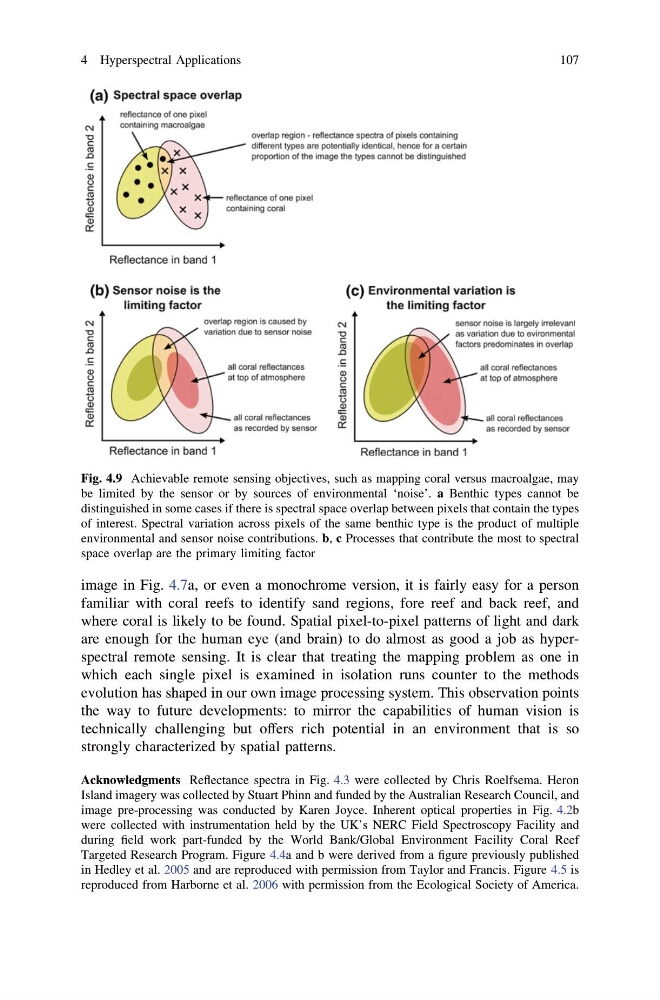
Fig. 4.9 Achievable remote sensing objectives, such as mapping coral versus macroalgae, may
be limited by the sensor or by sources of environmental ‘noise’. a Benthic types cannot be
distinguished in some cases if there is spectral space overlap between pixels that contain the types
of interest. Spectral variation across pixels of the same benthic type is the product of multiple
environmental and sensor noise contributions. b, c Processes that contribute the most to spectral
space overlap are the primary limiting factor
4 Hyperspectral Applications
107
familiar with coral reefs to identify sand regions, fore reef and back reef, and
where coral is likely to be found. Spatial pixel-to-pixel patterns of light and dark
are enough for the human eye (and brain) to do almost as good a job as hyperspectral remote sensing. It is clear that treating the mapping problem as one in
which each single pixel is examined in isolation runs counter to the methods
evolution has shaped in our own image processing system. This observation points
the way to future developments: to mirror the capabilities of human vision is
technically challenging but offers rich potential in an environment that is so
strongly characterized by spatial patterns.
Acknowledgments Reflectance spectra in Fig. 4.3 were collected by Chris Roelfsema. Heron
Island imagery was collected by Stuart Phinn and funded by the Australian Research Council, and
image pre-processing was conducted by Karen Joyce. Inherent optical properties in Fig. 4.2b
were collected with instrumentation held by the UK’s NERC Field Spectroscopy Facility and
during field work part-funded by the World Bank/Global Environment Facility Coral Reef
Targeted Research Program. Figure 4.4a and b were derived from a figure previously published
in Hedley et al. 2005 and are reproduced with permission from Taylor and Francis. Figure 4.5 is
reproduced from Harborne et al. 2006 with permission from the Ecological Society of America.
Fig. 4.9 Achievable remote sensing objectives, such as mapping coral versus macroalgae, may
be limited by the sensor or by sources of environmental ‘noise’. a Benthic types cannot be
distinguished in some cases if there is spectral space overlap between pixels that contain the types
of interest. Spectral variation across pixels of the same benthic type is the product of multiple
environmental and sensor noise contributions. b, c Processes that contribute the most to spectral
space overlap are the primary limiting factor
4 Hyperspectral Applications
107