

Hamylton 2011). However, with recent developments unmixing approaches can
now be thought of a subset of model inversion based techniques, which apply
similar reasoning but are more flexible in their formulation (Sect. 4.3.6)
4.3.4 Bathymetry
Depth variation across a coral reef can display strong and characteristic features,
from relative shallow back-reef lagoons and emergent fore-reef features and slopes,
to spur and groove zones and upstanding isolated coral heads. Mapping bathymetry
is an important objective for navigation or evaluating benthic light levels, and
published methods using optical remotely sensed data are numerous and among the
earliest shallow water remote sensing applications (Lyzenga 1978, 1981). While
bathymetry is a distinct objective from mapping benthic type, the effect of depth on
the above-water spectral reflectance means the two are intimately tied. Indeed, the
latest semi-empirical or ‘physics-based’ model inversion methods (Sect. 4.3.6)
extract both depth and benthic reflectance simultaneously. Lyzenga’s depth
invariant indices technique (Lyzenga 1978, 1981) can also produce a depth estimate
but requires the bottom to be classified first in order to factor out variation due to
bottom reflectance. However, while variable bottom reflectance and variation in
water column optical properties are considered the biggest weakness of bathymetry
extraction algorithms (Dekker et al. 2011), depth estimation can be surprisingly
robust if multispectral or hyperspectral data are used (Lyzenga et al. 2006). This is
because the light absorption by pure water is approximately exponential with depth
and has a wide range over visible wavelengths (Fig. 4.2; Maritorena et al. 1994).
Depth (m)
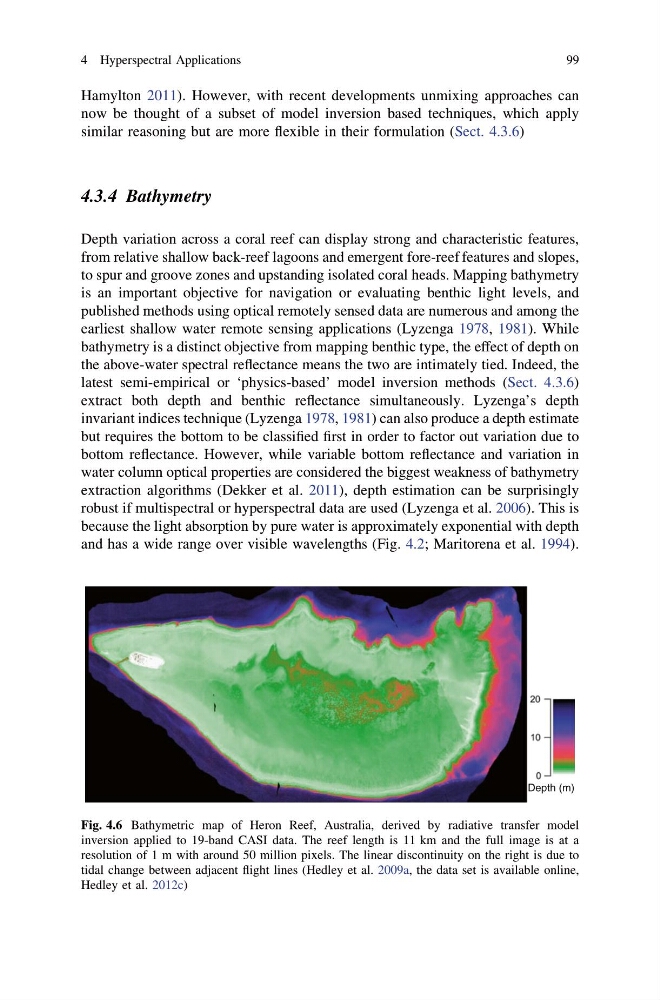
Fig. 4.6 Bathymetric map of Heron Reef, Australia, derived by radiative transfer model
inversion applied to 19-band CASI data. The reef length is 11 km and the full image is at a
resolution of 1 m with around 50 million pixels. The linear discontinuity on the right is due to
tidal change between adjacent flight lines (Hedley et al. 2009a, the data set is available online,
Hedley et al. 2012c)
4 Hyperspectral Applications
99
now be thought of a subset of model inversion based techniques, which apply
similar reasoning but are more flexible in their formulation (Sect. 4.3.6)
4.3.4 Bathymetry
Depth variation across a coral reef can display strong and characteristic features,
from relative shallow back-reef lagoons and emergent fore-reef features and slopes,
to spur and groove zones and upstanding isolated coral heads. Mapping bathymetry
is an important objective for navigation or evaluating benthic light levels, and
published methods using optical remotely sensed data are numerous and among the
earliest shallow water remote sensing applications (Lyzenga 1978, 1981). While
bathymetry is a distinct objective from mapping benthic type, the effect of depth on
the above-water spectral reflectance means the two are intimately tied. Indeed, the
latest semi-empirical or ‘physics-based’ model inversion methods (Sect. 4.3.6)
extract both depth and benthic reflectance simultaneously. Lyzenga’s depth
invariant indices technique (Lyzenga 1978, 1981) can also produce a depth estimate
but requires the bottom to be classified first in order to factor out variation due to
bottom reflectance. However, while variable bottom reflectance and variation in
water column optical properties are considered the biggest weakness of bathymetry
extraction algorithms (Dekker et al. 2011), depth estimation can be surprisingly
robust if multispectral or hyperspectral data are used (Lyzenga et al. 2006). This is
because the light absorption by pure water is approximately exponential with depth
and has a wide range over visible wavelengths (Fig. 4.2; Maritorena et al. 1994).
Depth (m)
Fig. 4.6 Bathymetric map of Heron Reef, Australia, derived by radiative transfer model
inversion applied to 19-band CASI data. The reef length is 11 km and the full image is at a
resolution of 1 m with around 50 million pixels. The linear discontinuity on the right is due to
tidal change between adjacent flight lines (Hedley et al. 2009a, the data set is available online,
Hedley et al. 2012c)
4 Hyperspectral Applications
99