

magnitudes of the values at the two pixels. So the question arises: how can a
processing step that does not increase information, or even discards information,
be useful? The answer is that the purpose of these image based preprocessing steps
(i.e., those that operate on image data without combining any ‘external’ auxiliary
data) is to transform the data into a form more acceptable to a subsequent processing step. Calculating depth invariant indices, for example (described below),
attempts to remove information about depth so a classification algorithm is not
‘confused’ by information that in a benthic cover mapping context we have no
interest in.
The situation is different if an external source of data is incorporated into the
analysis, such as acoustic bathymetry (Bejarano et al. 2010). In this case information is increased and, in theory, if the information is of good quality, the
accuracy of an analysis based on the new information should only increase. If after
adding data layers the accuracy remains the same or goes down, either the new
data is erroneous or the analysis technique is not appropriate.
These perspectives are very useful when evaluating different processing and
preprocessing algorithms. In many cases alternative algorithms are fundamentally
similar and by definition operate on the same data source (the image). They differ
only in the methods used to remove unnecessary information and the amount and
source of potentially useful external information incorporated. Subsequent sections
briefly mention a number of preprocessing steps that may be useful in different
contexts, to rearrange the existing data or to incorporate external data to facilitate
improved operation of the subsequent image analysis.
4.2.3 Atmospheric Correction
The passage of light from its source to the surface and subsequently from the
surface of the Earth, or the sea surface, to the sensor is affected by the atmosphere
in two ways: (1) light received at the sensor is reduced by absorption and scattering of photons out of the ‘beam’ that travels from the surface to the sensor; and
(2) conversely, the received light is increased by photons that are scattered into the
path of the beam. The latter contribution is termed the ‘path radiance’. Both
processes are dependent on wavelength, so that the apparent spectral reflectance at
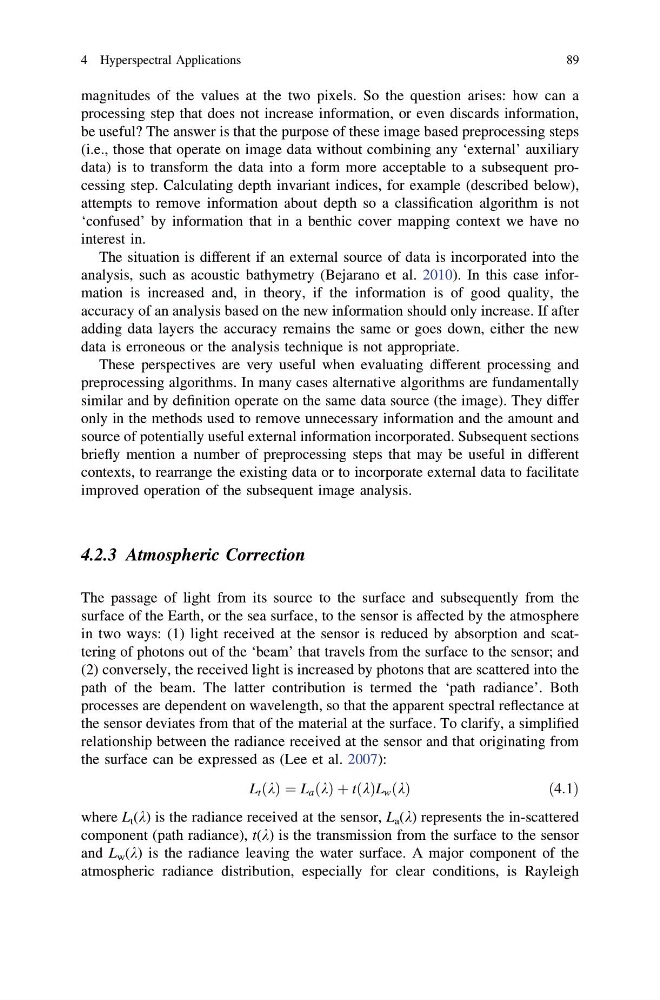
the sensor deviates from that of the material at the surface. To clarify, a simplified
relationship between the radiance received at the sensor and that originating from
the surface can be expressed as (Lee et al. 2007):
L t k
ð Þ ¼ L a k
ð Þ þ t k
ð ÞL w k
ð Þ
ð4:1Þ
where L t (k) is the radiance received at the sensor, L a (k) represents the in-scattered
component (path radiance), t(k) is the transmission from the surface to the sensor
and L w (k) is the radiance leaving the water surface. A major component of the
atmospheric radiance distribution, especially for clear conditions, is Rayleigh
4 Hyperspectral Applications
89
processing step that does not increase information, or even discards information,
be useful? The answer is that the purpose of these image based preprocessing steps
(i.e., those that operate on image data without combining any ‘external’ auxiliary
data) is to transform the data into a form more acceptable to a subsequent processing step. Calculating depth invariant indices, for example (described below),
attempts to remove information about depth so a classification algorithm is not
‘confused’ by information that in a benthic cover mapping context we have no
interest in.
The situation is different if an external source of data is incorporated into the
analysis, such as acoustic bathymetry (Bejarano et al. 2010). In this case information is increased and, in theory, if the information is of good quality, the
accuracy of an analysis based on the new information should only increase. If after
adding data layers the accuracy remains the same or goes down, either the new
data is erroneous or the analysis technique is not appropriate.
These perspectives are very useful when evaluating different processing and
preprocessing algorithms. In many cases alternative algorithms are fundamentally
similar and by definition operate on the same data source (the image). They differ
only in the methods used to remove unnecessary information and the amount and
source of potentially useful external information incorporated. Subsequent sections
briefly mention a number of preprocessing steps that may be useful in different
contexts, to rearrange the existing data or to incorporate external data to facilitate
improved operation of the subsequent image analysis.
4.2.3 Atmospheric Correction
The passage of light from its source to the surface and subsequently from the
surface of the Earth, or the sea surface, to the sensor is affected by the atmosphere
in two ways: (1) light received at the sensor is reduced by absorption and scattering of photons out of the ‘beam’ that travels from the surface to the sensor; and
(2) conversely, the received light is increased by photons that are scattered into the
path of the beam. The latter contribution is termed the ‘path radiance’. Both
processes are dependent on wavelength, so that the apparent spectral reflectance at
the sensor deviates from that of the material at the surface. To clarify, a simplified
relationship between the radiance received at the sensor and that originating from
the surface can be expressed as (Lee et al. 2007):
L t k
ð Þ ¼ L a k
ð Þ þ t k
ð ÞL w k
ð Þ
ð4:1Þ
where L t (k) is the radiance received at the sensor, L a (k) represents the in-scattered
component (path radiance), t(k) is the transmission from the surface to the sensor
and L w (k) is the radiance leaving the water surface. A major component of the
atmospheric radiance distribution, especially for clear conditions, is Rayleigh
4 Hyperspectral Applications
89