

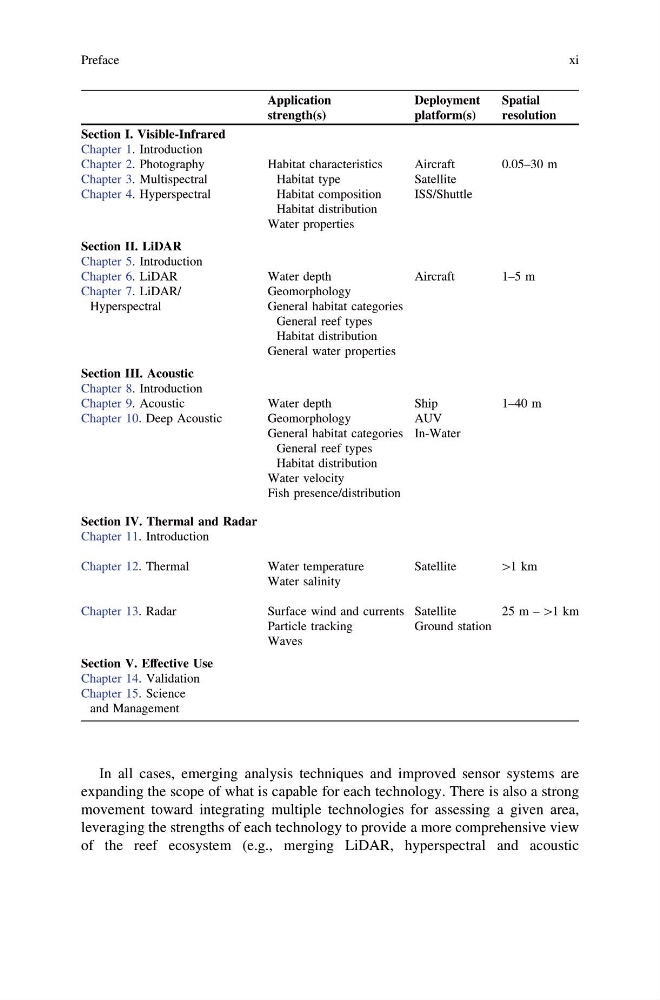
In all cases, emerging analysis techniques and improved sensor systems are
expanding the scope of what is capable for each technology. There is also a strong
movement toward integrating multiple technologies for assessing a given area,
leveraging the strengths of each technology to provide a more comprehensive view
of the reef ecosystem (e.g., merging LiDAR, hyperspectral and acoustic
Application
strength(s)
Deployment
platform(s)
Spatial
resolution
Section I. Visible-Infrared
Chapter 1. Introduction
Chapter 2. Photography
Chapter 3. Multispectral
Chapter 4. Hyperspectral
Habitat characteristics
Habitat type
Habitat composition
Habitat distribution
Water properties
Aircraft
Satellite
ISS/Shuttle
0.05–30 m
Section II. LiDAR
Chapter 5. Introduction
Chapter 6. LiDAR
Chapter 7. LiDAR/
Hyperspectral
Water depth
Geomorphology
General habitat categories
General reef types
Habitat distribution
General water properties
Aircraft
1–5 m
Section III. Acoustic
Chapter 8. Introduction
Chapter 9. Acoustic
Chapter 10. Deep Acoustic
Water depth
Geomorphology
General habitat categories
General reef types
Habitat distribution
Water velocity
Fish presence/distribution
Ship
AUV
In-Water
1–40 m
Section IV. Thermal and Radar
Chapter 11. Introduction
Chapter 12. Thermal
Chapter 13. Radar
Water temperature
Water salinity
Surface wind and currents
Particle tracking
Waves
Satellite
Satellite
Ground station
[1 km
25 m – [1 km
Section V. Effective Use
Chapter 14. Validation
Chapter 15. Science
and Management
Preface
xi
expanding the scope of what is capable for each technology. There is also a strong
movement toward integrating multiple technologies for assessing a given area,
leveraging the strengths of each technology to provide a more comprehensive view
of the reef ecosystem (e.g., merging LiDAR, hyperspectral and acoustic
Application
strength(s)
Deployment
platform(s)
Spatial
resolution
Section I. Visible-Infrared
Chapter 1. Introduction
Chapter 2. Photography
Chapter 3. Multispectral
Chapter 4. Hyperspectral
Habitat characteristics
Habitat type
Habitat composition
Habitat distribution
Water properties
Aircraft
Satellite
ISS/Shuttle
0.05–30 m
Section II. LiDAR
Chapter 5. Introduction
Chapter 6. LiDAR
Chapter 7. LiDAR/
Hyperspectral
Water depth
Geomorphology
General habitat categories
General reef types
Habitat distribution
General water properties
Aircraft
1–5 m
Section III. Acoustic
Chapter 8. Introduction
Chapter 9. Acoustic
Chapter 10. Deep Acoustic
Water depth
Geomorphology
General habitat categories
General reef types
Habitat distribution
Water velocity
Fish presence/distribution
Ship
AUV
In-Water
1–40 m
Section IV. Thermal and Radar
Chapter 11. Introduction
Chapter 12. Thermal
Chapter 13. Radar
Water temperature
Water salinity
Surface wind and currents
Particle tracking
Waves
Satellite
Satellite
Ground station
[1 km
25 m – [1 km
Section V. Effective Use
Chapter 14. Validation
Chapter 15. Science
and Management
Preface
xi