

in an estimated pore volume of 18 %. The mean increase in elevation in the
deposition area was +7 m and the maximum value (at the northeast side of the
former ridge) was +32 m.
9.5 Discussion
9.5.1 The Fading of a Glacier
At present Pasterze Glacier is far from equilibrium. As indicated by our analyses
there is basically no accumulation area left. The surface elevation change at
Pasterze Glacier (Fig. 9.6) below 2,500 m a.s.l. is strongly influenced by the
presence of supraglacial debris. The general increase in debris cover thickness
towards the glacier terminus (as shown by Kellerer-Pirklbauer 2008) offsets the
effect of increasing air temperature at lower elevations. This effect is not as strong
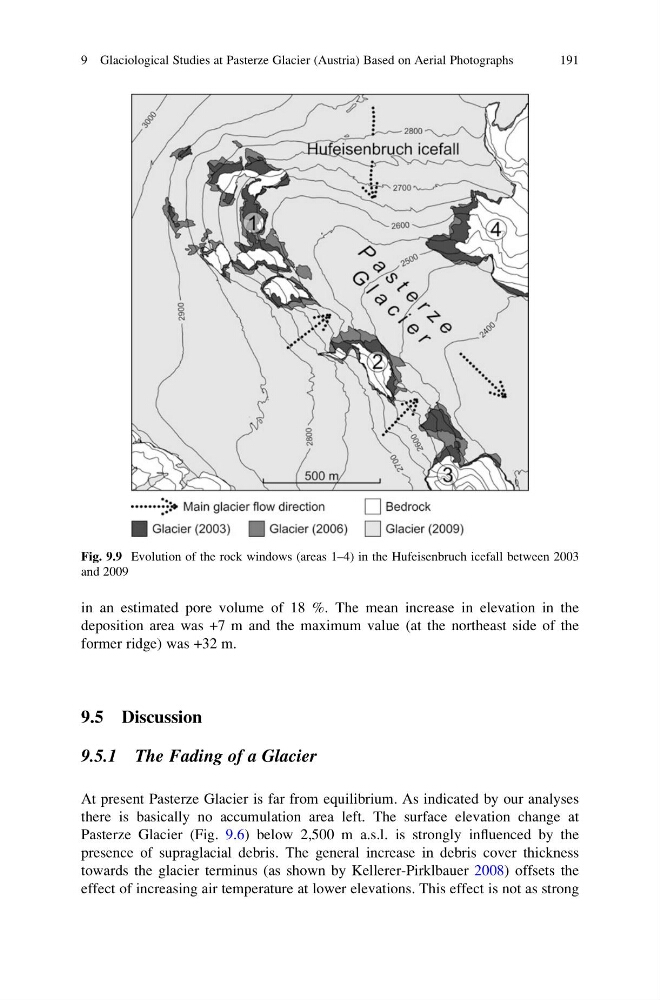
Fig. 9.9 Evolution of the rock windows (areas 1–4) in the Hufeisenbruch icefall between 2003
and 2009
9 Glaciological Studies at Pasterze Glacier (Austria) Based on Aerial Photographs
191
deposition area was +7 m and the maximum value (at the northeast side of the
former ridge) was +32 m.
9.5 Discussion
9.5.1 The Fading of a Glacier
At present Pasterze Glacier is far from equilibrium. As indicated by our analyses
there is basically no accumulation area left. The surface elevation change at
Pasterze Glacier (Fig. 9.6) below 2,500 m a.s.l. is strongly influenced by the
presence of supraglacial debris. The general increase in debris cover thickness
towards the glacier terminus (as shown by Kellerer-Pirklbauer 2008) offsets the
effect of increasing air temperature at lower elevations. This effect is not as strong
Fig. 9.9 Evolution of the rock windows (areas 1–4) in the Hufeisenbruch icefall between 2003
and 2009
9 Glaciological Studies at Pasterze Glacier (Austria) Based on Aerial Photographs
191