

Science, University of Graz, since 1958. These data and a large number of paintings, photographs (Fig. 9.2) and topographic maps provide very detailed information on the spatio-temporal changes of the glacier. These changes are in good
accordance with those observed for other alpine glaciers showing a strong recession
after the LIA maximum, a decelerated recession from the end of the nineteenth
century until the 1930s – although with intermittent periods of glacier advances in
the 1890s and 1920s –, and again a rapid recession from the mid-twentieth century
onwards with a slightly more favorable climatic phase between the mid-1960s and
early 1980s (Zemp 2006). Approximately two thirds of the Austrian glaciers
advanced during that period (Patzelt 1985). Years with mass gain did not last
long enough, however, to trigger advances of Pasterze Glacier, which can be
attributed to its long response time (Zuo and Oerlemans 1997). The mass surplus
flowed through the icefall with accelerated velocity, but melted gradually on its way
towards the glacier terminus (Wakonigg and Lieb 1996).
A massive rock fall was released at the southeast ridge of the mountain Mittlerer
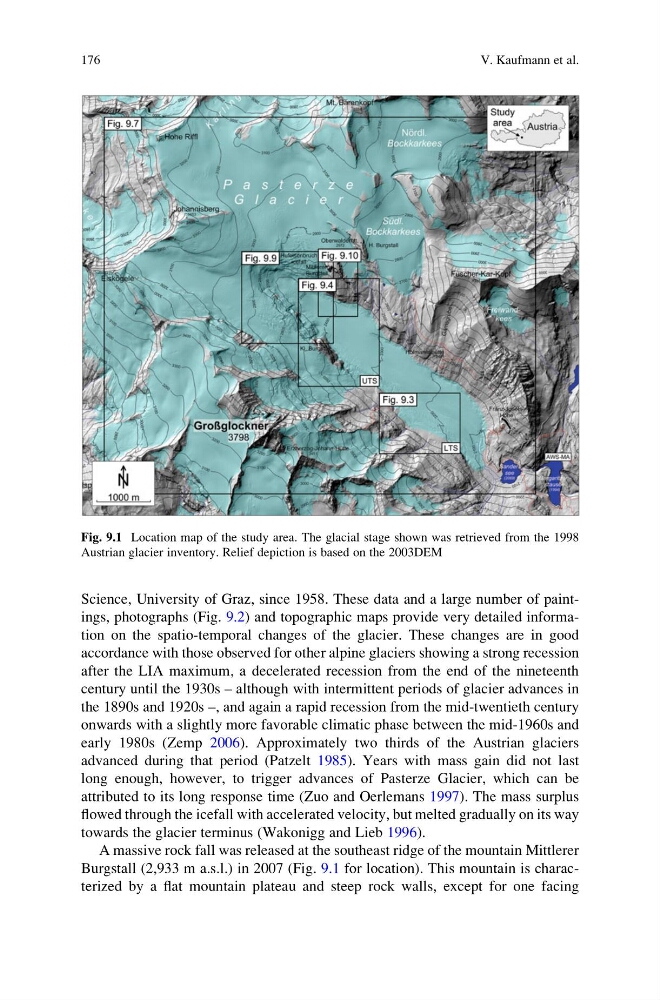
Burgstall (2,933 m a.s.l.) in 2007 (Fig. 9.1 for location). This mountain is characterized by a flat mountain plateau and steep rock walls, except for one facing
Fig. 9.1 Location map of the study area. The glacial stage shown was retrieved from the 1998
Austrian glacier inventory. Relief depiction is based on the 2003DEM
176
V. Kaufmann et al.
accordance with those observed for other alpine glaciers showing a strong recession
after the LIA maximum, a decelerated recession from the end of the nineteenth
century until the 1930s – although with intermittent periods of glacier advances in
the 1890s and 1920s –, and again a rapid recession from the mid-twentieth century
onwards with a slightly more favorable climatic phase between the mid-1960s and
early 1980s (Zemp 2006). Approximately two thirds of the Austrian glaciers
advanced during that period (Patzelt 1985). Years with mass gain did not last
long enough, however, to trigger advances of Pasterze Glacier, which can be
attributed to its long response time (Zuo and Oerlemans 1997). The mass surplus
flowed through the icefall with accelerated velocity, but melted gradually on its way
towards the glacier terminus (Wakonigg and Lieb 1996).
A massive rock fall was released at the southeast ridge of the mountain Mittlerer
Burgstall (2,933 m a.s.l.) in 2007 (Fig. 9.1 for location). This mountain is characterized by a flat mountain plateau and steep rock walls, except for one facing
Fig. 9.1 Location map of the study area. The glacial stage shown was retrieved from the 1998
Austrian glacier inventory. Relief depiction is based on the 2003DEM
176
V. Kaufmann et al.