

46
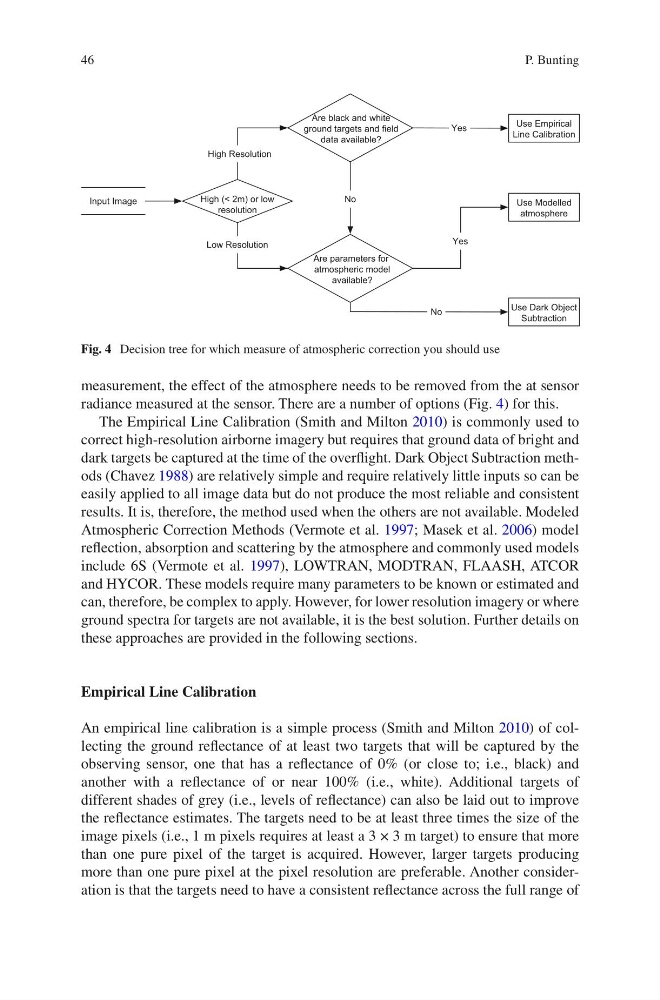
measurement, the effect of the atmosphere needs to be removed from the at sensor
radiance measured at the sensor. There are a number of options (Fig. 4) for this.
The Empirical Line Calibration (Smith and Milton 2010) is commonly used to
correct high-resolution airborne imagery but requires that ground data of bright and
dark targets be captured at the time of the overflight. Dark Object Subtraction methods (Chavez 1988) are relatively simple and require relatively little inputs so can be
easily applied to all image data but do not produce the most reliable and consistent
results. It is, therefore, the method used when the others are not available. Modeled
Atmospheric Correction Methods (Vermote et al. 1997; Masek et al. 2006) model
reflection, absorption and scattering by the atmosphere and commonly used models
include 6S (Vermote et al. 1997), LOWTRAN, MODTRAN, FLAASH, ATCOR
and HYCOR. These models require many parameters to be known or estimated and
can, therefore, be complex to apply. However, for lower resolution imagery or where
ground spectra for targets are not available, it is the best solution. Further details on
these approaches are provided in the following sections.
Empirical Line Calibration
An empirical line calibration is a simple process (Smith and Milton 2010) of collecting the ground reflectance of at least two targets that will be captured by the
observing sensor, one that has a reflectance of 0% (or close to; i.e., black) and
another with a reflectance of or near 100% (i.e., white). Additional targets of
different shades of grey (i.e., levels of reflectance) can also be laid out to improve
the reflectance estimates. The targets need to be at least three times the size of the
image pixels (i.e., 1 m pixels requires at least a 3 × 3 m target) to ensure that more
than one pure pixel of the target is acquired. However, larger targets producing
more than one pure pixel at the pixel resolution are preferable. Another consideration is that the targets need to have a consistent reflectance across the full range of
Input Image
High (< 2m) or low
resolution
Are black and white
ground targets and field
data available?
High Resolution
Are parameters for
atmospheric model
available?
Low Resolution
No
Use Empirical
Line Calibration
Use Modelled
atmosphere
Use Dark Object
Subtraction
Yes
Yes
No
Fig. 4 Decision tree for which measure of atmospheric correction you should use
P. Bunting
measurement, the effect of the atmosphere needs to be removed from the at sensor
radiance measured at the sensor. There are a number of options (Fig. 4) for this.
The Empirical Line Calibration (Smith and Milton 2010) is commonly used to
correct high-resolution airborne imagery but requires that ground data of bright and
dark targets be captured at the time of the overflight. Dark Object Subtraction methods (Chavez 1988) are relatively simple and require relatively little inputs so can be
easily applied to all image data but do not produce the most reliable and consistent
results. It is, therefore, the method used when the others are not available. Modeled
Atmospheric Correction Methods (Vermote et al. 1997; Masek et al. 2006) model
reflection, absorption and scattering by the atmosphere and commonly used models
include 6S (Vermote et al. 1997), LOWTRAN, MODTRAN, FLAASH, ATCOR
and HYCOR. These models require many parameters to be known or estimated and
can, therefore, be complex to apply. However, for lower resolution imagery or where
ground spectra for targets are not available, it is the best solution. Further details on
these approaches are provided in the following sections.
Empirical Line Calibration
An empirical line calibration is a simple process (Smith and Milton 2010) of collecting the ground reflectance of at least two targets that will be captured by the
observing sensor, one that has a reflectance of 0% (or close to; i.e., black) and
another with a reflectance of or near 100% (i.e., white). Additional targets of
different shades of grey (i.e., levels of reflectance) can also be laid out to improve
the reflectance estimates. The targets need to be at least three times the size of the
image pixels (i.e., 1 m pixels requires at least a 3 × 3 m target) to ensure that more
than one pure pixel of the target is acquired. However, larger targets producing
more than one pure pixel at the pixel resolution are preferable. Another consideration is that the targets need to have a consistent reflectance across the full range of
Input Image
High (< 2m) or low
resolution
Are black and white
ground targets and field
data available?
High Resolution
Are parameters for
atmospheric model
available?
Low Resolution
No
Use Empirical
Line Calibration
Use Modelled
atmosphere
Use Dark Object
Subtraction
Yes
Yes
No
Fig. 4 Decision tree for which measure of atmospheric correction you should use
P. Bunting