

287
Image Automatic Classification
The process of delineating training classes and applying classification procedures
took less than 2 hours. Random forests were slightly lower than SVM according to
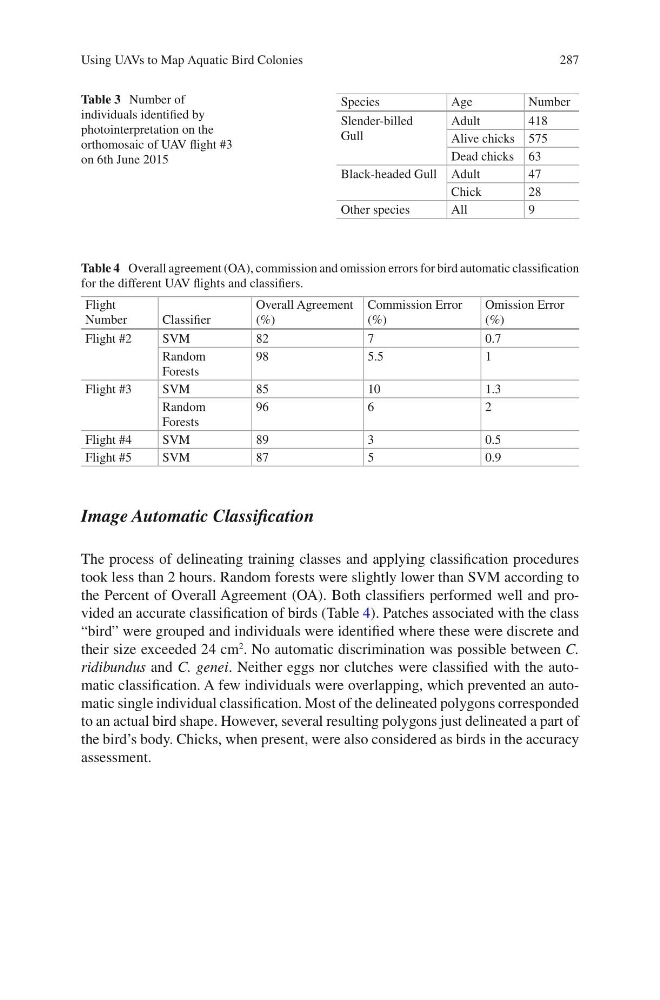
the Percent of Overall Agreement (OA). Both classifiers performed well and provided an accurate classification of birds (Table 4). Patches associated with the class
“bird” were grouped and individuals were identified where these were discrete and
their size exceeded 24 cm
2
. No automatic discrimination was possible between C.
ridibundus and C. genei. Neither eggs nor clutches were classified with the automatic classification. A few individuals were overlapping, which prevented an automatic single individual classification. Most of the delineated polygons corresponded
to an actual bird shape. However, several resulting polygons just delineated a part of
the bird’s body. Chicks, when present, were also considered as birds in the accuracy
assessment.
Table 3 Number of
individuals identified by
photointerpretation on the
orthomosaic of UAV flight #3
on 6th June 2015
Species
Age
Number
Slender-billed
Gull
Adult
418
Alive chicks 575
Dead chicks 63
Black-headed Gull Adult
47
Chick
28
Other species
All
9
Table 4 Overall agreement (OA), commission and omission errors for bird automatic classification
for the different UAV flights and classifiers.
Flight
Number
Classifier
Overall Agreement
(%)
Commission Error
(%)
Omission Error
(%)
Flight #2
SVM
82
7
0.7
Random
Forests
98
5.5
1
Flight #3
SVM
85
10
1.3
Random
Forests
96
6
2
Flight #4
SVM
89
3
0.5
Flight #5
SVM
87
5
0.9
Using UAVs to Map Aquatic Bird Colonies
Image Automatic Classification
The process of delineating training classes and applying classification procedures
took less than 2 hours. Random forests were slightly lower than SVM according to
the Percent of Overall Agreement (OA). Both classifiers performed well and provided an accurate classification of birds (Table 4). Patches associated with the class
“bird” were grouped and individuals were identified where these were discrete and
their size exceeded 24 cm
2
. No automatic discrimination was possible between C.
ridibundus and C. genei. Neither eggs nor clutches were classified with the automatic classification. A few individuals were overlapping, which prevented an automatic single individual classification. Most of the delineated polygons corresponded
to an actual bird shape. However, several resulting polygons just delineated a part of
the bird’s body. Chicks, when present, were also considered as birds in the accuracy
assessment.
Table 3 Number of
individuals identified by
photointerpretation on the
orthomosaic of UAV flight #3
on 6th June 2015
Species
Age
Number
Slender-billed
Gull
Adult
418
Alive chicks 575
Dead chicks 63
Black-headed Gull Adult
47
Chick
28
Other species
All
9
Table 4 Overall agreement (OA), commission and omission errors for bird automatic classification
for the different UAV flights and classifiers.
Flight
Number
Classifier
Overall Agreement
(%)
Commission Error
(%)
Omission Error
(%)
Flight #2
SVM
82
7
0.7
Random
Forests
98
5.5
1
Flight #3
SVM
85
10
1.3
Random
Forests
96
6
2
Flight #4
SVM
89
3
0.5
Flight #5
SVM
87
5
0.9
Using UAVs to Map Aquatic Bird Colonies