

253
challenge as, (a) we often have less than 30 seconds to make an estimate, (b) the
birds do not remain static for 30 seconds and (c) the dimensions of the flock are
constantly changing.
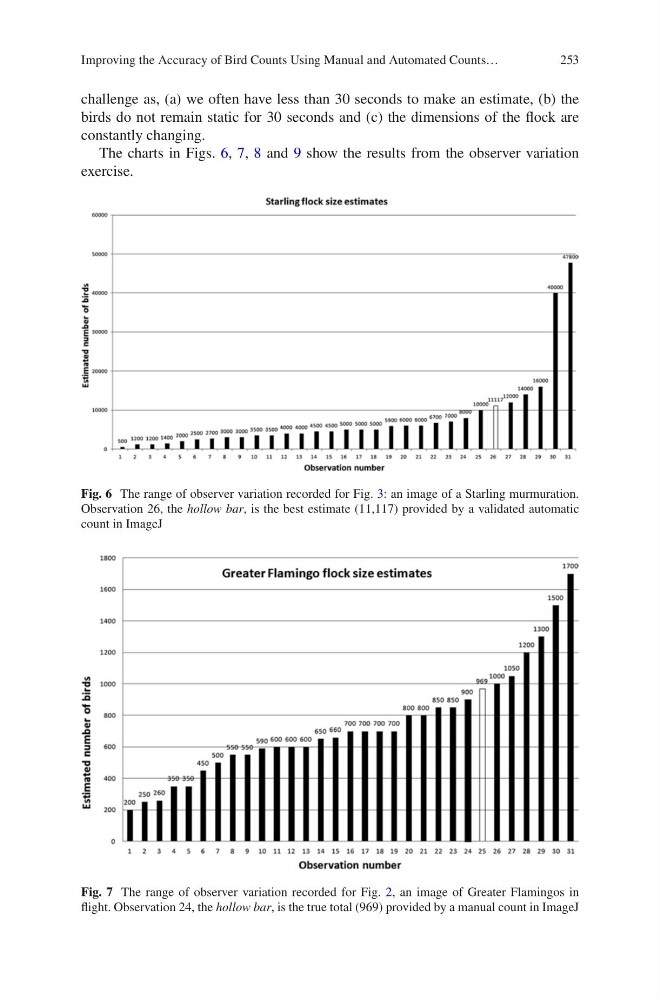
The charts in Figs. 6, 7, 8 and 9 show the results from the observer variation
exercise.
Fig. 6 The range of observer variation recorded for Fig. 3: an image of a Starling murmuration.
Observation 26, the hollow bar, is the best estimate (11,117) provided by a validated automatic
count in ImageJ
Fig. 7 The range of observer variation recorded for Fig. 2, an image of Greater Flamingos in
flight. Observation 24, the hollow bar, is the true total (969) provided by a manual count in ImageJ
Improving the Accuracy of Bird Counts Using Manual and Automated Counts…
challenge as, (a) we often have less than 30 seconds to make an estimate, (b) the
birds do not remain static for 30 seconds and (c) the dimensions of the flock are
constantly changing.
The charts in Figs. 6, 7, 8 and 9 show the results from the observer variation
exercise.
Fig. 6 The range of observer variation recorded for Fig. 3: an image of a Starling murmuration.
Observation 26, the hollow bar, is the best estimate (11,117) provided by a validated automatic
count in ImageJ
Fig. 7 The range of observer variation recorded for Fig. 2, an image of Greater Flamingos in
flight. Observation 24, the hollow bar, is the true total (969) provided by a manual count in ImageJ
Improving the Accuracy of Bird Counts Using Manual and Automated Counts…