

210
Sampling and Analysing DNA
DNA-based methods are of ever-increasing importance for large carnivore surveys.
For the brown bear, it is the most important method in Sweden for counting the
numbers of individuals that are encountered in a given area, which is then used to
estimate the total population size (Kindberg 2010). Brown bear DNA surveys are
usually undertaken intermittently in the counties. Management authorities provide
sampling material and ask volunteers, most of which are hunters, to collect samples
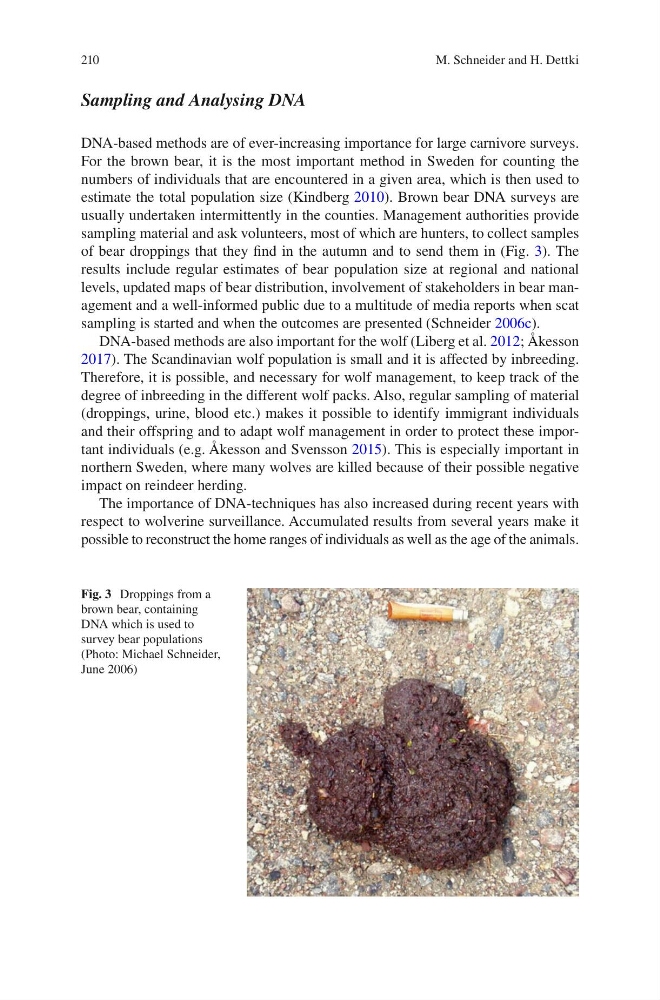
of bear droppings that they find in the autumn and to send them in (Fig. 3). The
results include regular estimates of bear population size at regional and national
levels, updated maps of bear distribution, involvement of stakeholders in bear management and a well-informed public due to a multitude of media reports when scat
sampling is started and when the outcomes are presented (Schneider 2006c).
DNA-based methods are also important for the wolf (Liberg et al. 2012; Åkesson
2017). The Scandinavian wolf population is small and it is affected by inbreeding.
Therefore, it is possible, and necessary for wolf management, to keep track of the
degree of inbreeding in the different wolf packs. Also, regular sampling of material
(droppings, urine, blood etc.) makes it possible to identify immigrant individuals
and their offspring and to adapt wolf management in order to protect these important individuals (e.g. Åkesson and Svensson 2015). This is especially important in
northern Sweden, where many wolves are killed because of their possible negative
impact on reindeer herding.
The importance of DNA-techniques has also increased during recent years with
respect to wolverine surveillance. Accumulated results from several years make it
possible to reconstruct the home ranges of individuals as well as the age of the animals.
Fig. 3 Droppings from a
brown bear, containing
DNA which is used to
survey bear populations
(Photo: Michael Schneider,
June 2006)
M. Schneider and H. Dettki
Sampling and Analysing DNA
DNA-based methods are of ever-increasing importance for large carnivore surveys.
For the brown bear, it is the most important method in Sweden for counting the
numbers of individuals that are encountered in a given area, which is then used to
estimate the total population size (Kindberg 2010). Brown bear DNA surveys are
usually undertaken intermittently in the counties. Management authorities provide
sampling material and ask volunteers, most of which are hunters, to collect samples
of bear droppings that they find in the autumn and to send them in (Fig. 3). The
results include regular estimates of bear population size at regional and national
levels, updated maps of bear distribution, involvement of stakeholders in bear management and a well-informed public due to a multitude of media reports when scat
sampling is started and when the outcomes are presented (Schneider 2006c).
DNA-based methods are also important for the wolf (Liberg et al. 2012; Åkesson
2017). The Scandinavian wolf population is small and it is affected by inbreeding.
Therefore, it is possible, and necessary for wolf management, to keep track of the
degree of inbreeding in the different wolf packs. Also, regular sampling of material
(droppings, urine, blood etc.) makes it possible to identify immigrant individuals
and their offspring and to adapt wolf management in order to protect these important individuals (e.g. Åkesson and Svensson 2015). This is especially important in
northern Sweden, where many wolves are killed because of their possible negative
impact on reindeer herding.
The importance of DNA-techniques has also increased during recent years with
respect to wolverine surveillance. Accumulated results from several years make it
possible to reconstruct the home ranges of individuals as well as the age of the animals.
Fig. 3 Droppings from a
brown bear, containing
DNA which is used to
survey bear populations
(Photo: Michael Schneider,
June 2006)
M. Schneider and H. Dettki