

151
Shrub Communities
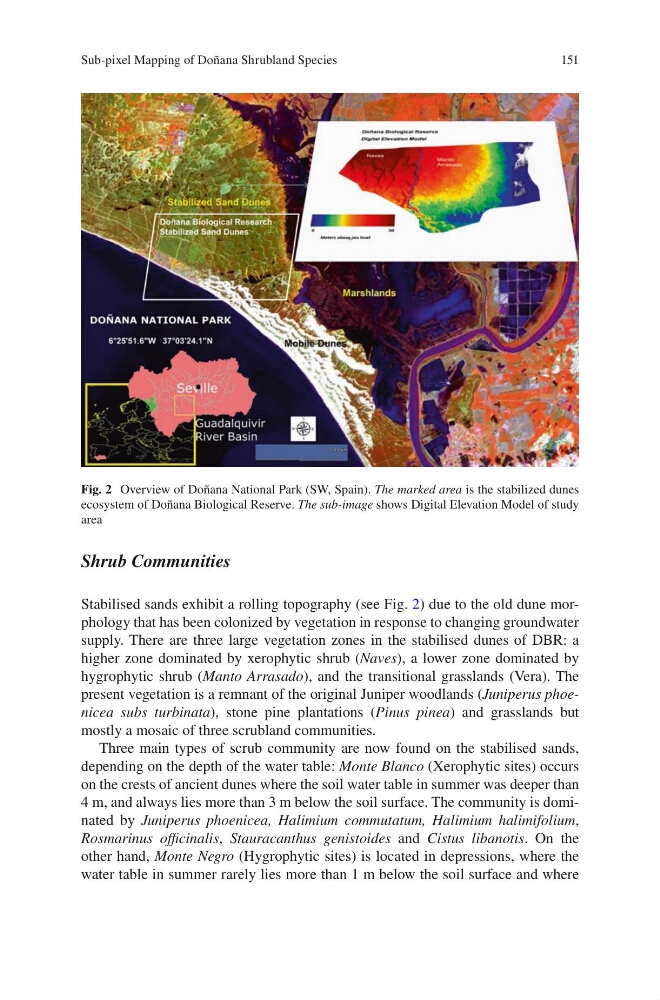
Stabilised sands exhibit a rolling topography (see Fig. 2) due to the old dune morphology that has been colonized by vegetation in response to changing groundwater
supply. There are three large vegetation zones in the stabilised dunes of DBR: a
higher zone dominated by xerophytic shrub (Naves), a lower zone dominated by
hygrophytic shrub (Manto Arrasado), and the transitional grasslands (Vera). The
present vegetation is a remnant of the original Juniper woodlands (Juniperus phoenicea subs turbinata), stone pine plantations (Pinus pinea) and grasslands but
mostly a mosaic of three scrubland communities.
Three main types of scrub community are now found on the stabilised sands,
depending on the depth of the water table: Monte Blanco (Xerophytic sites) occurs
on the crests of ancient dunes where the soil water table in summer was deeper than
4 m, and always lies more than 3 m below the soil surface. The community is dominated by Juniperus phoenicea, Halimium commutatum, Halimium halimifolium,
Rosmarinus officinalis, Stauracanthus genistoides and Cistus libanotis. On the
other hand, Monte Negro (Hygrophytic sites) is located in depressions, where the
water table in summer rarely lies more than 1 m below the soil surface and where
Fig. 2 Overview of Doñana National Park (SW, Spain). The marked area is the stabilized dunes
ecosystem of Doñana Biological Reserve. The sub-image shows Digital Elevation Model of study
area
Sub-pixel Mapping of Doñana Shrubland Species
Shrub Communities
Stabilised sands exhibit a rolling topography (see Fig. 2) due to the old dune morphology that has been colonized by vegetation in response to changing groundwater
supply. There are three large vegetation zones in the stabilised dunes of DBR: a
higher zone dominated by xerophytic shrub (Naves), a lower zone dominated by
hygrophytic shrub (Manto Arrasado), and the transitional grasslands (Vera). The
present vegetation is a remnant of the original Juniper woodlands (Juniperus phoenicea subs turbinata), stone pine plantations (Pinus pinea) and grasslands but
mostly a mosaic of three scrubland communities.
Three main types of scrub community are now found on the stabilised sands,
depending on the depth of the water table: Monte Blanco (Xerophytic sites) occurs
on the crests of ancient dunes where the soil water table in summer was deeper than
4 m, and always lies more than 3 m below the soil surface. The community is dominated by Juniperus phoenicea, Halimium commutatum, Halimium halimifolium,
Rosmarinus officinalis, Stauracanthus genistoides and Cistus libanotis. On the
other hand, Monte Negro (Hygrophytic sites) is located in depressions, where the
water table in summer rarely lies more than 1 m below the soil surface and where
Fig. 2 Overview of Doñana National Park (SW, Spain). The marked area is the stabilized dunes
ecosystem of Doñana Biological Reserve. The sub-image shows Digital Elevation Model of study
area
Sub-pixel Mapping of Doñana Shrubland Species