

70
Michela Bertolotto
• On-demand Mapping Request: In this case the time component is less critical
and the user is willing to wait for the desired map. The generation can thus
involve the entire process of generalization to obtain a high-quality map.
• On-the-fly and On-demand Mapping Request: In this case the advantages of the
other two approaches are combined. The user needs a map with good cartographic quality within a limited time.
For real-time solutions, the application of the map generalization process is
unacceptable. Alternative solutions have been proposed based on the pre-computation
of multiple map representations at increasing levels of detail for support to real-time
Web mapping (see also Chap. 5 for further discussions on the use of multiple representations for Web applications). One such proposal was described in [6] and relies
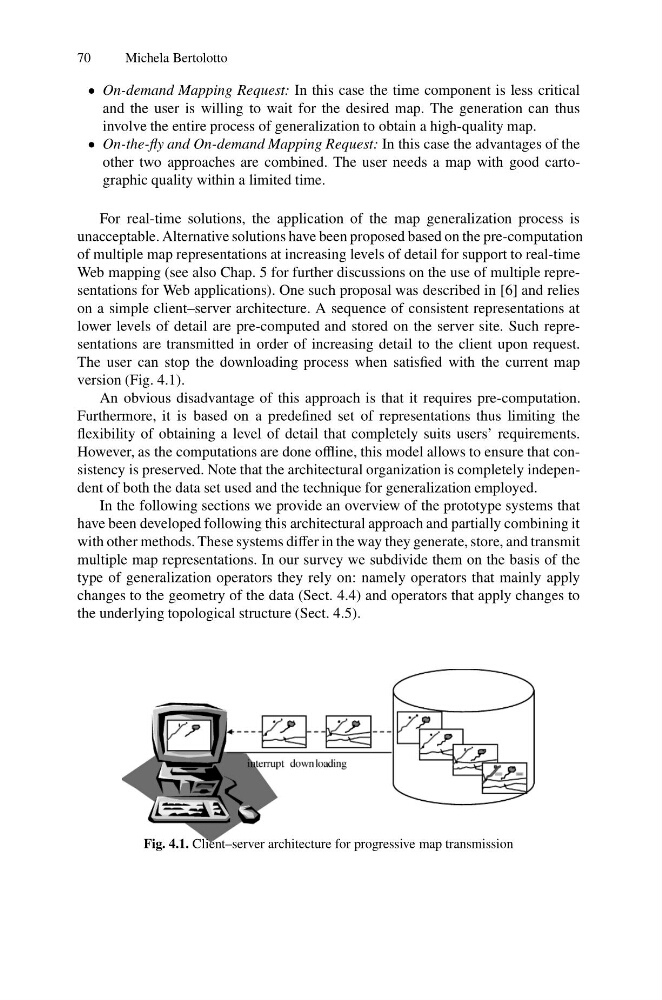
on a simple client–server architecture. A sequence of consistent representations at
lower levels of detail are pre-computed and stored on the server site. Such representations are transmitted in order of increasing detail to the client upon request.
The user can stop the downloading process when satisfied with the current map
version (Fig. 4.1).
An obvious disadvantage of this approach is that it requires pre-computation.
Furthermore, it is based on a predefined set of representations thus limiting the
flexibility of obtaining a level of detail that completely suits users’ requirements.
However, as the computations are done offline, this model allows to ensure that consistency is preserved. Note that the architectural organization is completely independent of both the data set used and the technique for generalization employed.
In the following sections we provide an overview of the prototype systems that
have been developed following this architectural approach and partially combining it
with other methods. These systems differ in the way they generate, store, and transmit
multiple map representations. In our survey we subdivide them on the basis of the
type of generalization operators they rely on: namely operators that mainly apply
changes to the geometry of the data (Sect. 4.4) and operators that apply changes to
the underlying topological structure (Sect. 4.5).
Fig. 4.1. Client–server architecture for progressive map transmission
Michela Bertolotto
• On-demand Mapping Request: In this case the time component is less critical
and the user is willing to wait for the desired map. The generation can thus
involve the entire process of generalization to obtain a high-quality map.
• On-the-fly and On-demand Mapping Request: In this case the advantages of the
other two approaches are combined. The user needs a map with good cartographic quality within a limited time.
For real-time solutions, the application of the map generalization process is
unacceptable. Alternative solutions have been proposed based on the pre-computation
of multiple map representations at increasing levels of detail for support to real-time
Web mapping (see also Chap. 5 for further discussions on the use of multiple representations for Web applications). One such proposal was described in [6] and relies
on a simple client–server architecture. A sequence of consistent representations at
lower levels of detail are pre-computed and stored on the server site. Such representations are transmitted in order of increasing detail to the client upon request.
The user can stop the downloading process when satisfied with the current map
version (Fig. 4.1).
An obvious disadvantage of this approach is that it requires pre-computation.
Furthermore, it is based on a predefined set of representations thus limiting the
flexibility of obtaining a level of detail that completely suits users’ requirements.
However, as the computations are done offline, this model allows to ensure that consistency is preserved. Note that the architectural organization is completely independent of both the data set used and the technique for generalization employed.
In the following sections we provide an overview of the prototype systems that
have been developed following this architectural approach and partially combining it
with other methods. These systems differ in the way they generate, store, and transmit
multiple map representations. In our survey we subdivide them on the basis of the
type of generalization operators they rely on: namely operators that mainly apply
changes to the geometry of the data (Sect. 4.4) and operators that apply changes to
the underlying topological structure (Sect. 4.5).
Fig. 4.1. Client–server architecture for progressive map transmission