

2 GeoMTGM
35
....
t1
t2
.........
tn
tn+1
......
....
(a)
(b)
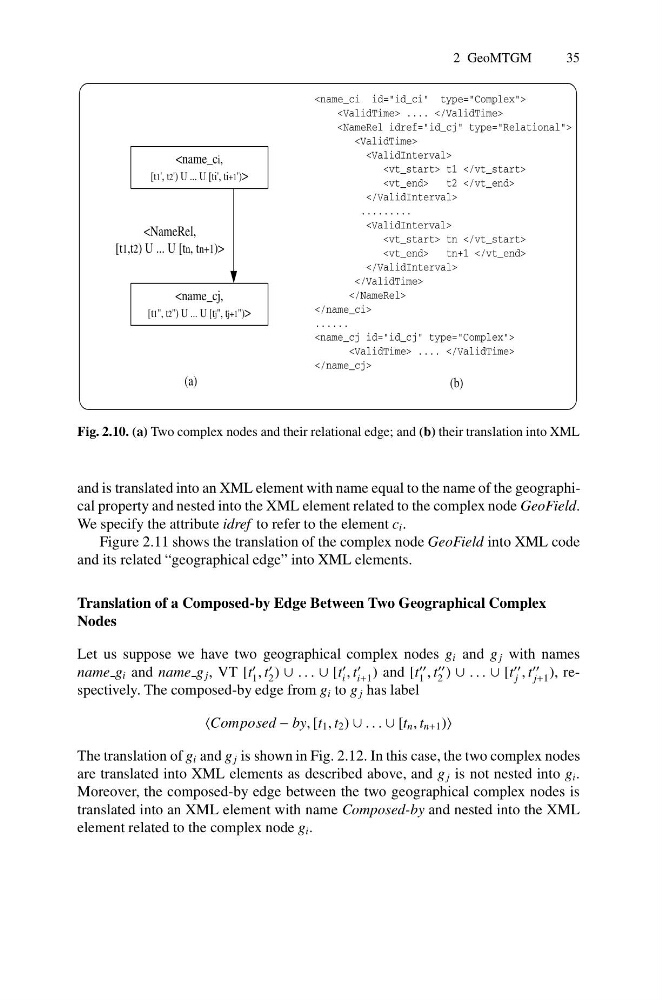
Fig. 2.10. (a) Two complex nodes and their relational edge; and (b) their translation into XML
and is translated into an XML element with name equal to the name of the geographical property and nested into the XML element related to the complex node GeoField.
We specify the attribute idref to refer to the element c i .
Figure 2.11 shows the translation of the complex node GeoField into XML code
and its related “geographical edge” into XML elements.
Translation of a Composed-by Edge Between Two Geographical Complex
Nodes
Let us suppose we have two geographical complex nodes g i and g j with names
name g i and name g j , VT [t
1 , t
2 ) ∪ . . . ∪ [t
i , t
i+1 ) and [t
1 , t
2 ) ∪ . . . ∪ [t
j , t
j+1 ), respectively. The composed-by edge from g i to g j has label
Composed − by, [t 1 , t 2 ) ∪ . . . ∪ [t n , t n+1 )
The translation of g i and g j is shown in Fig. 2.12. In this case, the two complex nodes
are translated into XML elements as described above, and g j is not nested into g i .
Moreover, the composed-by edge between the two geographical complex nodes is
translated into an XML element with name Composed-by and nested into the XML
element related to the complex node g i .
35
.........
......
(a)
(b)
Fig. 2.10. (a) Two complex nodes and their relational edge; and (b) their translation into XML
and is translated into an XML element with name equal to the name of the geographical property and nested into the XML element related to the complex node GeoField.
We specify the attribute idref to refer to the element c i .
Figure 2.11 shows the translation of the complex node GeoField into XML code
and its related “geographical edge” into XML elements.
Translation of a Composed-by Edge Between Two Geographical Complex
Nodes
Let us suppose we have two geographical complex nodes g i and g j with names
name g i and name g j , VT [t
1 , t
2 ) ∪ . . . ∪ [t
i , t
i+1 ) and [t
1 , t
2 ) ∪ . . . ∪ [t
j , t
j+1 ), respectively. The composed-by edge from g i to g j has label
Composed − by, [t 1 , t 2 ) ∪ . . . ∪ [t n , t n+1 )
The translation of g i and g j is shown in Fig. 2.12. In this case, the two complex nodes
are translated into XML elements as described above, and g j is not nested into g i .
Moreover, the composed-by edge between the two geographical complex nodes is
translated into an XML element with name Composed-by and nested into the XML
element related to the complex node g i .