

13 Tracking of Moving Objects with Accuracy Guarantees
287
13.2 Background
We first describe the general approach to tracking that we use. Then we describe
the real-world GPS and road network data that we use for evaluating the different
tracking techniques.
13.2.1 Tracking Approach
We assume that moving objects are constrained by a road network and that they
are capable of obtaining their positions from an associated GPS receiver. Moving
objects, also termed “clients,” send their location information to a central database,
also termed “the server,” via a wireless communication network. We assume that disconnects between client and server are dealt with by other mechanism in the network
than the tracking techniques we consider. When a disconnect occurs, these mechanisms notify the server that may then take appropriate action.
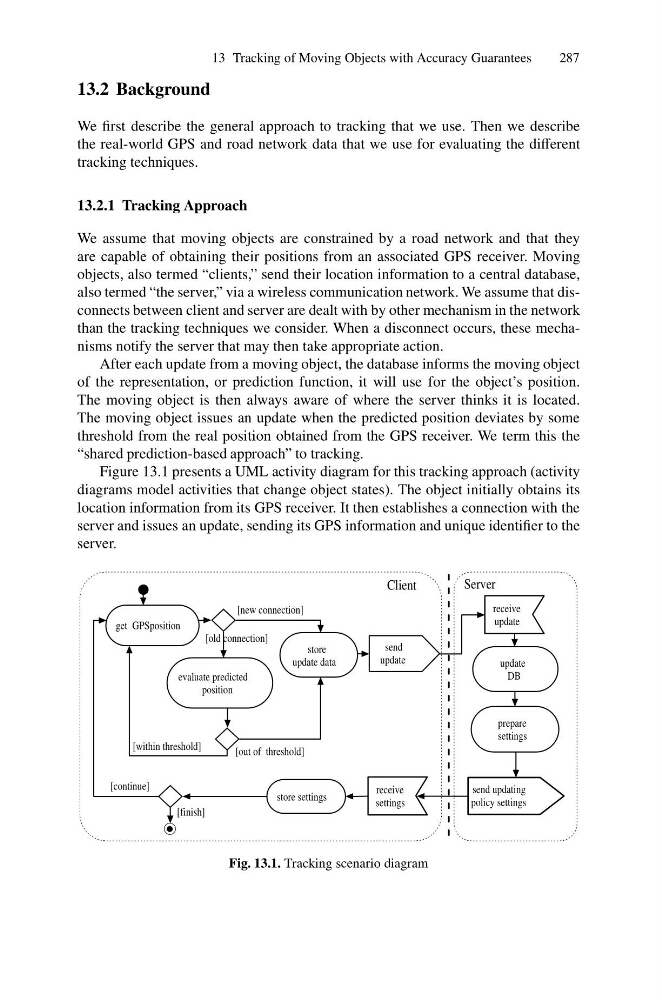
After each update from a moving object, the database informs the moving object
of the representation, or prediction function, it will use for the object’s position.
The moving object is then always aware of where the server thinks it is located.
The moving object issues an update when the predicted position deviates by some
threshold from the real position obtained from the GPS receiver. We term this the
“shared prediction-based approach” to tracking.
Figure 13.1 presents a UML activity diagram for this tracking approach (activity
diagrams model activities that change object states). The object initially obtains its
location information from its GPS receiver. It then establishes a connection with the
server and issues an update, sending its GPS information and unique identifier to the
server.
get GPSposition
evaluate predicted
position
store
update data
receive
update
send
update
update
DB
prepare
settings
send updating
policy settings
receive
settings
store settings
[continue]
[finish]
[old connection]
[new connection]
[within threshold]
Client
Server
[out of threshold]
Fig. 13.1. Tracking scenario diagram
287
13.2 Background
We first describe the general approach to tracking that we use. Then we describe
the real-world GPS and road network data that we use for evaluating the different
tracking techniques.
13.2.1 Tracking Approach
We assume that moving objects are constrained by a road network and that they
are capable of obtaining their positions from an associated GPS receiver. Moving
objects, also termed “clients,” send their location information to a central database,
also termed “the server,” via a wireless communication network. We assume that disconnects between client and server are dealt with by other mechanism in the network
than the tracking techniques we consider. When a disconnect occurs, these mechanisms notify the server that may then take appropriate action.
After each update from a moving object, the database informs the moving object
of the representation, or prediction function, it will use for the object’s position.
The moving object is then always aware of where the server thinks it is located.
The moving object issues an update when the predicted position deviates by some
threshold from the real position obtained from the GPS receiver. We term this the
“shared prediction-based approach” to tracking.
Figure 13.1 presents a UML activity diagram for this tracking approach (activity
diagrams model activities that change object states). The object initially obtains its
location information from its GPS receiver. It then establishes a connection with the
server and issues an update, sending its GPS information and unique identifier to the
server.
get GPSposition
evaluate predicted
position
store
update data
receive
update
send
update
update
DB
prepare
settings
send updating
policy settings
receive
settings
store settings
[continue]
[finish]
[old connection]
[new connection]
[within threshold]
Client
Server
[out of threshold]
Fig. 13.1. Tracking scenario diagram