

28
Carlo Combi, Sara Migliorini, Barbara Oliboni, and Alberto Belussi
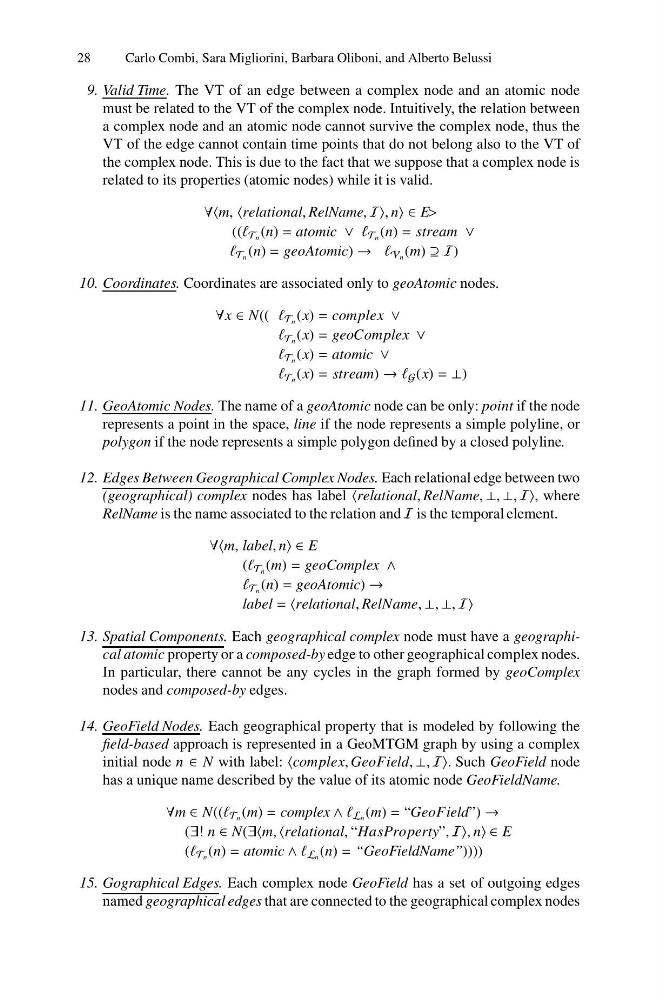
9. Valid Time. The VT of an edge between a complex node and an atomic node
must be related to the VT of the complex node. Intuitively, the relation between
a complex node and an atomic node cannot survive the complex node, thus the
VT of the edge cannot contain time points that do not belong also to the VT of
the complex node. This is due to the fact that we suppose that a complex node is
related to its properties (atomic nodes) while it is valid.
∀∀m, relational, RelName, II, n ∈ E>
(( T n (n) = atomic ∨ T n (n) = stream ∨
T n (n) = geoAtomic) → V n (m) ⊇ I)
10. Coordinates. Coordinates are associated only to geoAtomic nodes.
∀x ∈ N(( T n (x) = complex ∨
T n (x) = geoComplex ∨
T n (x) = atomic ∨
T n (x) = stream) → G (x) = ⊥)
11. GeoAtomic Nodes. The name of a geoAtomic node can be only: point if the node
represents a point in the space, line if the node represents a simple polyline, or
polygon if the node represents a simple polygon defined by a closed polyline.
12. Edges Between Geographical Complex Nodes. Each relational edge between two
(geographical) complex nodes has label relational, RelName, ⊥, ⊥, II, where
RelName is the name associated to the relation and I is the temporal element.
∀∀m, label, n ∈ E
( T n (m) = geoComplex ∧
T n (n) = geoAtomic) →
label = relational, RelName, ⊥, ⊥, II
13. Spatial Components. Each geographical complex node must have a geographical atomic property or a composed-by edge to other geographical complex nodes.
In particular, there cannot be any cycles in the graph formed by geoComplex
nodes and composed-by edges.
14. GeoField Nodes. Each geographical property that is modeled by following the
field-based approach is represented in a GeoMTGM graph by using a complex
initial node n ∈ N with label: complex, GeoField, ⊥, II. Such GeoField node
has a unique name described by the value of its atomic node GeoFieldName.
∀m ∈ N(( T n (m) = complex ∧ L n (m) = “GeoField”) →
(∃! n ∈ N(∃∃m, relational, “HasProperty”, II, n ∈ E
( T n (n) = atomic ∧ L n (n) = “GeoFieldName”))))
15. Gographical Edges. Each complex node GeoField has a set of outgoing edges
named geographical edges that are connected to the geographical complex nodes
Carlo Combi, Sara Migliorini, Barbara Oliboni, and Alberto Belussi
9. Valid Time. The VT of an edge between a complex node and an atomic node
must be related to the VT of the complex node. Intuitively, the relation between
a complex node and an atomic node cannot survive the complex node, thus the
VT of the edge cannot contain time points that do not belong also to the VT of
the complex node. This is due to the fact that we suppose that a complex node is
related to its properties (atomic nodes) while it is valid.
∀∀m, relational, RelName, II, n ∈ E>
(( T n (n) = atomic ∨ T n (n) = stream ∨
T n (n) = geoAtomic) → V n (m) ⊇ I)
10. Coordinates. Coordinates are associated only to geoAtomic nodes.
∀x ∈ N(( T n (x) = complex ∨
T n (x) = geoComplex ∨
T n (x) = atomic ∨
T n (x) = stream) → G (x) = ⊥)
11. GeoAtomic Nodes. The name of a geoAtomic node can be only: point if the node
represents a point in the space, line if the node represents a simple polyline, or
polygon if the node represents a simple polygon defined by a closed polyline.
12. Edges Between Geographical Complex Nodes. Each relational edge between two
(geographical) complex nodes has label relational, RelName, ⊥, ⊥, II, where
RelName is the name associated to the relation and I is the temporal element.
∀∀m, label, n ∈ E
( T n (m) = geoComplex ∧
T n (n) = geoAtomic) →
label = relational, RelName, ⊥, ⊥, II
13. Spatial Components. Each geographical complex node must have a geographical atomic property or a composed-by edge to other geographical complex nodes.
In particular, there cannot be any cycles in the graph formed by geoComplex
nodes and composed-by edges.
14. GeoField Nodes. Each geographical property that is modeled by following the
field-based approach is represented in a GeoMTGM graph by using a complex
initial node n ∈ N with label: complex, GeoField, ⊥, II. Such GeoField node
has a unique name described by the value of its atomic node GeoFieldName.
∀m ∈ N(( T n (m) = complex ∧ L n (m) = “GeoField”) →
(∃! n ∈ N(∃∃m, relational, “HasProperty”, II, n ∈ E
( T n (n) = atomic ∧ L n (n) = “GeoFieldName”))))
15. Gographical Edges. Each complex node GeoField has a set of outgoing edges
named geographical edges that are connected to the geographical complex nodes