

252
Maria Calagna and Luigi V. Mancini
5.a)
STEGO−MAP
SENSITIVE MAP
PK_i
DIGITAL
MAP
HIDDEN
CONTENT
EMBED
5.b)
STEGO−MAP
HIDDEN
CONTENT
DIGITAL
MAP
EXTRACT
SK_i
SENSITIVE MAP
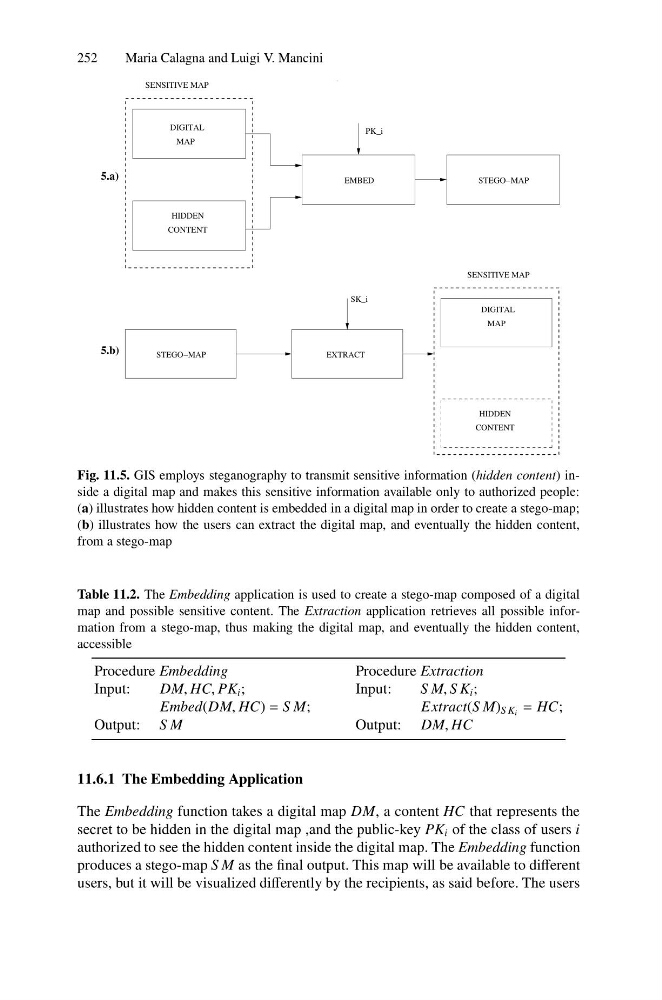
Fig. 11.5. GIS employs steganography to transmit sensitive information (hidden content) inside a digital map and makes this sensitive information available only to authorized people:
(a) illustrates how hidden content is embedded in a digital map in order to create a stego-map;
(b) illustrates how the users can extract the digital map, and eventually the hidden content,
from a stego-map
Table 11.2. The Embedding application is used to create a stego-map composed of a digital
map and possible sensitive content. The Extraction application retrieves all possible information from a stego-map, thus making the digital map, and eventually the hidden content,
accessible
Procedure Embedding
Procedure Extraction
Input:
DM, HC, PK i ;
Input:
S M, S K i ;
Embed(DM, HC) = S M;
Extract(S M) S K i = HC;
Output: S M
Output: DM, HC
11.6.1 The Embedding Application
The Embedding function takes a digital map DM, a content HC that represents the
secret to be hidden in the digital map ,and the public-key PK i of the class of users i
authorized to see the hidden content inside the digital map. The Embedding function
produces a stego-map S M as the final output. This map will be available to different
users, but it will be visualized differently by the recipients, as said before. The users
Maria Calagna and Luigi V. Mancini
5.a)
STEGO−MAP
SENSITIVE MAP
PK_i
DIGITAL
MAP
HIDDEN
CONTENT
EMBED
5.b)
STEGO−MAP
HIDDEN
CONTENT
DIGITAL
MAP
EXTRACT
SK_i
SENSITIVE MAP
Fig. 11.5. GIS employs steganography to transmit sensitive information (hidden content) inside a digital map and makes this sensitive information available only to authorized people:
(a) illustrates how hidden content is embedded in a digital map in order to create a stego-map;
(b) illustrates how the users can extract the digital map, and eventually the hidden content,
from a stego-map
Table 11.2. The Embedding application is used to create a stego-map composed of a digital
map and possible sensitive content. The Extraction application retrieves all possible information from a stego-map, thus making the digital map, and eventually the hidden content,
accessible
Procedure Embedding
Procedure Extraction
Input:
DM, HC, PK i ;
Input:
S M, S K i ;
Embed(DM, HC) = S M;
Extract(S M) S K i = HC;
Output: S M
Output: DM, HC
11.6.1 The Embedding Application
The Embedding function takes a digital map DM, a content HC that represents the
secret to be hidden in the digital map ,and the public-key PK i of the class of users i
authorized to see the hidden content inside the digital map. The Embedding function
produces a stego-map S M as the final output. This map will be available to different
users, but it will be visualized differently by the recipients, as said before. The users