

9 Access Control Systems for Geospatial Data and Applications
207
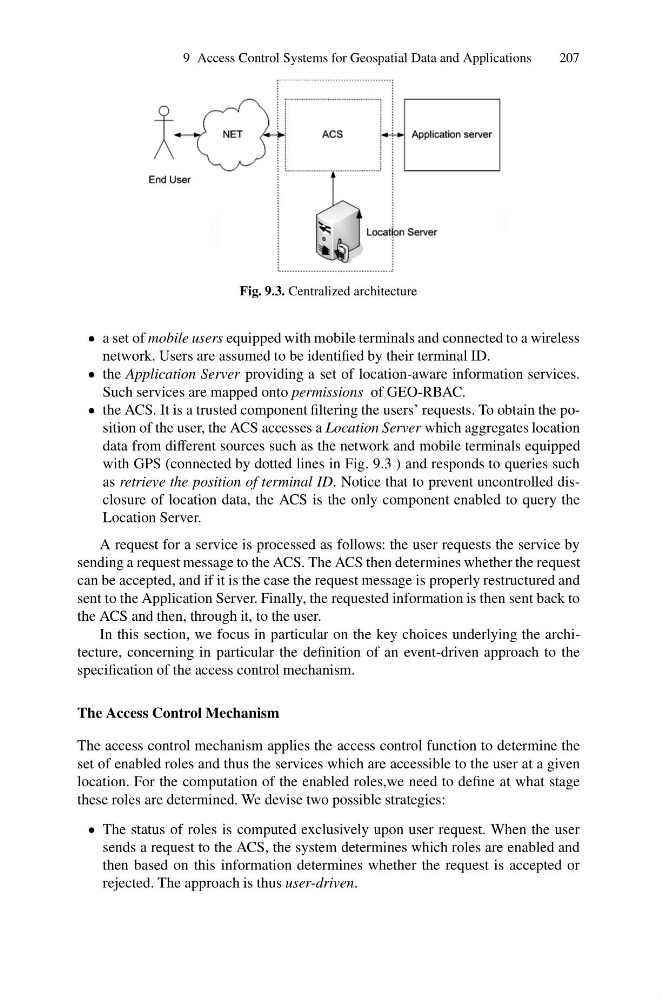
Fig. 9.3. Centralized architecture
• a set of mobile users equipped with mobile terminals and connected to a wireless
network. Users are assumed to be identified by their terminal ID.
• the Application Server providing a set of location-aware information services.
Such services are mapped onto permissions of GEO-RBAC.
• the ACS. It is a trusted component filtering the users’ requests. To obtain the position of the user, the ACS accesses a Location Server which aggregates location
data from different sources such as the network and mobile terminals equipped
with GPS (connected by dotted lines in Fig. 9.3 ) and responds to queries such
as retrieve the position of terminal ID. Notice that to prevent uncontrolled disclosure of location data, the ACS is the only component enabled to query the
Location Server.
A request for a service is processed as follows: the user requests the service by
sending a request message to the ACS. The ACS then determines whether the request
can be accepted, and if it is the case the request message is properly restructured and
sent to the Application Server. Finally, the requested information is then sent back to
the ACS and then, through it, to the user.
In this section, we focus in particular on the key choices underlying the architecture, concerning in particular the definition of an event-driven approach to the
specification of the access control mechanism.
The Access Control Mechanism
The access control mechanism applies the access control function to determine the
set of enabled roles and thus the services which are accessible to the user at a given
location. For the computation of the enabled roles,we need to define at what stage
these roles are determined. We devise two possible strategies:
• The status of roles is computed exclusively upon user request. When the user
sends a request to the ACS, the system determines which roles are enabled and
then based on this information determines whether the request is accepted or
rejected. The approach is thus user-driven.
207
Fig. 9.3. Centralized architecture
• a set of mobile users equipped with mobile terminals and connected to a wireless
network. Users are assumed to be identified by their terminal ID.
• the Application Server providing a set of location-aware information services.
Such services are mapped onto permissions of GEO-RBAC.
• the ACS. It is a trusted component filtering the users’ requests. To obtain the position of the user, the ACS accesses a Location Server which aggregates location
data from different sources such as the network and mobile terminals equipped
with GPS (connected by dotted lines in Fig. 9.3 ) and responds to queries such
as retrieve the position of terminal ID. Notice that to prevent uncontrolled disclosure of location data, the ACS is the only component enabled to query the
Location Server.
A request for a service is processed as follows: the user requests the service by
sending a request message to the ACS. The ACS then determines whether the request
can be accepted, and if it is the case the request message is properly restructured and
sent to the Application Server. Finally, the requested information is then sent back to
the ACS and then, through it, to the user.
In this section, we focus in particular on the key choices underlying the architecture, concerning in particular the definition of an event-driven approach to the
specification of the access control mechanism.
The Access Control Mechanism
The access control mechanism applies the access control function to determine the
set of enabled roles and thus the services which are accessible to the user at a given
location. For the computation of the enabled roles,we need to define at what stage
these roles are determined. We devise two possible strategies:
• The status of roles is computed exclusively upon user request. When the user
sends a request to the ACS, the system determines which roles are enabled and
then based on this information determines whether the request is accepted or
rejected. The approach is thus user-driven.