

178
Paola Podest` a, Barbara Catania, and Alberto Belussi
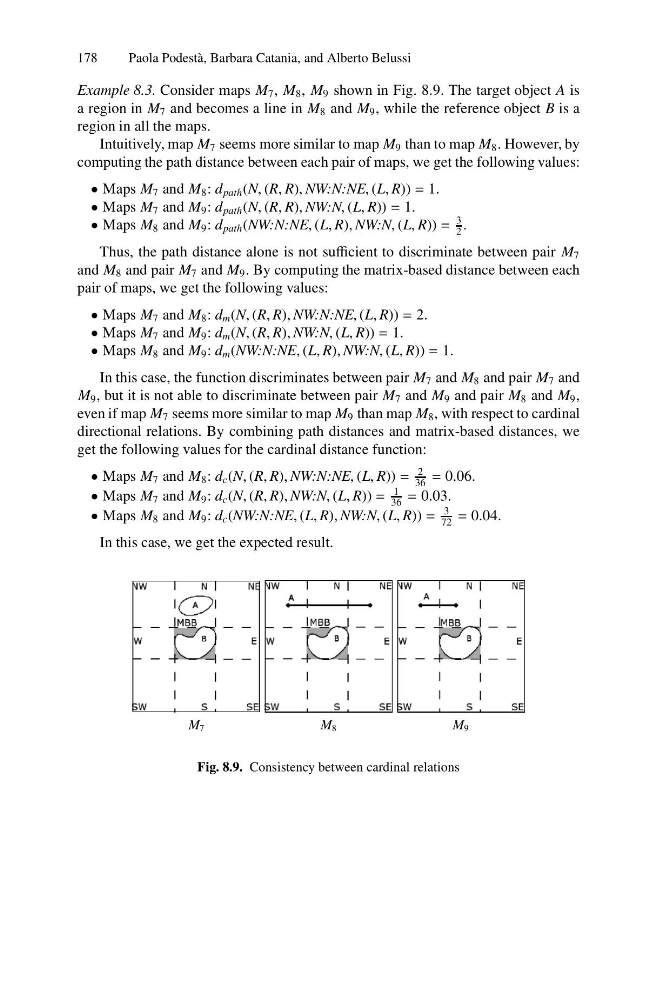
Example 8.3. Consider maps M 7 , M 8 , M 9 shown in Fig. 8.9. The target object A is
a region in M 7 and becomes a line in M 8 and M 9 , while the reference object B is a
region in all the maps.
Intuitively, map M 7 seems more similar to map M 9 than to map M 8 . However, by
computing the path distance between each pair of maps, we get the following values:
• Maps M 7 and M 8 : d path (N, (R, R), NW:N:NE, (L, R)) = 1.
• Maps M 7 and M 9 : d path (N, (R, R), NW:N, (L, R)) = 1.
• Maps M 8 and M 9 : d path (NW:N:NE, (L, R), NW:N, (L, R)) =
3
2 .
Thus, the path distance alone is not sufficient to discriminate between pair M 7
and M 8 and pair M 7 and M 9 . By computing the matrix-based distance between each
pair of maps, we get the following values:
• Maps M 7 and M 8 : d m (N, (R, R), NW:N:NE, (L, R)) = 2.
• Maps M 7 and M 9 : d m (N, (R, R), NW:N, (L, R)) = 1.
• Maps M 8 and M 9 : d m (NW:N:NE, (L, R), NW:N, (L, R)) = 1.
In this case, the function discriminates between pair M 7 and M 8 and pair M 7 and
M 9 , but it is not able to discriminate between pair M 7 and M 9 and pair M 8 and M 9 ,
even if map M 7 seems more similar to map M 9 than map M 8 , with respect to cardinal
directional relations. By combining path distances and matrix-based distances, we
get the following values for the cardinal distance function:
• Maps M 7 and M 8 : d c (N, (R, R), NW:N:NE, (L, R)) =
2
36 = 0.06.
• Maps M 7 and M 9 : d c (N, (R, R), NW:N, (L, R)) =
1
36 = 0.03.
• Maps M 8 and M 9 : d c (NW:N:NE, (L, R), NW:N, (L, R)) =
3
72 = 0.04.
In this case, we get the expected result.
M 7
M 8
M 9
Fig. 8.9. Consistency between cardinal relations
Paola Podest` a, Barbara Catania, and Alberto Belussi
Example 8.3. Consider maps M 7 , M 8 , M 9 shown in Fig. 8.9. The target object A is
a region in M 7 and becomes a line in M 8 and M 9 , while the reference object B is a
region in all the maps.
Intuitively, map M 7 seems more similar to map M 9 than to map M 8 . However, by
computing the path distance between each pair of maps, we get the following values:
• Maps M 7 and M 8 : d path (N, (R, R), NW:N:NE, (L, R)) = 1.
• Maps M 7 and M 9 : d path (N, (R, R), NW:N, (L, R)) = 1.
• Maps M 8 and M 9 : d path (NW:N:NE, (L, R), NW:N, (L, R)) =
3
2 .
Thus, the path distance alone is not sufficient to discriminate between pair M 7
and M 8 and pair M 7 and M 9 . By computing the matrix-based distance between each
pair of maps, we get the following values:
• Maps M 7 and M 8 : d m (N, (R, R), NW:N:NE, (L, R)) = 2.
• Maps M 7 and M 9 : d m (N, (R, R), NW:N, (L, R)) = 1.
• Maps M 8 and M 9 : d m (NW:N:NE, (L, R), NW:N, (L, R)) = 1.
In this case, the function discriminates between pair M 7 and M 8 and pair M 7 and
M 9 , but it is not able to discriminate between pair M 7 and M 9 and pair M 8 and M 9 ,
even if map M 7 seems more similar to map M 9 than map M 8 , with respect to cardinal
directional relations. By combining path distances and matrix-based distances, we
get the following values for the cardinal distance function:
• Maps M 7 and M 8 : d c (N, (R, R), NW:N:NE, (L, R)) =
2
36 = 0.06.
• Maps M 7 and M 9 : d c (N, (R, R), NW:N, (L, R)) =
1
36 = 0.03.
• Maps M 8 and M 9 : d c (NW:N:NE, (L, R), NW:N, (L, R)) =
3
72 = 0.04.
In this case, we get the expected result.
M 7
M 8
M 9
Fig. 8.9. Consistency between cardinal relations