

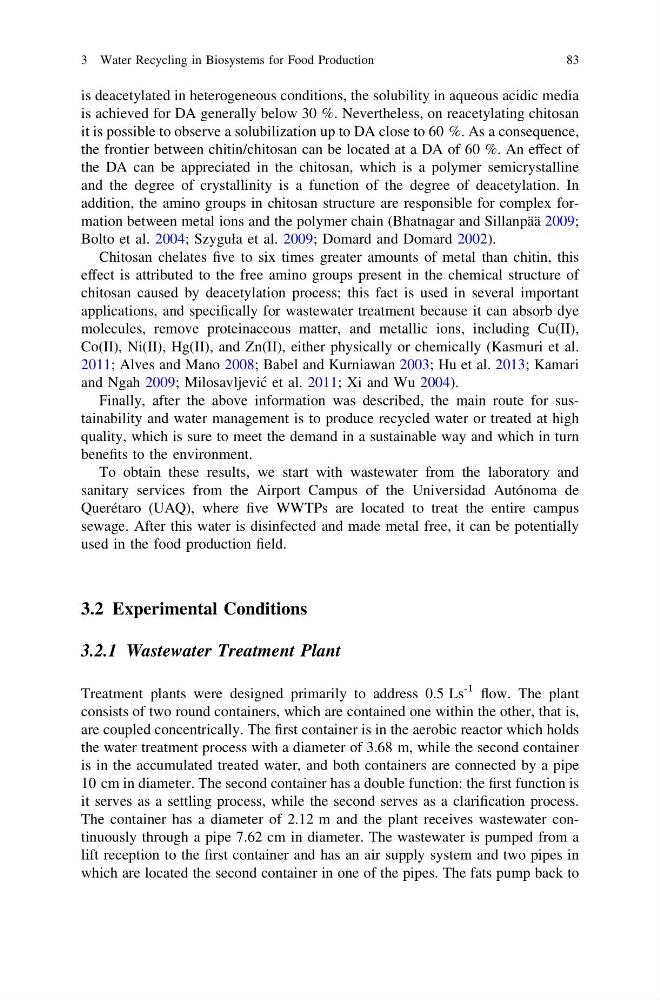
is deacetylated in heterogeneous conditions, the solubility in aqueous acidic media
is achieved for DA generally below 30 %. Nevertheless, on reacetylating chitosan
it is possible to observe a solubilization up to DA close to 60 %. As a consequence,
the frontier between chitin/chitosan can be located at a DA of 60 %. An effect of
the DA can be appreciated in the chitosan, which is a polymer semicrystalline
and the degree of crystallinity is a function of the degree of deacetylation. In
addition, the amino groups in chitosan structure are responsible for complex formation between metal ions and the polymer chain (Bhatnagar and Sillanpää 2009;
Bolto et al. 2004; Szyguła et al. 2009; Domard and Domard 2002).
Chitosan chelates five to six times greater amounts of metal than chitin, this
effect is attributed to the free amino groups present in the chemical structure of
chitosan caused by deacetylation process; this fact is used in several important
applications, and specifically for wastewater treatment because it can absorb dye
molecules, remove proteinaceous matter, and metallic ions, including Cu(II),
Co(II), Ni(II), Hg(II), and Zn(II), either physically or chemically (Kasmuri et al.
2011; Alves and Mano 2008; Babel and Kurniawan 2003; Hu et al. 2013; Kamari
and Ngah 2009; Milosavljevic ´ et al. 2011; Xi and Wu 2004).
Finally, after the above information was described, the main route for sustainability and water management is to produce recycled water or treated at high
quality, which is sure to meet the demand in a sustainable way and which in turn
benefits to the environment.
To obtain these results, we start with wastewater from the laboratory and
sanitary services from the Airport Campus of the Universidad Autónoma de
Querétaro (UAQ), where five WWTPs are located to treat the entire campus
sewage. After this water is disinfected and made metal free, it can be potentially
used in the food production field.
3.2 Experimental Conditions
3.2.1 Wastewater Treatment Plant
Treatment plants were designed primarily to address 0.5 Ls
-1 flow. The plant
consists of two round containers, which are contained one within the other, that is,
are coupled concentrically. The first container is in the aerobic reactor which holds
the water treatment process with a diameter of 3.68 m, while the second container
is in the accumulated treated water, and both containers are connected by a pipe
10 cm in diameter. The second container has a double function: the first function is
it serves as a settling process, while the second serves as a clarification process.
The container has a diameter of 2.12 m and the plant receives wastewater continuously through a pipe 7.62 cm in diameter. The wastewater is pumped from a
lift reception to the first container and has an air supply system and two pipes in
which are located the second container in one of the pipes. The fats pump back to
3 Water Recycling in Biosystems for Food Production
83
is achieved for DA generally below 30 %. Nevertheless, on reacetylating chitosan
it is possible to observe a solubilization up to DA close to 60 %. As a consequence,
the frontier between chitin/chitosan can be located at a DA of 60 %. An effect of
the DA can be appreciated in the chitosan, which is a polymer semicrystalline
and the degree of crystallinity is a function of the degree of deacetylation. In
addition, the amino groups in chitosan structure are responsible for complex formation between metal ions and the polymer chain (Bhatnagar and Sillanpää 2009;
Bolto et al. 2004; Szyguła et al. 2009; Domard and Domard 2002).
Chitosan chelates five to six times greater amounts of metal than chitin, this
effect is attributed to the free amino groups present in the chemical structure of
chitosan caused by deacetylation process; this fact is used in several important
applications, and specifically for wastewater treatment because it can absorb dye
molecules, remove proteinaceous matter, and metallic ions, including Cu(II),
Co(II), Ni(II), Hg(II), and Zn(II), either physically or chemically (Kasmuri et al.
2011; Alves and Mano 2008; Babel and Kurniawan 2003; Hu et al. 2013; Kamari
and Ngah 2009; Milosavljevic ´ et al. 2011; Xi and Wu 2004).
Finally, after the above information was described, the main route for sustainability and water management is to produce recycled water or treated at high
quality, which is sure to meet the demand in a sustainable way and which in turn
benefits to the environment.
To obtain these results, we start with wastewater from the laboratory and
sanitary services from the Airport Campus of the Universidad Autónoma de
Querétaro (UAQ), where five WWTPs are located to treat the entire campus
sewage. After this water is disinfected and made metal free, it can be potentially
used in the food production field.
3.2 Experimental Conditions
3.2.1 Wastewater Treatment Plant
Treatment plants were designed primarily to address 0.5 Ls
-1 flow. The plant
consists of two round containers, which are contained one within the other, that is,
are coupled concentrically. The first container is in the aerobic reactor which holds
the water treatment process with a diameter of 3.68 m, while the second container
is in the accumulated treated water, and both containers are connected by a pipe
10 cm in diameter. The second container has a double function: the first function is
it serves as a settling process, while the second serves as a clarification process.
The container has a diameter of 2.12 m and the plant receives wastewater continuously through a pipe 7.62 cm in diameter. The wastewater is pumped from a
lift reception to the first container and has an air supply system and two pipes in
which are located the second container in one of the pipes. The fats pump back to
3 Water Recycling in Biosystems for Food Production
83