

oxygen demand, or any other component. In such applications, it has been
assumed that removal rates decrease during the course of time, because easily
biodegradable substances are removed first and fast, thus leaving a solution with
less biodegradable constituents and hence with slower removal kinetics. This
continuous change in solution composition can be represented by a continuously
varying volumetric first-order rate constant (Kumar and Zhao 2011).
2.3.2.7 Neuronal Networks
Artificial neural networks (ANNs) are parallel computational models, comprised
of densely interconnected adaptive processing units. These networks are finegrained parallel implementations of nonlinear static or dynamic systems. A very
important feature of these networks is their adaptive nature where ‘‘learning by
example’’ replaces ‘‘programming’’ in solving problems. This feature makes such
computational models very appealing in application domains where one has little
or incomplete understanding of the problem to be solved, but where training data is
available (Hassoun 1995).
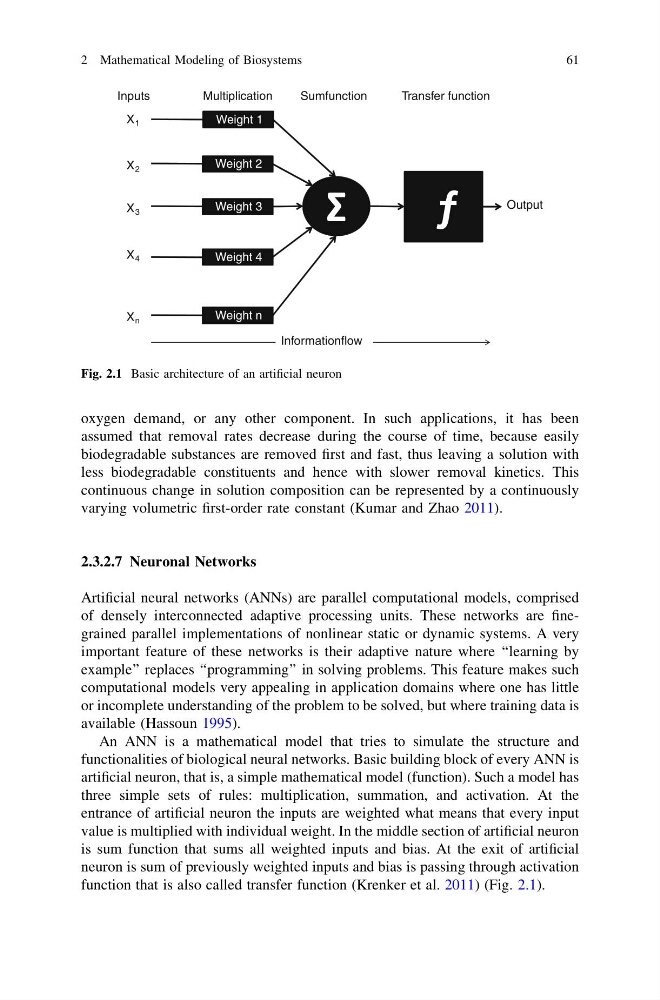
An ANN is a mathematical model that tries to simulate the structure and
functionalities of biological neural networks. Basic building block of every ANN is
artificial neuron, that is, a simple mathematical model (function). Such a model has
three simple sets of rules: multiplication, summation, and activation. At the
entrance of artificial neuron the inputs are weighted what means that every input
value is multiplied with individual weight. In the middle section of artificial neuron
is sum function that sums all weighted inputs and bias. At the exit of artificial
neuron is sum of previously weighted inputs and bias is passing through activation
function that is also called transfer function (Krenker et al. 2011) (Fig. 2.1).
Informationflow
X 1
X 2
X 3
X 4
X n
Weight 1
Weight 2
Weight 3
Weight 4
Weight n
Inputs
Multiplication
Sumfunction
Σ
ƒ
Transfer function
Output
Fig. 2.1 Basic architecture of an artificial neuron
2 Mathematical Modeling of Biosystems
61
assumed that removal rates decrease during the course of time, because easily
biodegradable substances are removed first and fast, thus leaving a solution with
less biodegradable constituents and hence with slower removal kinetics. This
continuous change in solution composition can be represented by a continuously
varying volumetric first-order rate constant (Kumar and Zhao 2011).
2.3.2.7 Neuronal Networks
Artificial neural networks (ANNs) are parallel computational models, comprised
of densely interconnected adaptive processing units. These networks are finegrained parallel implementations of nonlinear static or dynamic systems. A very
important feature of these networks is their adaptive nature where ‘‘learning by
example’’ replaces ‘‘programming’’ in solving problems. This feature makes such
computational models very appealing in application domains where one has little
or incomplete understanding of the problem to be solved, but where training data is
available (Hassoun 1995).
An ANN is a mathematical model that tries to simulate the structure and
functionalities of biological neural networks. Basic building block of every ANN is
artificial neuron, that is, a simple mathematical model (function). Such a model has
three simple sets of rules: multiplication, summation, and activation. At the
entrance of artificial neuron the inputs are weighted what means that every input
value is multiplied with individual weight. In the middle section of artificial neuron
is sum function that sums all weighted inputs and bias. At the exit of artificial
neuron is sum of previously weighted inputs and bias is passing through activation
function that is also called transfer function (Krenker et al. 2011) (Fig. 2.1).
Informationflow
X 1
X 2
X 3
X 4
X n
Weight 1
Weight 2
Weight 3
Weight 4
Weight n
Inputs
Multiplication
Sumfunction
Σ
ƒ
Transfer function
Output
Fig. 2.1 Basic architecture of an artificial neuron
2 Mathematical Modeling of Biosystems
61