

intuition for the physical system. In addition, in this phase, the level of complexity
and degree of approximation are determined (Ljung and Glad 1994).
The basic equations are formulated
We have to formulate quantitative relationships between the inputs and outputs of
the system (Ljung and Glad 1994). We must use knowledge about the mechanics,
physics, chemists, and biological processes occurred in the system.
The relationships between the system variables can be of different kinds:
conservation laws and constitutive relationships. Conservation laws are wellestablished laws like physics, chemises, or mechanics laws can be used. On the
other hand, constitutive relationships might be given by experimental data or can
be simple formulas that describe the general character of the relationship (Ljung
and Glad 1994).
A good way of formulating the basic equation of a subsystem is the following:
1. Write down the conservation laws that are relevant for the subsystem.
2. Use suitable constitutive relationship to express the conservation laws in the
model variables. Calculate the dimensions of the different quantities as a check
(Ljung and Glad 1994).
The state-space model is formed
In this phase, we need to choose which internal variables will be considered state
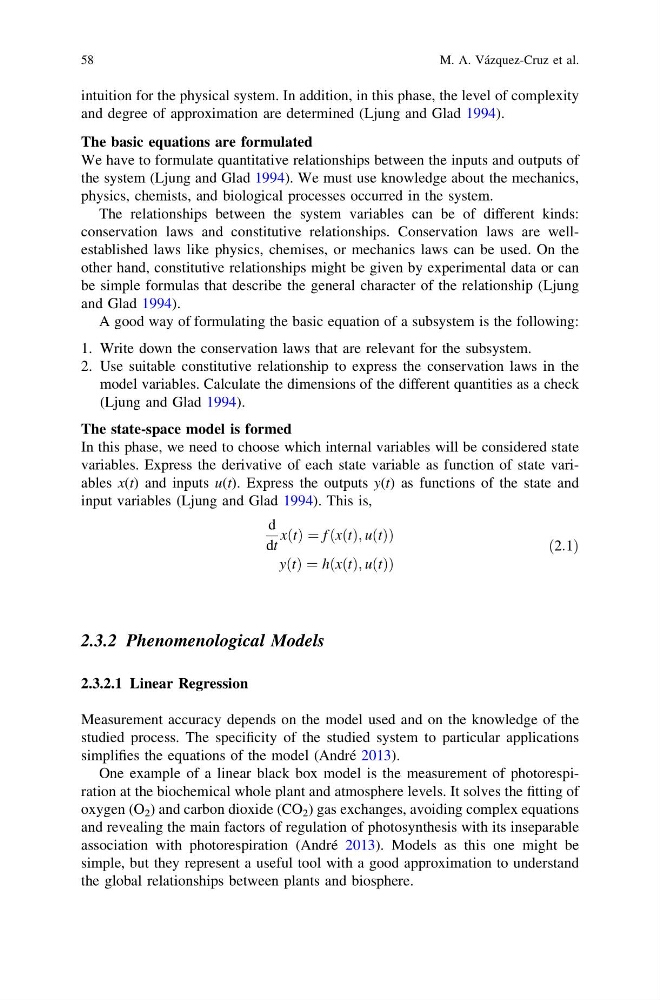
variables. Express the derivative of each state variable as function of state variables x(t) and inputs u(t). Express the outputs y(t) as functions of the state and
input variables (Ljung and Glad 1994). This is,
d
dt
x t
ð Þ ¼ f x t
ð Þ; u t
ð Þ
ð
Þ
y t
ð Þ ¼ h x t
ð Þ; u t
ð Þ
ð
Þ
ð2:1Þ
2.3.2 Phenomenological Models
2.3.2.1 Linear Regression
Measurement accuracy depends on the model used and on the knowledge of the
studied process. The specificity of the studied system to particular applications
simplifies the equations of the model (André 2013).
One example of a linear black box model is the measurement of photorespiration at the biochemical whole plant and atmosphere levels. It solves the fitting of
oxygen (O 2 ) and carbon dioxide (CO 2 ) gas exchanges, avoiding complex equations
and revealing the main factors of regulation of photosynthesis with its inseparable
association with photorespiration (André 2013). Models as this one might be
simple, but they represent a useful tool with a good approximation to understand
the global relationships between plants and biosphere.
58
M. A. Vázquez-Cruz et al.
and degree of approximation are determined (Ljung and Glad 1994).
The basic equations are formulated
We have to formulate quantitative relationships between the inputs and outputs of
the system (Ljung and Glad 1994). We must use knowledge about the mechanics,
physics, chemists, and biological processes occurred in the system.
The relationships between the system variables can be of different kinds:
conservation laws and constitutive relationships. Conservation laws are wellestablished laws like physics, chemises, or mechanics laws can be used. On the
other hand, constitutive relationships might be given by experimental data or can
be simple formulas that describe the general character of the relationship (Ljung
and Glad 1994).
A good way of formulating the basic equation of a subsystem is the following:
1. Write down the conservation laws that are relevant for the subsystem.
2. Use suitable constitutive relationship to express the conservation laws in the
model variables. Calculate the dimensions of the different quantities as a check
(Ljung and Glad 1994).
The state-space model is formed
In this phase, we need to choose which internal variables will be considered state
variables. Express the derivative of each state variable as function of state variables x(t) and inputs u(t). Express the outputs y(t) as functions of the state and
input variables (Ljung and Glad 1994). This is,
d
dt
x t
ð Þ ¼ f x t
ð Þ; u t
ð Þ
ð
Þ
y t
ð Þ ¼ h x t
ð Þ; u t
ð Þ
ð
Þ
ð2:1Þ
2.3.2 Phenomenological Models
2.3.2.1 Linear Regression
Measurement accuracy depends on the model used and on the knowledge of the
studied process. The specificity of the studied system to particular applications
simplifies the equations of the model (André 2013).
One example of a linear black box model is the measurement of photorespiration at the biochemical whole plant and atmosphere levels. It solves the fitting of
oxygen (O 2 ) and carbon dioxide (CO 2 ) gas exchanges, avoiding complex equations
and revealing the main factors of regulation of photosynthesis with its inseparable
association with photorespiration (André 2013). Models as this one might be
simple, but they represent a useful tool with a good approximation to understand
the global relationships between plants and biosphere.
58
M. A. Vázquez-Cruz et al.