

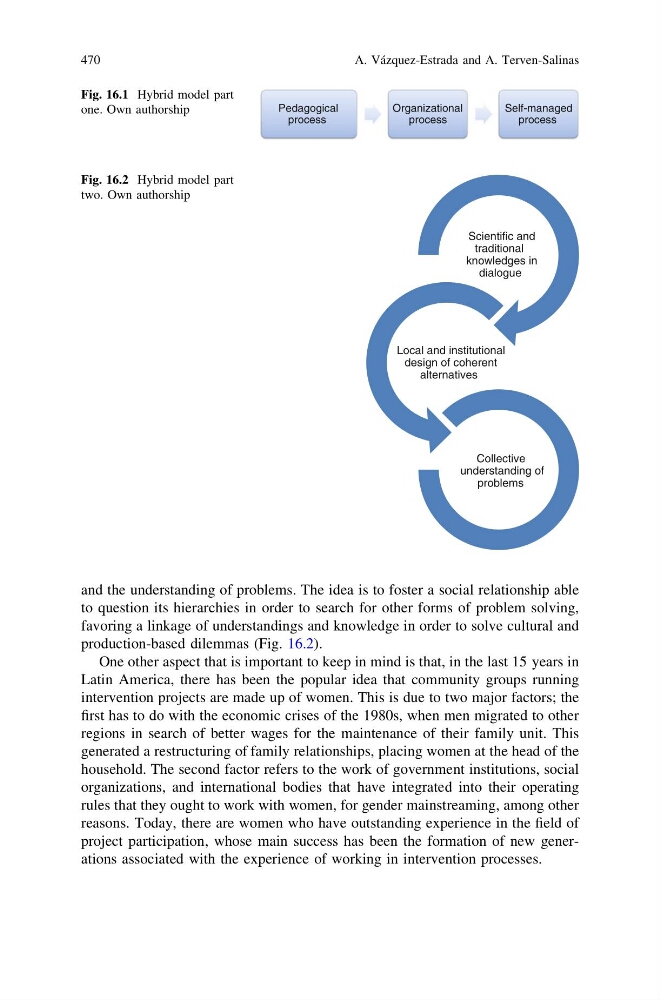
and the understanding of problems. The idea is to foster a social relationship able
to question its hierarchies in order to search for other forms of problem solving,
favoring a linkage of understandings and knowledge in order to solve cultural and
production-based dilemmas (Fig. 16.2).
One other aspect that is important to keep in mind is that, in the last 15 years in
Latin America, there has been the popular idea that community groups running
intervention projects are made up of women. This is due to two major factors; the
first has to do with the economic crises of the 1980s, when men migrated to other
regions in search of better wages for the maintenance of their family unit. This
generated a restructuring of family relationships, placing women at the head of the
household. The second factor refers to the work of government institutions, social
organizations, and international bodies that have integrated into their operating
rules that they ought to work with women, for gender mainstreaming, among other
reasons. Today, there are women who have outstanding experience in the field of
project participation, whose main success has been the formation of new generations associated with the experience of working in intervention processes.
Pedagogical
process
Organizational
process
Self-managed
process
Fig. 16.1 Hybrid model part
one. Own authorship
Scientific and
traditional
knowledges in
dialogue
Local and institutional
design of coherent
alternatives
Collective
understanding of
problems
Fig. 16.2 Hybrid model part
two. Own authorship
470
A. Vázquez-Estrada and A. Terven-Salinas
to question its hierarchies in order to search for other forms of problem solving,
favoring a linkage of understandings and knowledge in order to solve cultural and
production-based dilemmas (Fig. 16.2).
One other aspect that is important to keep in mind is that, in the last 15 years in
Latin America, there has been the popular idea that community groups running
intervention projects are made up of women. This is due to two major factors; the
first has to do with the economic crises of the 1980s, when men migrated to other
regions in search of better wages for the maintenance of their family unit. This
generated a restructuring of family relationships, placing women at the head of the
household. The second factor refers to the work of government institutions, social
organizations, and international bodies that have integrated into their operating
rules that they ought to work with women, for gender mainstreaming, among other
reasons. Today, there are women who have outstanding experience in the field of
project participation, whose main success has been the formation of new generations associated with the experience of working in intervention processes.
Pedagogical
process
Organizational
process
Self-managed
process
Fig. 16.1 Hybrid model part
one. Own authorship
Scientific and
traditional
knowledges in
dialogue
Local and institutional
design of coherent
alternatives
Collective
understanding of
problems
Fig. 16.2 Hybrid model part
two. Own authorship
470
A. Vázquez-Estrada and A. Terven-Salinas