

that they represent an alternative to genetically modified (GM) plants. Some
disadvantages may include a decrease in photosynthesis, reduced plant growth,
and the cost of the products (Holopainen et al. 2009). Nevertheless, it is considered
more knowledge of the mode of action of this compound could minimize these
disadvantages.
To be sustainable, an activity must be viable from both economic and environmental points of view. Thus, the use of elicitors could become a viable strategy for
the development of sustainable agriculture because when they are applied to crops, a
reduction in the use of agrochemicals can be achieved (Mejía-Teniente et al. 2010).
In addition, when they are applied at the right concentrations, the yields can be
maintained or even improved. Here, it is not intended to go deep into the mechanisms
of action of elicitors, but to present them as an alternative for sustainable agriculture.
Information related to elicitor signal transduction is given by Mejía-Teniente et al.
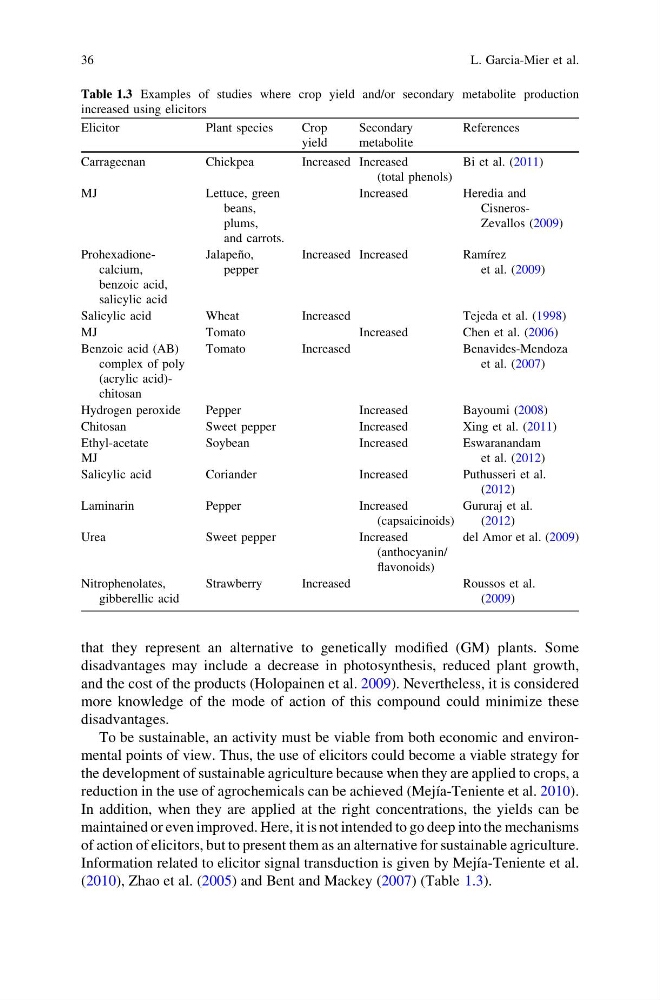
(2010), Zhao et al. (2005) and Bent and Mackey (2007) (Table 1.3).
Table 1.3 Examples of studies where crop yield and/or secondary metabolite production
increased using elicitors
Elicitor
Plant species
Crop
yield
Secondary
metabolite
References
Carrageenan
Chickpea
Increased Increased
(total phenols)
Bi et al. (2011)
MJ
Lettuce, green
beans,
plums,
and carrots.
Increased
Heredia and
CisnerosZevallos (2009)
Prohexadionecalcium,
benzoic acid,
salicylic acid
Jalapeño,
pepper
Increased Increased
Ramírez
et al. (2009)
Salicylic acid
Wheat
Increased
Tejeda et al. (1998)
MJ
Tomato
Increased
Chen et al. (2006)
Benzoic acid (AB)
complex of poly
(acrylic acid)chitosan
Tomato
Increased
Benavides-Mendoza
et al. (2007)
Hydrogen peroxide
Pepper
Increased
Bayoumi (2008)
Chitosan
Sweet pepper
Increased
Xing et al. (2011)
Ethyl-acetate
MJ
Soybean
Increased
Eswaranandam
et al. (2012)
Salicylic acid
Coriander
Increased
Puthusseri et al.
(2012)
Laminarin
Pepper
Increased
(capsaicinoids)
Gururaj et al.
(2012)
Urea
Sweet pepper
Increased
(anthocyanin/
flavonoids)
del Amor et al. (2009)
Nitrophenolates,
gibberellic acid
Strawberry
Increased
Roussos et al.
(2009)
36
L. Garcia-Mier et al.
disadvantages may include a decrease in photosynthesis, reduced plant growth,
and the cost of the products (Holopainen et al. 2009). Nevertheless, it is considered
more knowledge of the mode of action of this compound could minimize these
disadvantages.
To be sustainable, an activity must be viable from both economic and environmental points of view. Thus, the use of elicitors could become a viable strategy for
the development of sustainable agriculture because when they are applied to crops, a
reduction in the use of agrochemicals can be achieved (Mejía-Teniente et al. 2010).
In addition, when they are applied at the right concentrations, the yields can be
maintained or even improved. Here, it is not intended to go deep into the mechanisms
of action of elicitors, but to present them as an alternative for sustainable agriculture.
Information related to elicitor signal transduction is given by Mejía-Teniente et al.
(2010), Zhao et al. (2005) and Bent and Mackey (2007) (Table 1.3).
Table 1.3 Examples of studies where crop yield and/or secondary metabolite production
increased using elicitors
Elicitor
Plant species
Crop
yield
Secondary
metabolite
References
Carrageenan
Chickpea
Increased Increased
(total phenols)
Bi et al. (2011)
MJ
Lettuce, green
beans,
plums,
and carrots.
Increased
Heredia and
CisnerosZevallos (2009)
Prohexadionecalcium,
benzoic acid,
salicylic acid
Jalapeño,
pepper
Increased Increased
Ramírez
et al. (2009)
Salicylic acid
Wheat
Increased
Tejeda et al. (1998)
MJ
Tomato
Increased
Chen et al. (2006)
Benzoic acid (AB)
complex of poly
(acrylic acid)chitosan
Tomato
Increased
Benavides-Mendoza
et al. (2007)
Hydrogen peroxide
Pepper
Increased
Bayoumi (2008)
Chitosan
Sweet pepper
Increased
Xing et al. (2011)
Ethyl-acetate
MJ
Soybean
Increased
Eswaranandam
et al. (2012)
Salicylic acid
Coriander
Increased
Puthusseri et al.
(2012)
Laminarin
Pepper
Increased
(capsaicinoids)
Gururaj et al.
(2012)
Urea
Sweet pepper
Increased
(anthocyanin/
flavonoids)
del Amor et al. (2009)
Nitrophenolates,
gibberellic acid
Strawberry
Increased
Roussos et al.
(2009)
36
L. Garcia-Mier et al.