

The TFs represent a new group of strategies that allow to overcome the
bottleneck in a multienzymatic reaction, controlling series of genes in specific
tissues, organs, or plants (Grotewold 2008). Until recent years the knowledge
about TFs was limited, because it was just possible to identify those that have a
Table 15.1 Transcription factors used for nutrient manipulation in plants
Transcription factor
Metabolite
Plant
Reference
R and Cl
Antocyanins
Z. mays
Grotewold et al. (1998)
ORCA2
Alcaloids
Catharanthus roseus
Menke et al. (1999)
TT2 and TT8
Condensed tanins A. thaliana
Nesi et al. (2000, 2001)
Rosea 1, Rosea 2
and Venosa
Anthocyanins
(magenta)
Antirrhinum majus
Schwinn et al. (2006)
OR
Carotenoids
Brassica oleracea
Lu et al. (2006)
MYB75/PAP1
Anthocyanins
Solanum lycopersicum Zuluaga et al. (2007)
DELILA (Del)
and ROSEA (Ros1)
Anthocyanins
Solanum lycopersicum Butelli et al. (2008)
Purple (Pr)
Anthocianins
Brassica oleracea
Chiu et al. (2010)
PcMYBlO
Anthocyanins
Pyrus communis
Pierantoni et al. (2010)
MYB12
Flavonoids
Solanum lycopersicum Ballester et al. (2010)
DELILA (Del)
and ROSEAL (Ros1)
Anthocyanins
Brassica napus
Nie et al. (2013)
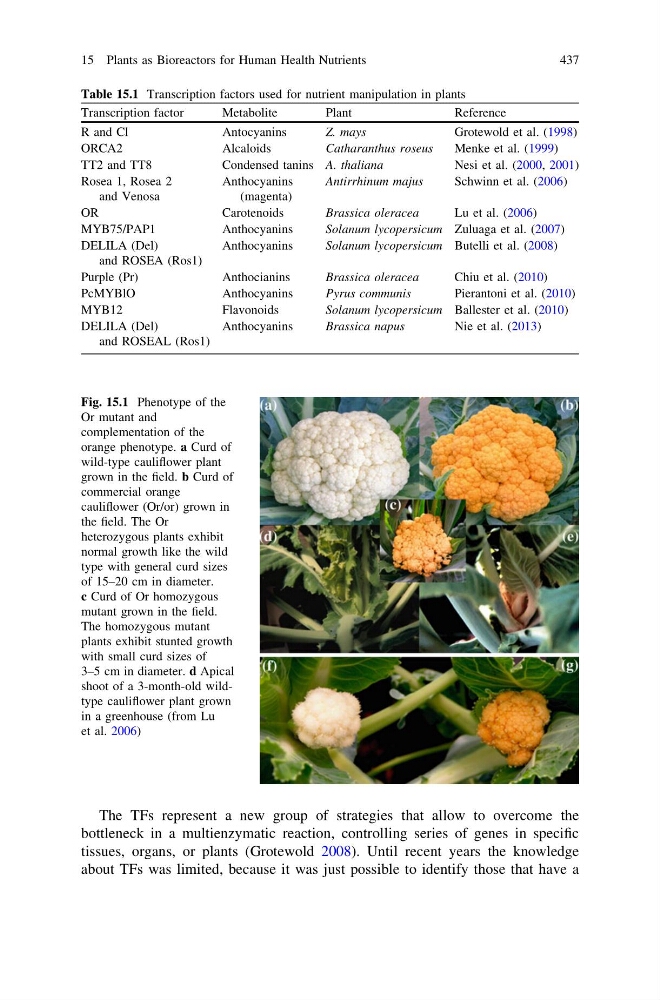
Fig. 15.1 Phenotype of the
Or mutant and
complementation of the
orange phenotype. a Curd of
wild-type cauliflower plant
grown in the field. b Curd of
commercial orange
cauliflower (Or/or) grown in
the field. The Or
heterozygous plants exhibit
normal growth like the wild
type with general curd sizes
of 15–20 cm in diameter.
c Curd of Or homozygous
mutant grown in the field.
The homozygous mutant
plants exhibit stunted growth
with small curd sizes of
3–5 cm in diameter. d Apical
shoot of a 3-month-old wildtype cauliflower plant grown
in a greenhouse (from Lu
et al. 2006)
15 Plants as Bioreactors for Human Health Nutrients
437
bottleneck in a multienzymatic reaction, controlling series of genes in specific
tissues, organs, or plants (Grotewold 2008). Until recent years the knowledge
about TFs was limited, because it was just possible to identify those that have a
Table 15.1 Transcription factors used for nutrient manipulation in plants
Transcription factor
Metabolite
Plant
Reference
R and Cl
Antocyanins
Z. mays
Grotewold et al. (1998)
ORCA2
Alcaloids
Catharanthus roseus
Menke et al. (1999)
TT2 and TT8
Condensed tanins A. thaliana
Nesi et al. (2000, 2001)
Rosea 1, Rosea 2
and Venosa
Anthocyanins
(magenta)
Antirrhinum majus
Schwinn et al. (2006)
OR
Carotenoids
Brassica oleracea
Lu et al. (2006)
MYB75/PAP1
Anthocyanins
Solanum lycopersicum Zuluaga et al. (2007)
DELILA (Del)
and ROSEA (Ros1)
Anthocyanins
Solanum lycopersicum Butelli et al. (2008)
Purple (Pr)
Anthocianins
Brassica oleracea
Chiu et al. (2010)
PcMYBlO
Anthocyanins
Pyrus communis
Pierantoni et al. (2010)
MYB12
Flavonoids
Solanum lycopersicum Ballester et al. (2010)
DELILA (Del)
and ROSEAL (Ros1)
Anthocyanins
Brassica napus
Nie et al. (2013)
Fig. 15.1 Phenotype of the
Or mutant and
complementation of the
orange phenotype. a Curd of
wild-type cauliflower plant
grown in the field. b Curd of
commercial orange
cauliflower (Or/or) grown in
the field. The Or
heterozygous plants exhibit
normal growth like the wild
type with general curd sizes
of 15–20 cm in diameter.
c Curd of Or homozygous
mutant grown in the field.
The homozygous mutant
plants exhibit stunted growth
with small curd sizes of
3–5 cm in diameter. d Apical
shoot of a 3-month-old wildtype cauliflower plant grown
in a greenhouse (from Lu
et al. 2006)
15 Plants as Bioreactors for Human Health Nutrients
437