

control error. This optimization method was designed as a tool for real-time
applications for both linear and nonlinear systems. A feedback–feedforward
approach to system linearization and decoupling for climate control of greenhouses has been tested for ventilation/cooling and humidity proposed (Pasgianos
et al. 2003). The method has three components. First, a model-based feedback–
feedforward compensation for system disturbances based on an input–output linearization and decoupling. Second, the transformation of user-defined desired
settings for temperature and humidity into feasible controller specifications, taking
into consideration system’s constraints. Third, PI control loops to compensate for
model uncertainties and deviations from the disturbances predictions.
14.2.8 Multiobjective Optimization
Recently, the approach of multiobjective optimization (Miettinen 1998) has been
applied to the optimization and control of the greenhouse environment. A generic
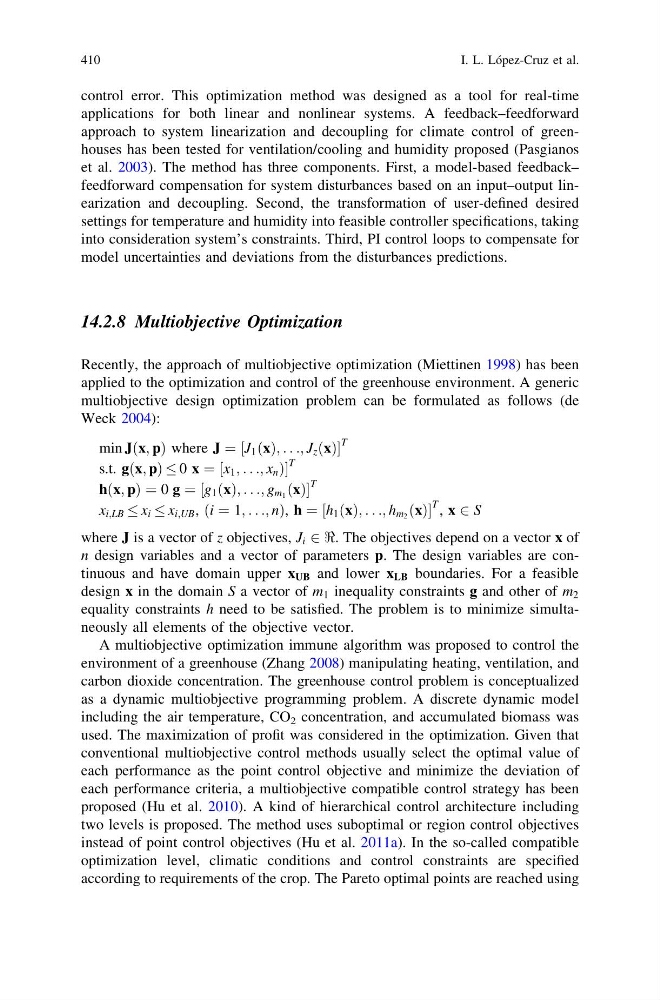
multiobjective design optimization problem can be formulated as follows (de
Weck 2004):
min Jðx; pÞ where J ¼ J 1 ðxÞ; . . .; J z ðxÞ
½
T
s.t. gðx; pÞ 0 x ¼ x 1 ; . . .; x n Þ
½
T
hðx; pÞ ¼ 0 g ¼ g 1 ðxÞ; . . .; g m 1 ðxÞ
½
T
x i;LB x i x i;UB , ði ¼ 1; . . .; nÞ, h ¼ h 1 ðxÞ; . . .; h m 2 ðxÞ
½
T , x 2 S
where J is a vector of z objectives, J i 2 <. The objectives depend on a vector x of
n design variables and a vector of parameters p. The design variables are continuous and have domain upper x UB and lower x LB boundaries. For a feasible
design x in the domain S a vector of m 1 inequality constraints g and other of m 2
equality constraints h need to be satisfied. The problem is to minimize simultaneously all elements of the objective vector.
A multiobjective optimization immune algorithm was proposed to control the
environment of a greenhouse (Zhang 2008) manipulating heating, ventilation, and
carbon dioxide concentration. The greenhouse control problem is conceptualized
as a dynamic multiobjective programming problem. A discrete dynamic model
including the air temperature, CO 2 concentration, and accumulated biomass was
used. The maximization of profit was considered in the optimization. Given that
conventional multiobjective control methods usually select the optimal value of
each performance as the point control objective and minimize the deviation of
each performance criteria, a multiobjective compatible control strategy has been
proposed (Hu et al. 2010). A kind of hierarchical control architecture including
two levels is proposed. The method uses suboptimal or region control objectives
instead of point control objectives (Hu et al. 2011a). In the so-called compatible
optimization level, climatic conditions and control constraints are specified
according to requirements of the crop. The Pareto optimal points are reached using
410
I. L. López-Cruz et al.
applications for both linear and nonlinear systems. A feedback–feedforward
approach to system linearization and decoupling for climate control of greenhouses has been tested for ventilation/cooling and humidity proposed (Pasgianos
et al. 2003). The method has three components. First, a model-based feedback–
feedforward compensation for system disturbances based on an input–output linearization and decoupling. Second, the transformation of user-defined desired
settings for temperature and humidity into feasible controller specifications, taking
into consideration system’s constraints. Third, PI control loops to compensate for
model uncertainties and deviations from the disturbances predictions.
14.2.8 Multiobjective Optimization
Recently, the approach of multiobjective optimization (Miettinen 1998) has been
applied to the optimization and control of the greenhouse environment. A generic
multiobjective design optimization problem can be formulated as follows (de
Weck 2004):
min Jðx; pÞ where J ¼ J 1 ðxÞ; . . .; J z ðxÞ
½
T
s.t. gðx; pÞ 0 x ¼ x 1 ; . . .; x n Þ
½
T
hðx; pÞ ¼ 0 g ¼ g 1 ðxÞ; . . .; g m 1 ðxÞ
½
T
x i;LB x i x i;UB , ði ¼ 1; . . .; nÞ, h ¼ h 1 ðxÞ; . . .; h m 2 ðxÞ
½
T , x 2 S
where J is a vector of z objectives, J i 2 <. The objectives depend on a vector x of
n design variables and a vector of parameters p. The design variables are continuous and have domain upper x UB and lower x LB boundaries. For a feasible
design x in the domain S a vector of m 1 inequality constraints g and other of m 2
equality constraints h need to be satisfied. The problem is to minimize simultaneously all elements of the objective vector.
A multiobjective optimization immune algorithm was proposed to control the
environment of a greenhouse (Zhang 2008) manipulating heating, ventilation, and
carbon dioxide concentration. The greenhouse control problem is conceptualized
as a dynamic multiobjective programming problem. A discrete dynamic model
including the air temperature, CO 2 concentration, and accumulated biomass was
used. The maximization of profit was considered in the optimization. Given that
conventional multiobjective control methods usually select the optimal value of
each performance as the point control objective and minimize the deviation of
each performance criteria, a multiobjective compatible control strategy has been
proposed (Hu et al. 2010). A kind of hierarchical control architecture including
two levels is proposed. The method uses suboptimal or region control objectives
instead of point control objectives (Hu et al. 2011a). In the so-called compatible
optimization level, climatic conditions and control constraints are specified
according to requirements of the crop. The Pareto optimal points are reached using
410
I. L. López-Cruz et al.