

operation consists in designing a mechanical arrangement which be capable of
being attached to a trunk or a fruit and linked to the variable displacement section
of the strain gauge. By this way, plant mechanical variations are converted to
electrical resistance variations and consequently to a voltage signal often through a
Wheatstone bridge circuit which is connected to a data logger (Morandi et al.
2007). On the other hand, LVDT sensors are more utilized to build point dendrometers which are a variable displacement bar connected to a transformer
nucleus. The LVDT variable displacement bar is installed on the side of the plant
trunk. Hence, any variations produced by the plant trunk diameter are sensed by
LVDT nucleus (Korpela et al. 2010). Also there are some less common technologies to build stem diameter and other morphological sensors such as optical fibers
to build point dendrometers for tree growth monitoring (Uchida et al. 2010).
The design of morphological sensors varies and depends on plant characteristics
such as size, shape, or location. For example, there are fruit growth sensors which
are designed to measure microvariations on apples, tomato, or other fruits size.
Also, there are stem diameter sensors for different types of plants stems or trunks
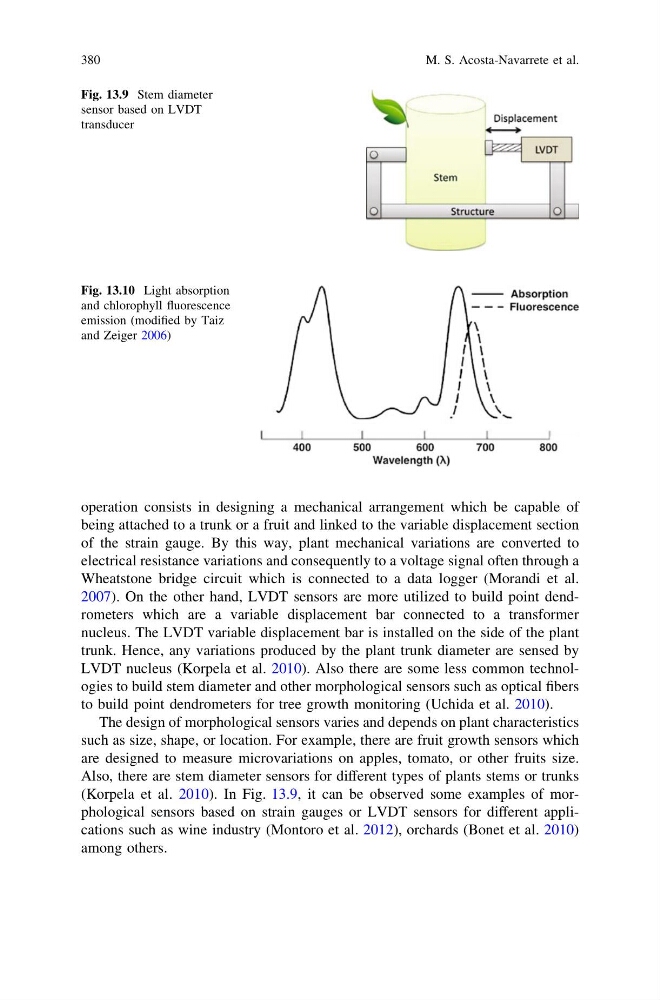
(Korpela et al. 2010). In Fig. 13.9, it can be observed some examples of morphological sensors based on strain gauges or LVDT sensors for different applications such as wine industry (Montoro et al. 2012), orchards (Bonet et al. 2010)
among others.
Fig. 13.9 Stem diameter
sensor based on LVDT
transducer
Fig. 13.10 Light absorption
and chlorophyll fluorescence
emission (modified by Taiz
and Zeiger 2006)
380
M. S. Acosta-Navarrete et al.
being attached to a trunk or a fruit and linked to the variable displacement section
of the strain gauge. By this way, plant mechanical variations are converted to
electrical resistance variations and consequently to a voltage signal often through a
Wheatstone bridge circuit which is connected to a data logger (Morandi et al.
2007). On the other hand, LVDT sensors are more utilized to build point dendrometers which are a variable displacement bar connected to a transformer
nucleus. The LVDT variable displacement bar is installed on the side of the plant
trunk. Hence, any variations produced by the plant trunk diameter are sensed by
LVDT nucleus (Korpela et al. 2010). Also there are some less common technologies to build stem diameter and other morphological sensors such as optical fibers
to build point dendrometers for tree growth monitoring (Uchida et al. 2010).
The design of morphological sensors varies and depends on plant characteristics
such as size, shape, or location. For example, there are fruit growth sensors which
are designed to measure microvariations on apples, tomato, or other fruits size.
Also, there are stem diameter sensors for different types of plants stems or trunks
(Korpela et al. 2010). In Fig. 13.9, it can be observed some examples of morphological sensors based on strain gauges or LVDT sensors for different applications such as wine industry (Montoro et al. 2012), orchards (Bonet et al. 2010)
among others.
Fig. 13.9 Stem diameter
sensor based on LVDT
transducer
Fig. 13.10 Light absorption
and chlorophyll fluorescence
emission (modified by Taiz
and Zeiger 2006)
380
M. S. Acosta-Navarrete et al.