

(stable) and a fluctuating component. Most turbulence models, standard k-e Model,
Re-Normalized Group Turbulence Model (RNG), to name a few, increase the
turbulence model flow viscosity (Rico-García 2008).
The postprocessing stage allows the user to visualize and search for the solution. Figure contours, vectors, and graphs can be obtained by analyzing the
solution. It is remarkable that figures allow us to observe the full distribution of
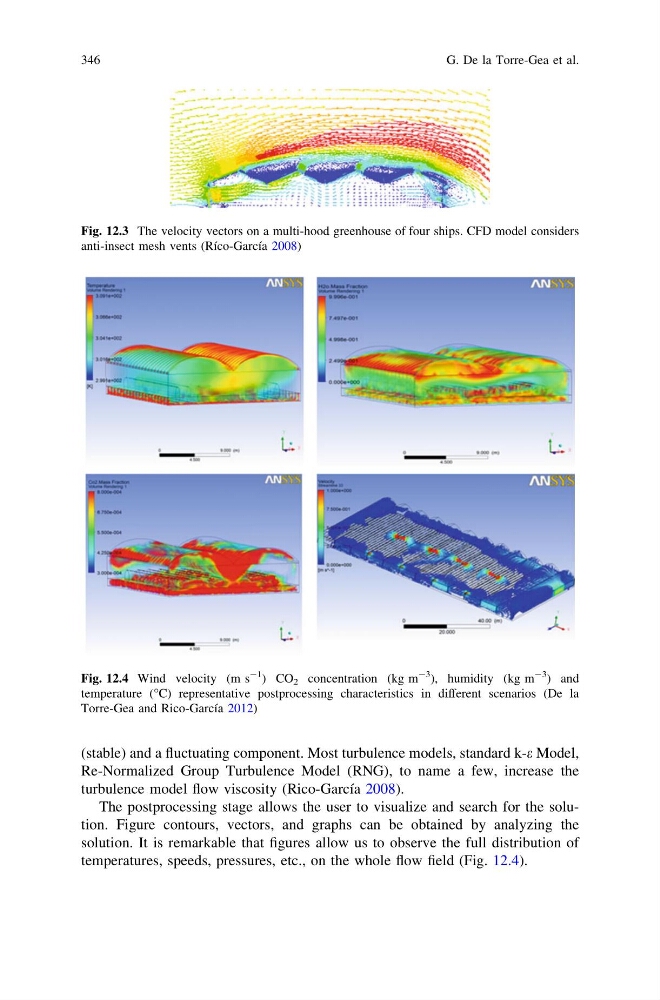
temperatures, speeds, pressures, etc., on the whole flow field (Fig. 12.4).
Fig. 12.3 The velocity vectors on a multi-hood greenhouse of four ships. CFD model considers
anti-insect mesh vents (Ríco-García 2008)
Fig. 12.4 Wind velocity (m s
-1
) CO 2 concentration (kg m
-3
), humidity (kg m
-3
) and
temperature (°C) representative postprocessing characteristics in different scenarios (De la
Torre-Gea and Rico-García 2012)
346
G. De la Torre-Gea et al.
Re-Normalized Group Turbulence Model (RNG), to name a few, increase the
turbulence model flow viscosity (Rico-García 2008).
The postprocessing stage allows the user to visualize and search for the solution. Figure contours, vectors, and graphs can be obtained by analyzing the
solution. It is remarkable that figures allow us to observe the full distribution of
temperatures, speeds, pressures, etc., on the whole flow field (Fig. 12.4).
Fig. 12.3 The velocity vectors on a multi-hood greenhouse of four ships. CFD model considers
anti-insect mesh vents (Ríco-García 2008)
Fig. 12.4 Wind velocity (m s
-1
) CO 2 concentration (kg m
-3
), humidity (kg m
-3
) and
temperature (°C) representative postprocessing characteristics in different scenarios (De la
Torre-Gea and Rico-García 2012)
346
G. De la Torre-Gea et al.