

transportation within the endoplasmic reticulum, and protein excretion at the hyphal
tips (Geysens et al. 2009). This makes it necessary to consider multiple mutations for
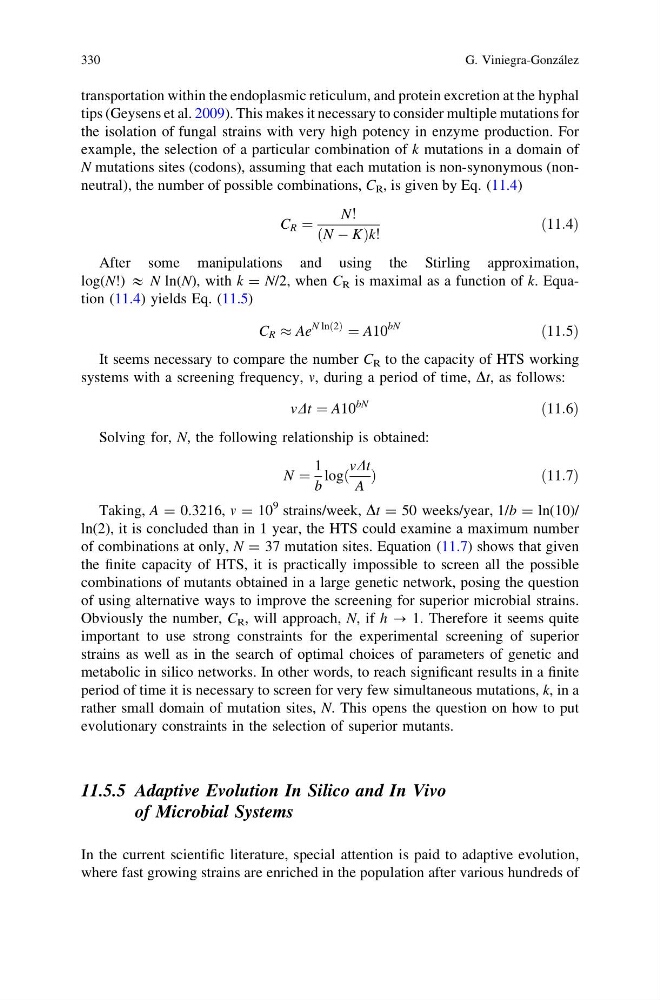
the isolation of fungal strains with very high potency in enzyme production. For
example, the selection of a particular combination of k mutations in a domain of
N mutations sites (codons), assuming that each mutation is non-synonymous (nonneutral), the number of possible combinations, C R , is given by Eq. (11.4)
C R ¼
N!
ðN À KÞk!
ð11:4Þ
After some manipulations and using the Stirling approximation,
log(N!) & N ln(N), with k = N/2, when C R is maximal as a function of k. Equation (11.4) yields Eq. (11.5)
C R % Ae
N lnð2Þ ¼ A10
bN
ð11:5Þ
It seems necessary to compare the number C R to the capacity of HTS working
systems with a screening frequency, m, during a period of time, Dt, as follows:
vDt ¼ A10
bN
ð11:6Þ
Solving for, N, the following relationship is obtained:
N ¼
1
b
logð
vDt
A
Þ
ð 11:7Þ
Taking, A = 0.3216, m = 10
9 strains/week, Dt = 50 weeks/year, 1/b = ln(10)/
ln(2), it is concluded than in 1 year, the HTS could examine a maximum number
of combinations at only, N = 37 mutation sites. Equation (11.7) shows that given
the finite capacity of HTS, it is practically impossible to screen all the possible
combinations of mutants obtained in a large genetic network, posing the question
of using alternative ways to improve the screening for superior microbial strains.
Obviously the number, C R , will approach, N, if h ? 1. Therefore it seems quite
important to use strong constraints for the experimental screening of superior
strains as well as in the search of optimal choices of parameters of genetic and
metabolic in silico networks. In other words, to reach significant results in a finite
period of time it is necessary to screen for very few simultaneous mutations, k, in a
rather small domain of mutation sites, N. This opens the question on how to put
evolutionary constraints in the selection of superior mutants.
11.5.5 Adaptive Evolution In Silico and In Vivo
of Microbial Systems
In the current scientific literature, special attention is paid to adaptive evolution,
where fast growing strains are enriched in the population after various hundreds of
330
G. Viniegra-González
tips (Geysens et al. 2009). This makes it necessary to consider multiple mutations for
the isolation of fungal strains with very high potency in enzyme production. For
example, the selection of a particular combination of k mutations in a domain of
N mutations sites (codons), assuming that each mutation is non-synonymous (nonneutral), the number of possible combinations, C R , is given by Eq. (11.4)
C R ¼
N!
ðN À KÞk!
ð11:4Þ
After some manipulations and using the Stirling approximation,
log(N!) & N ln(N), with k = N/2, when C R is maximal as a function of k. Equation (11.4) yields Eq. (11.5)
C R % Ae
N lnð2Þ ¼ A10
bN
ð11:5Þ
It seems necessary to compare the number C R to the capacity of HTS working
systems with a screening frequency, m, during a period of time, Dt, as follows:
vDt ¼ A10
bN
ð11:6Þ
Solving for, N, the following relationship is obtained:
N ¼
1
b
logð
vDt
A
Þ
ð 11:7Þ
Taking, A = 0.3216, m = 10
9 strains/week, Dt = 50 weeks/year, 1/b = ln(10)/
ln(2), it is concluded than in 1 year, the HTS could examine a maximum number
of combinations at only, N = 37 mutation sites. Equation (11.7) shows that given
the finite capacity of HTS, it is practically impossible to screen all the possible
combinations of mutants obtained in a large genetic network, posing the question
of using alternative ways to improve the screening for superior microbial strains.
Obviously the number, C R , will approach, N, if h ? 1. Therefore it seems quite
important to use strong constraints for the experimental screening of superior
strains as well as in the search of optimal choices of parameters of genetic and
metabolic in silico networks. In other words, to reach significant results in a finite
period of time it is necessary to screen for very few simultaneous mutations, k, in a
rather small domain of mutation sites, N. This opens the question on how to put
evolutionary constraints in the selection of superior mutants.
11.5.5 Adaptive Evolution In Silico and In Vivo
of Microbial Systems
In the current scientific literature, special attention is paid to adaptive evolution,
where fast growing strains are enriched in the population after various hundreds of
330
G. Viniegra-González