

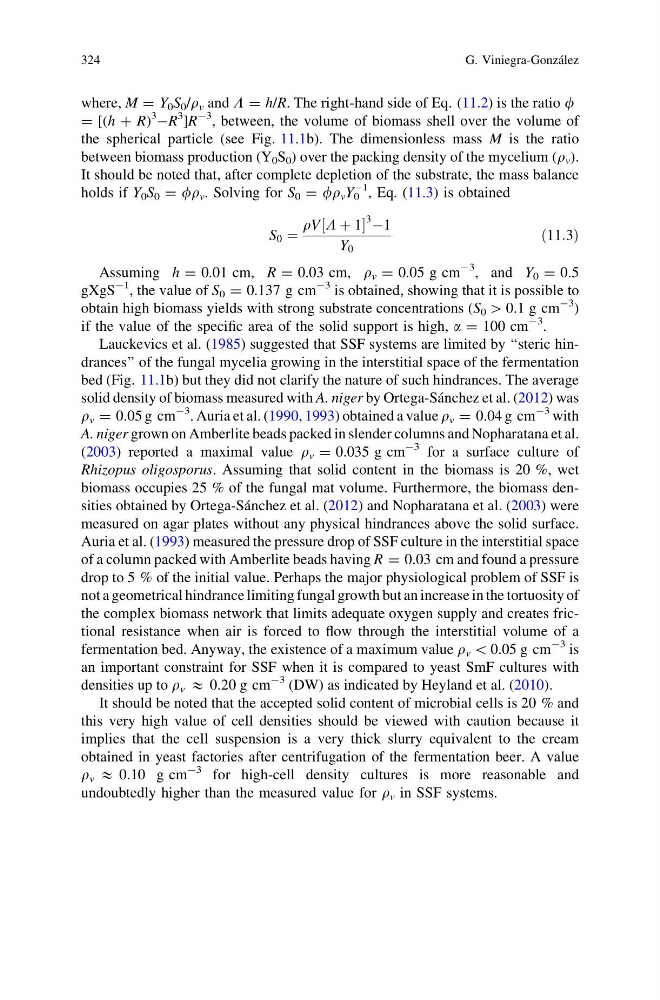
where, M = Y 0 S 0 /q v and K = h/R. The right-hand side of Eq. (11.2) is the ratio /
= [(h ? R)
3 -R
3 ]R
-3 , between, the volume of biomass shell over the volume of
the spherical particle (see Fig. 11.1b). The dimensionless mass M is the ratio
between biomass production (Y 0 S 0 ) over the packing density of the mycelium (q v ).
It should be noted that, after complete depletion of the substrate, the mass balance
holds if Y 0 S 0 = /q v . Solving for S 0 = /q v Y 0
-1 , Eq. (11.3) is obtained
S 0 ¼
qV K þ 1
½
3 À1
Y 0
ð11:3Þ
Assuming h = 0.01 cm, R = 0.03 cm, q v = 0.05 g cm
-3 , and Y 0 = 0.5
gXgS
-1 , the value of S 0 = 0.137 g cm
-3 is obtained, showing that it is possible to
obtain high biomass yields with strong substrate concentrations (S 0 [ 0.1 g cm
-3 )
if the value of the specific area of the solid support is high, a = 100 cm
-3
.
Lauckevics et al. (1985) suggested that SSF systems are limited by ‘‘steric hindrances’’ of the fungal mycelia growing in the interstitial space of the fermentation
bed (Fig. 11.1b) but they did not clarify the nature of such hindrances. The average
solid density of biomass measured with A. niger by Ortega-Sánchez et al. (2012) was
q v = 0.05 g cm
-3 . Auria et al. (1990, 1993) obtained a value q v = 0.04 g cm
-3 with
A. niger grown on Amberlite beads packed in slender columns and Nopharatana et al.
(2003) reported a maximal value q v = 0.035 g cm
-3 for a surface culture of
Rhizopus oligosporus. Assuming that solid content in the biomass is 20 %, wet
biomass occupies 25 % of the fungal mat volume. Furthermore, the biomass densities obtained by Ortega-Sánchez et al. (2012) and Nopharatana et al. (2003) were
measured on agar plates without any physical hindrances above the solid surface.
Auria et al. (1993) measured the pressure drop of SSF culture in the interstitial space
of a column packed with Amberlite beads having R = 0.03 cm and found a pressure
drop to 5 % of the initial value. Perhaps the major physiological problem of SSF is
not a geometrical hindrance limiting fungal growth but an increase in the tortuosity of
the complex biomass network that limits adequate oxygen supply and creates frictional resistance when air is forced to flow through the interstitial volume of a
fermentation bed. Anyway, the existence of a maximum value q v \ 0.05 g cm
-3 is
an important constraint for SSF when it is compared to yeast SmF cultures with
densities up to q v & 0.20 g cm
-3 (DW) as indicated by Heyland et al. (2010).
It should be noted that the accepted solid content of microbial cells is 20 % and
this very high value of cell densities should be viewed with caution because it
implies that the cell suspension is a very thick slurry equivalent to the cream
obtained in yeast factories after centrifugation of the fermentation beer. A value
q v & 0.10 g cm
-3 for high-cell density cultures is more reasonable and
undoubtedly higher than the measured value for q v in SSF systems.
324
G. Viniegra-González
= [(h ? R)
3 -R
3 ]R
-3 , between, the volume of biomass shell over the volume of
the spherical particle (see Fig. 11.1b). The dimensionless mass M is the ratio
between biomass production (Y 0 S 0 ) over the packing density of the mycelium (q v ).
It should be noted that, after complete depletion of the substrate, the mass balance
holds if Y 0 S 0 = /q v . Solving for S 0 = /q v Y 0
-1 , Eq. (11.3) is obtained
S 0 ¼
qV K þ 1
½
3 À1
Y 0
ð11:3Þ
Assuming h = 0.01 cm, R = 0.03 cm, q v = 0.05 g cm
-3 , and Y 0 = 0.5
gXgS
-1 , the value of S 0 = 0.137 g cm
-3 is obtained, showing that it is possible to
obtain high biomass yields with strong substrate concentrations (S 0 [ 0.1 g cm
-3 )
if the value of the specific area of the solid support is high, a = 100 cm
-3
.
Lauckevics et al. (1985) suggested that SSF systems are limited by ‘‘steric hindrances’’ of the fungal mycelia growing in the interstitial space of the fermentation
bed (Fig. 11.1b) but they did not clarify the nature of such hindrances. The average
solid density of biomass measured with A. niger by Ortega-Sánchez et al. (2012) was
q v = 0.05 g cm
-3 . Auria et al. (1990, 1993) obtained a value q v = 0.04 g cm
-3 with
A. niger grown on Amberlite beads packed in slender columns and Nopharatana et al.
(2003) reported a maximal value q v = 0.035 g cm
-3 for a surface culture of
Rhizopus oligosporus. Assuming that solid content in the biomass is 20 %, wet
biomass occupies 25 % of the fungal mat volume. Furthermore, the biomass densities obtained by Ortega-Sánchez et al. (2012) and Nopharatana et al. (2003) were
measured on agar plates without any physical hindrances above the solid surface.
Auria et al. (1993) measured the pressure drop of SSF culture in the interstitial space
of a column packed with Amberlite beads having R = 0.03 cm and found a pressure
drop to 5 % of the initial value. Perhaps the major physiological problem of SSF is
not a geometrical hindrance limiting fungal growth but an increase in the tortuosity of
the complex biomass network that limits adequate oxygen supply and creates frictional resistance when air is forced to flow through the interstitial volume of a
fermentation bed. Anyway, the existence of a maximum value q v \ 0.05 g cm
-3 is
an important constraint for SSF when it is compared to yeast SmF cultures with
densities up to q v & 0.20 g cm
-3 (DW) as indicated by Heyland et al. (2010).
It should be noted that the accepted solid content of microbial cells is 20 % and
this very high value of cell densities should be viewed with caution because it
implies that the cell suspension is a very thick slurry equivalent to the cream
obtained in yeast factories after centrifugation of the fermentation beer. A value
q v & 0.10 g cm
-3 for high-cell density cultures is more reasonable and
undoubtedly higher than the measured value for q v in SSF systems.
324
G. Viniegra-González