

gene expression that control both physiological and pathological processes such as
development and cancer (Milenkovic et al. 2013).
Other dietary components that regulate cancer cell proliferation and survival
include dietary fiber (Campos-Vega et al. 2013). The transcriptional effects of the
non-digestible fraction (NDF) from common bean cv. Bayo Madero on the gene
expression profile regulated by Tp53 signal transduction in an in vivo model of
early stage colon cancer were investigated to elucidate the molecular mechanism
involved in prevention (Vergara-Castañeda et al. 2012). Significant differences
were detected in 72 genes of the Tp53-mediated signaling pathway involved in
apoptosis, cell cycle regulation and arrest, inhibition of proliferation and inflammation, and DNA repair. Campos-Vega et al. (2009) demonstrated that common
bean is an excellent source of NDF that can be fermented in the colon and produce
Short Chain Fatty Acids (SCFAs), compounds previously reported to exert health
benefits. Later, this research group investigated the molecular changes of p53
pathway in HT-29 cells after 24 h exposure to in vitro (human gut flora, FE-hgf)
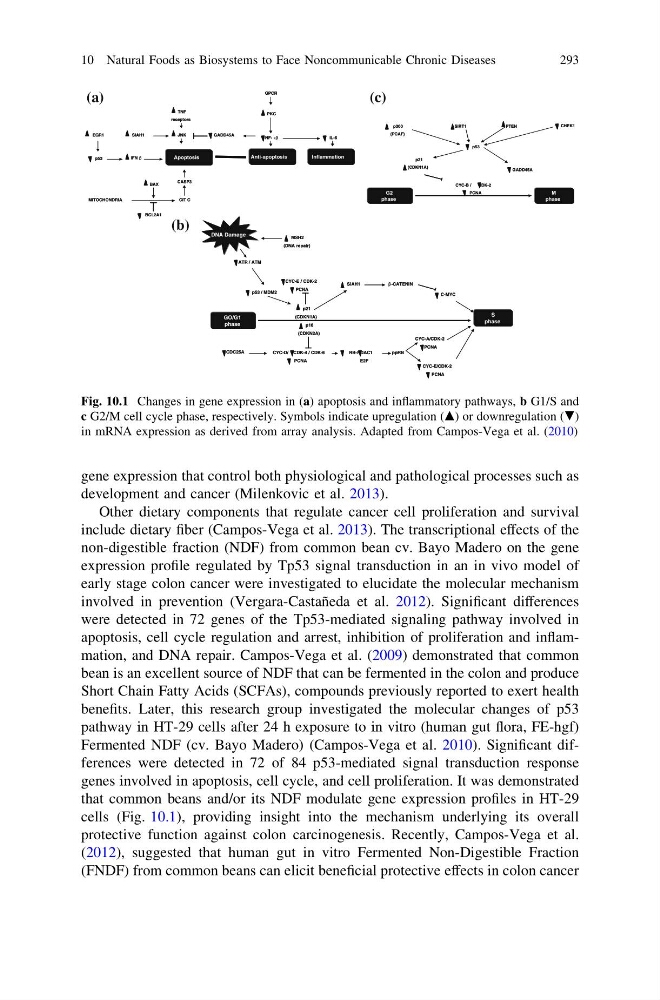
Fermented NDF (cv. Bayo Madero) (Campos-Vega et al. 2010). Significant differences were detected in 72 of 84 p53-mediated signal transduction response
genes involved in apoptosis, cell cycle, and cell proliferation. It was demonstrated
that common beans and/or its NDF modulate gene expression profiles in HT-29
cells (Fig. 10.1), providing insight into the mechanism underlying its overall
protective function against colon carcinogenesis. Recently, Campos-Vega et al.
(2012), suggested that human gut in vitro Fermented Non-Digestible Fraction
(FNDF) from common beans can elicit beneficial protective effects in colon cancer
Apoptosis
Anti-apoptosis
JNK
GADD45A
NF- κβ
TNF
receptors
SIAH1
GPCR
PKC
IL-6
Inflammation
IFN β
p53
EGR1
MITOCHONDRIA
CIT C
CASP3
BAX
BCL2A1
Apoptosis
Anti-apoptosis
JNK
GADD45A
NF- κβ
TNF
receptors
SIAH1
GPCR
PKC
IL-6
Inflammation
IFN β
p53
EGR1
MITOCHONDRIA
CIT C
CASP3
BAX
BCL2A1
CYC-B /
CDK-2
PCNA
GADD45A
p21
(CDKN1A)
SIRT1
p300
(PCAF)
p53
PTEN
CHEK1
G2
phase
M
phase
CYC-B /
CDK-2
PCNA
GADD45A
p21
(CDKN1A)
SIRT1
p300
(PCAF)
p53
PTEN
CHEK1
G2
phase
M
phase
p21
(CDKN1A)
CYC-E / CDK-2
PCNA
SIAH1
β -CATENIN
C-MYC
p53 / MDM2
ATR / ATM
p16
(CDKN2A)
CYC-D/ CDK-4 / CDK-6
PCNA
CDC25A
RB-HDAC1
E2F
ppRB
CYC-E/CDK-2
PCNA
CYC-A/CDK-2
PCNA
DNA Damage
GO/G1
phase
S
phase
MSH2
(DNA repair)
p21
(CDKN1A)
CYC-E / CDK-2
PCNA
SIAH1
β -CATENIN
C-MYC
p53 / MDM2
ATR / ATM
p16
(CDKN2A)
CYC-D/ CDK-4 / CDK-6
PCNA
CDC25A
RB-HDAC1
E2F
ppRB
CYC-E/CDK-2
PCNA
CYC-A/CDK-2
PCNA
DNA Damage
GO/G1
phase
S
phase
MSH2
(DNA repair)
(a)
(b)
(c)
Fig. 10.1 Changes in gene expression in (a) apoptosis and inflammatory pathways, b G1/S and
c G2/M cell cycle phase, respectively. Symbols indicate upregulation (m) or downregulation (.)
in mRNA expression as derived from array analysis. Adapted from Campos-Vega et al. (2010)
10 Natural Foods as Biosystems to Face Noncommunicable Chronic Diseases
293
development and cancer (Milenkovic et al. 2013).
Other dietary components that regulate cancer cell proliferation and survival
include dietary fiber (Campos-Vega et al. 2013). The transcriptional effects of the
non-digestible fraction (NDF) from common bean cv. Bayo Madero on the gene
expression profile regulated by Tp53 signal transduction in an in vivo model of
early stage colon cancer were investigated to elucidate the molecular mechanism
involved in prevention (Vergara-Castañeda et al. 2012). Significant differences
were detected in 72 genes of the Tp53-mediated signaling pathway involved in
apoptosis, cell cycle regulation and arrest, inhibition of proliferation and inflammation, and DNA repair. Campos-Vega et al. (2009) demonstrated that common
bean is an excellent source of NDF that can be fermented in the colon and produce
Short Chain Fatty Acids (SCFAs), compounds previously reported to exert health
benefits. Later, this research group investigated the molecular changes of p53
pathway in HT-29 cells after 24 h exposure to in vitro (human gut flora, FE-hgf)
Fermented NDF (cv. Bayo Madero) (Campos-Vega et al. 2010). Significant differences were detected in 72 of 84 p53-mediated signal transduction response
genes involved in apoptosis, cell cycle, and cell proliferation. It was demonstrated
that common beans and/or its NDF modulate gene expression profiles in HT-29
cells (Fig. 10.1), providing insight into the mechanism underlying its overall
protective function against colon carcinogenesis. Recently, Campos-Vega et al.
(2012), suggested that human gut in vitro Fermented Non-Digestible Fraction
(FNDF) from common beans can elicit beneficial protective effects in colon cancer
Apoptosis
Anti-apoptosis
JNK
GADD45A
NF- κβ
TNF
receptors
SIAH1
GPCR
PKC
IL-6
Inflammation
IFN β
p53
EGR1
MITOCHONDRIA
CIT C
CASP3
BAX
BCL2A1
Apoptosis
Anti-apoptosis
JNK
GADD45A
NF- κβ
TNF
receptors
SIAH1
GPCR
PKC
IL-6
Inflammation
IFN β
p53
EGR1
MITOCHONDRIA
CIT C
CASP3
BAX
BCL2A1
CYC-B /
CDK-2
PCNA
GADD45A
p21
(CDKN1A)
SIRT1
p300
(PCAF)
p53
PTEN
CHEK1
G2
phase
M
phase
CYC-B /
CDK-2
PCNA
GADD45A
p21
(CDKN1A)
SIRT1
p300
(PCAF)
p53
PTEN
CHEK1
G2
phase
M
phase
p21
(CDKN1A)
CYC-E / CDK-2
PCNA
SIAH1
β -CATENIN
C-MYC
p53 / MDM2
ATR / ATM
p16
(CDKN2A)
CYC-D/ CDK-4 / CDK-6
PCNA
CDC25A
RB-HDAC1
E2F
ppRB
CYC-E/CDK-2
PCNA
CYC-A/CDK-2
PCNA
DNA Damage
GO/G1
phase
S
phase
MSH2
(DNA repair)
p21
(CDKN1A)
CYC-E / CDK-2
PCNA
SIAH1
β -CATENIN
C-MYC
p53 / MDM2
ATR / ATM
p16
(CDKN2A)
CYC-D/ CDK-4 / CDK-6
PCNA
CDC25A
RB-HDAC1
E2F
ppRB
CYC-E/CDK-2
PCNA
CYC-A/CDK-2
PCNA
DNA Damage
GO/G1
phase
S
phase
MSH2
(DNA repair)
(a)
(b)
(c)
Fig. 10.1 Changes in gene expression in (a) apoptosis and inflammatory pathways, b G1/S and
c G2/M cell cycle phase, respectively. Symbols indicate upregulation (m) or downregulation (.)
in mRNA expression as derived from array analysis. Adapted from Campos-Vega et al. (2010)
10 Natural Foods as Biosystems to Face Noncommunicable Chronic Diseases
293